Anne Boleyn's miscarriage
Wolf HallAnne Boleyn’s miscarriage is narrated through concealment and uncertainty rather than a confirmed account of the pregnancy’s outcome. At Midsummer, household women carry clean linen into the queen’s apartments, and fires are lit to burn what has bled away; whether there is anything to bury is kept secret. The king later blames Katherine of Aragon, while courtiers offer money to the maids and midwives for the child’s sex, but the women give different answers. The episode makes the queen’s pregnancy a matter of succession, political calculation, and guarded knowledge.
The pregnancy and its political stakes
The crisis takes place within the wider contest over the Tudor succession. Henry VIII tells the imperial ambassador that his purpose in marrying Anne is to have a son, and his distress rises when the ambassador points out that no marriage can guarantee living children. Henry’s claim to be acting for the welfare of the realm thus rests on the uncertain outcome of a pregnancy carried by one woman.
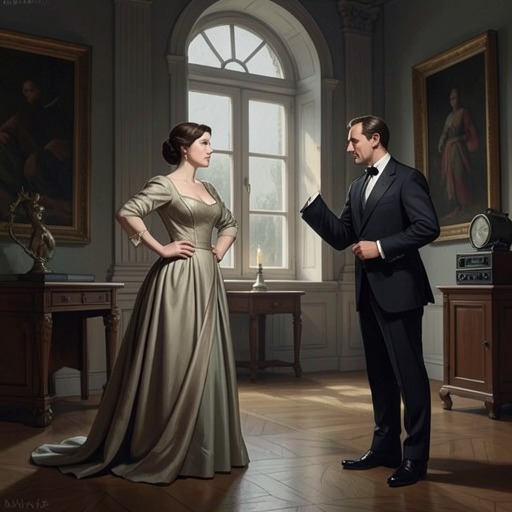
That uncertainty is already visible in the court’s plans for succession. When a bill concerning Anne’s children is discussed, its language anticipates her possible death and the possibility that Henry might marry again. Anne reacts angrily to the provision, insisting that she is strong and objecting to a document that makes her death imaginable. The miscarriage later gives this abstract contingency an immediate, private weight.
The concealed event
At Midsummer, the women entering Anne’s apartments do not explain what has happened. Their hurried movement and shocked expressions signal a crisis, while the linen and the fires indicate that the household is managing its aftermath. The text withholds whether there is anything to bury, preserving the event’s uncertainty instead of offering a definitive account.
The uncertainty extends to the child’s sex. Lords and ladies pay the maids and midwives for an answer, but they receive conflicting accounts. The narrative leaves open two possibilities—a lost daughter or a miscarried son—and makes the absence of reliable information part of the event itself.
Henry’s response and the succession crisis
That night, Henry tells Thomas Cromwell that he blames Katherine, accusing her of ill-wishing him and claiming that she and her doctors knew she could not bear a son. His explanation turns the loss into an extension of his grievance against his first wife. The narrative presents this as Henry’s accusation, not as established fact about Katherine or the cause of the miscarriage.
The episode also exposes the gap between dynastic expectation and what the court can know. The survival of the Tudor line is repeatedly discussed through heirs, legitimacy, and the prospect of a male child, yet the pregnancy’s outcome remains concealed even from those who try to buy information. Anne Boleyn’s miscarriage therefore matters not only as a personal loss but as a political shock whose consequences are measured against the king’s demand for an heir.