Bakudengon Palace
Wolf HallBuckden Palace is the residence to which Katherine of Aragon is sent after her household is reduced, and a focal point in the contest over her status and movement. Its gardens and surrounding fenland frame her temporary refuge; later, the prospect of another relocation turns the palace into the setting for her refusal to yield to the king’s plans.
Setting and Royal Displacement
Katherine is moved to the Bishop of Lincoln’s palace at Buckden as the court presses forward with the consequences of Henry VIII’s disputed marriage. The narrative places the old red-brick house amid gardens, copses, fields, and the fenland landscape. Its rural setting contrasts with the political reach of the decisions being imposed on its occupant: Katherine is far from the center of court, but her title, household, and future remain matters of royal policy.
Her household has been much reduced by the time she arrives. The text marks the changing season around the palace, with autumn approaching and mists expected in October, giving this episode a measured, temporary quality: Buckden is a place of residence, but not a secure settlement.
Katherine’s Resistance to Removal
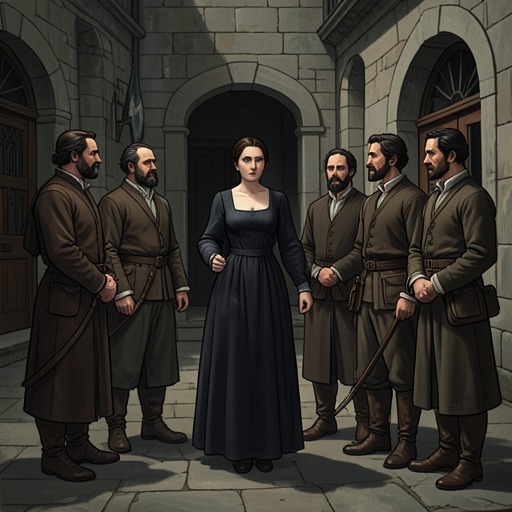
The palace becomes a point of resistance when Charles Brandon, Duke of Suffolk, travels to Buckden to persuade Katherine to move to another house. She has heard that the proposed destination will be even damper than Buckden and says that the damp will kill her. Rather than agree to leave, she shuts herself inside and refuses the demand, insisting that she will go nowhere unless Brandon is prepared to force the door, bind her, and carry her away.
Her response makes the question of residence inseparable from authority. The court treats her movement as an administrative matter; at Buckden, Katherine asserts that departure cannot be obtained through persuasion alone. Brandon reports the confrontation to London in a tone of grievance, and the council hears his complaint alongside the practical difficulty of compelling her to move.
Connection to Mary Tudor and the Succession
Buckden also belongs to the wider geography of the royal family’s separation. Norfolk goes to Beaulieu to tell Mary Tudor that she must move to Hatfield, attend the young princess, and live under the governance of Lady Anne Shelton. Mary answers that her mother is the only queen and withdraws to her room. At Buckden, Suffolk faces a parallel task: persuading Katherine to leave the house. The juxtaposition connects the daughter’s removal with the mother’s threatened relocation, showing how control of residence serves the reordering of family roles and royal allegiance.
The surrounding political context sharpens that connection. Henry VIII demands the robes in which Mary was christened for the child he hopes to have with Anne Boleyn; Katherine’s answer draws laughter from Thomas Cromwell, who recognizes her force of character. A document addressing her as Princess Dowager has already provoked her to strike through the title with her pen. Buckden therefore stands within a continuing dispute over who may define Katherine’s rank and what that definition means for Mary’s place in the succession.
Narrative Significance
Buckden Palace is not presented as a detailed architectural portrait so much as a setting in which the limits of royal command become visible. Katherine’s reduced household and the prospect of transfer indicate her political vulnerability, while her refusal to leave makes clear that she still contests the terms imposed on her. The palace’s quiet rural surroundings do not remove it from the struggle at court: from Buckden, a residence becomes a contested boundary between royal policy and a queen’s insistence on her own status and choice of place.