Cats
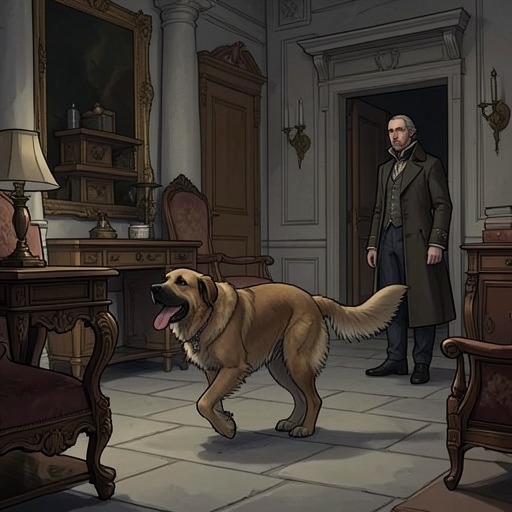
Wolf HallCats are recurring presences in Thomas Cromwell’s world, where domestic affection, political memory, and religious argument meet. Most notably, Marlinspike is the household cat Cromwell calls the cardinal’s, a playful companion around whom news, scripture, and homecoming gather; in Sir Henry Wyatt’s tale, a cat’s food sustains him in prison until the Tudors take power.## Household Companions Marlinspike belongs to the intimate life of Austin Friars. When Thomas Avery returns from abroad with a small bag tucked under his arm, Marlinspike leaps onto the desk and investigates it with a paw. The bag contains sugar comfits as well as a letter hidden in the lining of Avery’s woollen jerkin. The cat’s curiosity draws the scene’s domestic and political strands together: Avery has brought gifts for the household, but also a message from William Tyndale, carried secretly across borders.
Cromwell teases Avery about the sugar mice in the bag, then turns to the dangerous contents concealed in its seam. After reading Tyndale’s letter, he tears it up rather than burn it, and Marlinspike chews one of the fragments. Cromwell calls the animal “Brother cat” and recalls that he loved the scriptures. The moment is comic, but it also gives the cat a place inside a world where possession of evangelical writing can expose people to danger. A torn message becomes the cat’s plaything; the words themselves have been destroyed, while the argument about scripture continues in conversation.
Marlinspike’s presence also marks the household as a place where people return. Avery asks whether Cromwell ever felt homesick during his travels; Cromwell answers that he supposes he would have, if he had had a home. The boy hopes to come home the following spring, and the exchange takes place in the company of a cat who roams the desk, the garden, and the household’s shared spaces. Later, Cromwell points Marlinspike out to visitors as the cardinal’s cat. At their arrival, the animal races along the garden wall and disappears into unknown territory. The gesture gives the cat both a household identity and an independence that resists possession: he is known, but cannot be kept in view.
The domestic world around the cats is also shaped by children and games. Alice and Jo go into the garden trying to catch the cat, while Sir Henry Wyatt approves of a household that honours one. Their pursuit is a small, ordinary counterpoint to stories of imprisonment, religious persecution, and courtly danger. Cats are not simply decorative presences: they give the household a shared object of attention and make its moments of ease visible.## A Cat in the Prison Story When Sir Henry Wyatt visits Austin Friars, the children persuade him to tell a story. He presents himself as a prisoner of Richard Plantagenet, shut in a dungeon without fire, food, or water. The story draws on Wyatt’s actual torture under Richard: the historical wound beneath the entertainment is that hot knives were laid against him and his teeth pulled. In the tale, however, the dungeon’s damp wall provides water, and a cat brings the food that allows the prisoner to live.
Wyatt tells the children that a black-and-white London cat appears at his barred window and drops its burden. Jo guesses that the gift is a pigeon. The children are absorbed in the rescue; the young men listening lower their eyes, imagining a prisoner with fettered hands tearing apart a bird covered in lice. Wyatt turns deprivation into a tale with suspense and a reprieve, but the scene does not let the audience forget what the rescue costs or how little comfort prison leaves its victim.
The cat’s gift keeps Wyatt alive long enough to hear the cry of “A Tudor!” and the bells marking the change of power. In the story, he says that Henry himself comes to the cell and calls him forth to his reward. The narration corrects this forgivable exaggeration: Henry did not visit the dungeon. Richard had overseen Wyatt’s torture, listening as the knife was heated and applied again. The contrast makes the cat’s act more than a charming anecdote. Its small, contingent kindness carries Wyatt across a political reversal, while the tale’s embroidered royal ending shows how memory reshapes suffering for its listeners.
The children also ask for Wyatt’s story about his son’s lion, and the animal tales continue to mingle affection with danger. The cat in the prison narrative is a source of food and survival; Marlinspike is a familiar companion; neither is made into a tame symbol without remainder. One appears at a barred window and leaves its burden, while the other slips away beyond the garden wall. Their appearances make animals part of the book’s thinking about dependence, freedom, and the uncertain boundary between shelter and exposure.## Cats, Politics, and Scripture Cats occur at moments when the book places private life beside public power. During a conversation with Anne Boleyn, Thomas Cromwell reports that Thomas More’s household has a little monkey sitting on Alice More’s knee at table. Anne says she hates monkeys; the exchange is a passing glimpse of another household, but it also distinguishes the exotic pet from the cats that belong to Cromwell’s domestic world. His account of More’s family moves quickly into the court’s rivalries, the redistribution of Wolsey’s lands, and the information that travels between political factions.
The more explicit political parallel comes when Cromwell and his colleagues debate how to handle threats and competition. Men are compared to wolves snapping over a carcass and lions fighting over Christians, images of struggle in which the vulnerable are prey. Against this harsh political bestiary, the cat’s appearances are quieter and less instrumental. Marlinspike investigates a concealed letter, chews its torn remains, and escapes beyond the garden wall; Sir Henry’s cat supplies food without joining the human contest for office or allegiance.
The wordless animal presence also sharpens the religious tension surrounding Tyndale’s writing. Cromwell destroys the letter rather than keep a dangerous document, while the cat mouths one of its scraps. The episode does not suggest that Marlinspike understands or endorses the text; instead, its ordinary play gives the scene an incongruous intimacy. Scripture, secrecy, and the risk of persecution remain human burdens, even as the household cat is drawn into the physical aftermath of the message.
Across these episodes, cats provide neither a single allegorical meaning nor an escape from history. They are creatures to be pursued in the garden, companions at the desk, and agents of survival in a prison story. Their recurring presence changes scale: from the small ease of family life to the life-or-death pressure of Wyatt’s confinement, and from Cromwell’s private household to the political past that still governs it. Their movement between enclosure and escape echoes a world in which safety is temporary, messages are vulnerable, and survival may depend on an unexpected gift.