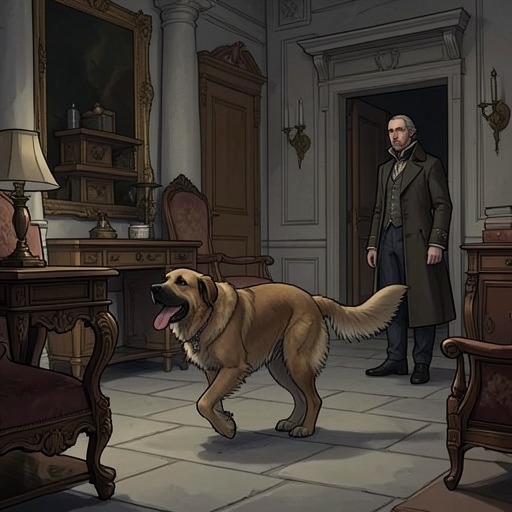
Dogs
Wolf HallDogs are a recurring presence in the novel, moving between intimate companions, fashionable possessions, working animals, and reminders of loss. Their changing settings—from the streets and kitchens of Cromwell’s childhood to the court, kennels, and Austin Friars—show how people claim, value, care for, and sometimes fail to protect them.
Childhood Loss and Attachment
As a boy moving between Putney and Lambeth, Cromwell encounters an abandoned puppy and carries her home in one hand, alongside a small cheese wrapped in sage leaves. The dog dies. When his sister Bet says another can be found, he searches the street but discovers that the dogs there belong to someone. The episode makes ownership a barrier between a child and the animal he wants to keep, and gives the later recurrence of dogs called Bella a personal resonance without establishing that they are the same animals.
The childhood passage places this loss among other details of a life spent between households. Cromwell carries food home, sometimes eats what he has been given, and, when the gift is only a cabbage, kicks and rolls it until it is destroyed. Against that unsettled pattern, the lost dog stands out as an attachment he cannot replace. The narration does not turn the animal into a symbol alone: it records a specific effort to bring a small, cold creature home and the finality of its death.
Anne Boleyn’s Puppies and Courtly Fashion
Later, at York Place, three little dogs dart out from beneath Anne Boleyn’s skirts. Cromwell gathers them with practiced gentleness and returns them to her; they nibble his fingers and coat and lick his face. Anne calls them her babies and contrasts them with Katherine of Aragon’s chained marmosets, which she dislikes. In the scene, animals are part of the language of household intimacy and courtly distinction: Anne claims that her dogs love her for herself, while the comparison with the queen’s pets sharpens the rivalry between the women.
The puppies are also part of the room’s social atmosphere. Mary Boleyn is among the women present, keeping her head down, while other women observe Cromwell and Anne’s encounter. Anne’s affection for the dogs does not make the political tension disappear; the small animals move freely around a gathering shaped by surveillance, status, and unsettled relationships. Their presence gives Cromwell a practical task—catching and returning them—before Anne turns the conversation to his influence with the king.
Fashion becomes explicit in another household exchange. When Cromwell offers the children marmosets, Alice answers that they are no longer fashionable at court since Anne arrived; instead, she says, they would like Bella’s puppies. Cromwell replies that this may happen in time. The dogs thus carry a changing courtly preference into family life: what is desired is not simply a pet, but the kind of pet associated with current fashion and with Anne’s household.
Hounds, Expertise, and Favor
Cromwell’s son Gregory has a matched pair of black greyhounds, but at Cambridge people mock them. They say that black dogs are difficult to see at night, associate them with felons, and accuse Gregory of hunting unlawfully and behaving like a churl. Cromwell asks whether Gregory wants white dogs or dogs with some colour, then offers to take the black pair, though he has little time to hunt and expects Richard or Rafe to use them. Johane reassures Gregory that no one will dare laugh at his father. The episode connects the dogs’ appearance to status and reputation: what makes them a source of ridicule for Gregory is also something Cromwell can absorb by taking them into his own keeping.
At court, that same practical attention becomes a form of competence. While spending time with Charles Brandon among the royal hounds, Cromwell is shown Barbada, a four-year-old favorite bitch whose eyes are clouded and who may be of little use for the hunting season. He says that the membrane can be drawn off with a curved needle, describes the instrument’s necessary fineness, and proposes speaking to the smith. Brandon calls him a useful sort of man. The scene makes care for an animal and knowledge of a procedure part of Cromwell’s capacity to be useful at court; it does not present the hound solely as equipment, since Cromwell also attends to her condition and to the risk of leaving her blind.
The kennel scene sets that individual encounter within a larger working system. The running dogs are well fed while the season for hunting the hart has not yet begun; tracking dogs, trained to remain silent, rise to watch their supper being brought. Children carry baskets of bread and bones, buckets of offal, and basins of pigs’-blood pottage. Dogs here depend on organized human labor and occupy distinct roles, from the running hounds whose barking fills the evening to the silent trackers waiting for food. Their care is practical and routine, but the scene’s details make the scale of the royal kennel visible.
Dogs at Home and in Memory
Dogs also mark the texture of Cromwell’s household. When Thomas Cranmer visits, Alice describes the family running Gregory’s greyhounds up and down the hall and making a noise; she jokes that their manners will prevent them from ever marrying. Cromwell acknowledges that the children enjoy the dogs and the commotion, and Cranmer asks whether they are whipped. Cromwell says that they try to teach them by example, as Erasmus suggests, while admitting that the household does not always meet that standard. The dogs belong to a noisy, affectionate family life rather than to the disciplined world of courtly hunting.
The household’s instability nevertheless remains in view. Cromwell thinks of the people and animals he has around him, including Gregory and his dogs, Alice, Johane, Jo, and the pale girl connected to the Boleyn household. Later, amid religious disagreements within Austin Friars, he offers Alice and Jo marmosets, but accepts their preference for Bella’s puppies. He picks up Bella and carries her away to continue his work; she sits on his desk among his papers, sucking the end of her ribbon and trying to loosen the knot at her throat. The small domestic gesture places a dependent animal beside the documents and duties of political life, without resolving the arguments taking place under the same roof.
The novel’s repeated dogs therefore gather several kinds of value without reducing one to another. The childhood dog is lost and cannot be replaced; Anne’s puppies declare affection while also registering fashionable allegiance; Gregory’s black greyhounds expose the social risks attached to appearance; and Barbada’s care shows Cromwell’s useful knowledge in a royal setting. At Austin Friars, a Bella can be a companion among children and papers. Across these scenes, dogs make attachment, ownership, status, labor, and vulnerability concrete features of the world around Cromwell.