Dr Butts
Wolf HallDr Butts is a physician trusted by the royal household and by Thomas Cromwell, whose episodes in the novel place medical care at the intersection of family distress, religious division, and political power. He is proposed as a doctor for the isolated Mary Tudor, attends Thomas More in prison, and is among the physicians sent to Cromwell during a serious fever.
Identity and Courtly Role
The evidence identifies Dr Butts as a doctor whom Cromwell can call upon for politically and personally delicate cases. His name carries familiarity for Mary: she remembers him from her household at Ludlow, when she was Princess of Wales. Cromwell proposes sending him to her not merely to treat her, but to prescribe a regimen that could secure her better food and care in her own room. Medical authority thus offers a practical means of easing the conditions of her confinement.
The same trust appears in Cromwell’s dealings with Thomas More. When More complains of tight breathing and fears he may not see morning, Cromwell promises that Dr Butts will visit him. He instructs More’s attendant to raise him with bolsters and cushions, treating the physician’s care as one way to preserve the prisoner’s life—and, in Cromwell’s stated hope, to give him more time to reconsider his political position.
Care for Mary Tudor
At the time of Cromwell’s visit, Mary is eighteen, living in a cold, sparsely furnished room and resisting the diminished status imposed on her. She reports that her sight is failing and that her head aches. Cromwell offers to send Dr Butts, whom she knows from Ludlow; her expression softens at the suggestion. He tells her that the doctor will arrive within a day and that she should have a proper fire and supper as well.
The proposed treatment is inseparable from Mary’s political circumstances. She has been excluded from the succession and will not accept the title of Lady Mary. Cromwell tries to persuade her to show outward respect to Queen Anne in return for restoration to court life and its comforts. His offer of a physician is therefore both concrete care for her health and part of a larger attempt to negotiate her return to favor. The scene does not establish whether Dr Butts’s visit changes her condition or her political position.
More’s Imprisonment and Health
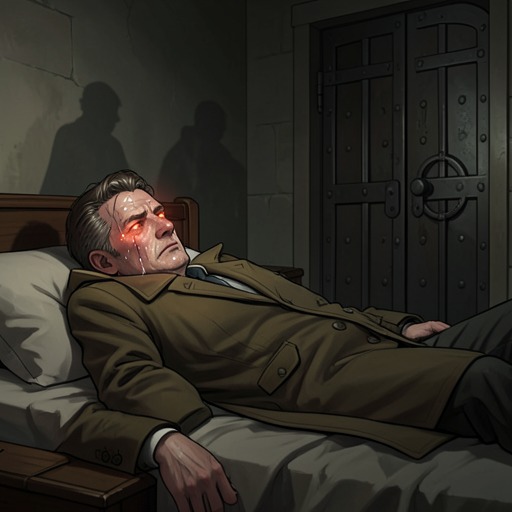
Cromwell invokes Dr Butts while speaking with More, whose breathing has become difficult during imprisonment. More says that the nights are long and his chest is bad; Cromwell answers that the doctor will come to examine him and provide medicine. He also orders practical support—cushions to prop More up—so the care is not confined to a promise of treatment.
Cromwell’s stated purpose is to keep More alive long enough to reconsider his stance and demonstrate loyalty to the king. The medical intervention therefore belongs to an uneasy relationship between mercy and political pressure: Cromwell seeks to improve More’s immediate comfort while still hoping for a change in his allegiance. The evidence records the promise and arrangements for care, not a recovery.
Cromwell’s Fever
When Cromwell himself becomes seriously ill, Dr Butts arrives among a group of physicians sent by the king. Cromwell tells him that the fever came from Italy, and Butts answers cautiously rather than simply accepting the explanation. The doctors discuss Cromwell’s heart, give him a draught, and monitor his condition. He returns to his ledgers while still weak, struggling to keep the figures in order; later, the fever or the medicine loosens its hold and he wakes with the pages still before him.
Butts’s place in this episode completes the pattern of reciprocal care: the doctor whom Cromwell would send to Mary and More is now part of the royal medical response to Cromwell’s own illness. The episode gives Dr Butts no independent account of his life or motives, but makes his presence a measure of the trust surrounding him and of how medical attention moves through the same courtly networks as political service.