Dreams, prophecy and omens
Wolf HallDreams, prophecy and omens are a recurring way the novel tests how people make meaning from what they cannot know. A dream, a drawing, a comet, or a remembered legend does not arrive with a settled explanation: characters interpret it through fear, ambition, faith, and political circumstance. The clearest instance comes when Henry VIII dreams of his dead brother Arthur. Thomas Cromwell recasts the king’s distress as a mandate to secure his kingdom, turning private vision into public argument about the authority of the crown.
Legends, prophecies, and political fear
In a rainy household scene, Gregory Cromwell reads Le Morte d'Arthur aloud and considers the uncertain truth of the stories it contains. The book’s image of a woman riding behind a king prompts him to ask whether it represents Anne Boleyn. He recounts the tradition that Arthur never truly died, but waits in a forest or perhaps a lake, and distinguishes between what may be true and what may be lies while valuing the stories all the same. The scene makes legend a living political language: the king’s supposed descent from Arthur can lend ancient weight to present rule, even as the tale remains unstable and disputable.
Anne confronts a more immediate prophecy in a drawing found in her bed. It shows Henry crowned between two women, one of them headless; Anne identifies the other as herself and jokes about the image, but also acknowledges a prophecy that an English queen will be burned. She crumples the paper rather than letting Thomas Cranmer destroy it, and says the prophecy does not frighten her. Her defiance does not resolve what the image means. Instead, the drawing makes the danger surrounding her future visible while leaving its author and authority uncertain.
Arthur's dream and Henry's shame
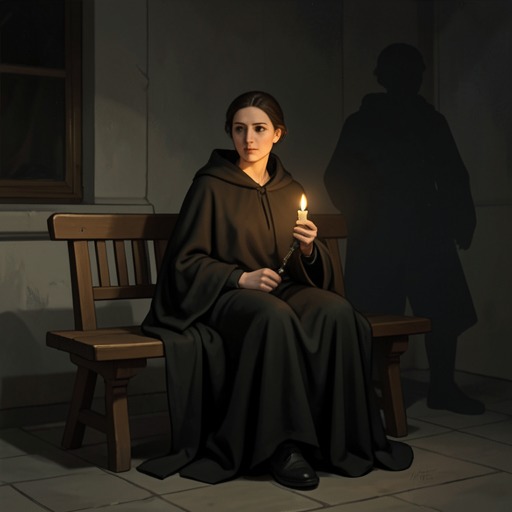
During the Christmas period, Henry summons Cromwell and describes a dream of Arthur, who appeared pale and thin, surrounded by white light. The vision revives a wound bound up with the succession: Arthur died at Ludlow in winter, his coffin carried to Worcester in an ox-cart, and Henry never saw his brother’s face after death. Henry fears that Arthur has returned to accuse him of taking his place and using his wife, Katherine of Aragon. Cranmer counters that the image is formed in the king’s mind, not Arthur’s body, and advises against trusting dreams.
Cromwell takes a different course. He asks whether Arthur spoke or made a sign; when Henry answers no, Cromwell argues that the king has read accusation into an expression that conveyed no such thing. He invokes the legal maxim “Le mort saisit le vif” and recasts the dream as a reminder that a dead prince’s power passes to his successor without interruption. Arthur’s appearance, in this interpretation, is not a condemnation but a charge to exercise kingship.
Cromwell strengthens the argument with Arthur’s tomb inscription, “Rex quondam rexque futurus,” and with the story of Henry’s father returning from exile to claim his ancestral right. A realm, he insists, must not only be claimed but held and made secure in every generation. He connects this reading to the present political moment: Henry should become the sole and supreme head of his kingdom, a course Anne also supports in opposing submission to Rome. Henry’s mood shifts; he says he understands why he summoned Cromwell and prepares to attend Mass. Cranmer calls the response deft, while questioning whether Cromwell’s service to the Gospel risks making scripture a surface on which he writes his own desires. The dream’s political force thus comes not from an uncontested revelation, but from the persuasive interpretation that turns guilt into authorization.
Omens in a contested religious world
The summer of 1531 is marked as the summer of the comet. At Austin Friars, scholars and clergy discuss salvation beneath the unusual star, while Cromwell warns that they do not agree with one another about scripture and may turn against each other when their common opponent is absent. The comet gives the gathering an atmosphere of portent, but the conversation exposes a more immediate uncertainty: even learned religious interpreters cannot be assumed to share a single account of truth.
The astronomer Nicholas Kratzer questions whether comets must be bad signs and why they should foretell the fall of nations rather than their rise. The narrative supplies the histories that sustain the fear: a comet recorded in 1456 was followed by the siege of Belgrade; planetary alignments in 1524 were associated with war, the rise of Martin Luther’s movement, popular uprisings, deaths among the Emperor’s subjects, and years of rain. The Sack of Rome, too, was said to have been foretold by noises of invisible battle. Yet the account of that prediction travels through hearsay, passed from one supposed witness to another. Portents may be recorded and discussed, but their evidence is partial and their meanings remain open.
Signs, law, and the making of authority
Across these episodes, signs acquire force through the people who interpret and circulate them. Anne’s drawing becomes a threat because it touches her uncertain future; Arthur’s dream becomes a royal summons because Cromwell links it to succession and political power; the comet gathers significance from inherited records and current religious conflict. None of these readings is presented as an uncomplicated confirmation of supernatural knowledge.
That ambiguity matters in a world where political and religious authority are being remade through words, laws, and oaths. The novel sets the apparent message of a dream beside disputes about who may define legitimate rule, and the omen beside competing readings of scripture and history. What changes events is not simply that a sign appears, but that someone persuades others to treat it as meaningful. Henry’s dream shows the stakes most sharply: an image that begins as personal shame can be made to support the king’s claim to rule without Rome’s direction.