English Reformation
Wolf HallThe English Reformation is presented as a contest over both religious authority and the institutions that make authority effective. It proceeds through parliamentary legislation, royal appointments, financial oversight, and arguments about scripture and jurisdiction, not through a single declaration. The same changes that make the king head of the church also place the status of vernacular Bibles, the reach of Rome, and the limits of Parliament under intense dispute.
Reform, Parliament, and the English Church
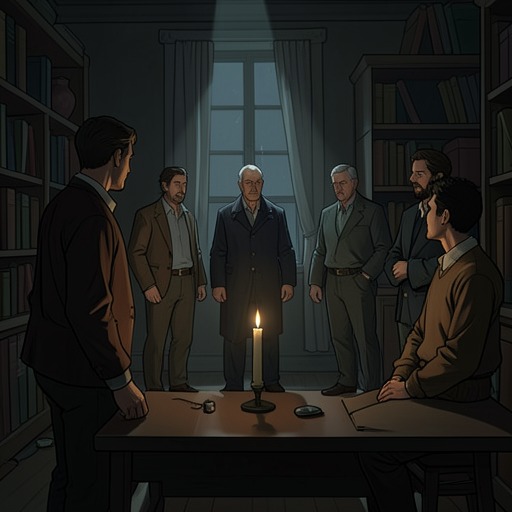
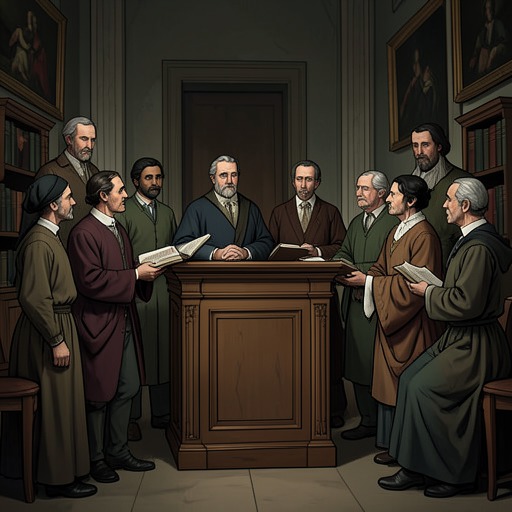
In the spring of 1532, the crisis is framed as a question of England’s capacity for self-rule: what protection a king owes his people, and whether an English subject may answer to a foreign authority in matters of faith. Parliament considers legislation that would restrict revenues sent to Rome and make Henry’s supremacy in the church more than a formula. The Commons also drafts a petition against church courts, challenging both their procedures and their claimed jurisdiction. Thomas Cromwell and Rafe Sadler work through amendments late into the night, while Stephen Gardiner leads the bishops resisting the proposed settlement.
The dispute is not confined to abstract principles. Cromwell brings forward a bill suspending annates, payments to Rome, and proposes dividing the Commons so members’ positions can be seen. Henry watches the division and gives Cromwell a nod of approval. The Lords prove harder to persuade: the king must appear in person three times to argue his case. Some powerful noble families remain attached to the Pope and Katherine, and Cromwell’s parliamentary tactics also serve to identify and divide his opponents.
The arguments find a reformist intellectual defense in the jurist Christopher St German, who tells Cromwell that the church needs reform and that, if the church cannot undertake it, the king in Parliament can. Cromwell likewise urges Henry to consider proposals associated with Marsiglio of Padua. In this account, Christ did not establish papal rule over temporal affairs; priests remain subjects, while a prince governs the bodies of citizens and Parliament expresses the people’s will. Henry is told that Parliament can determine civil matters such as marriage and legitimacy, and that church wealth may be assigned to public purposes. The case for reform therefore joins royal sovereignty to legislative authority, while challenging the church’s claims to independent jurisdiction and property.
Scripture, Readers, and Persecution
The Reformation’s religious challenge also travels in books. Cromwell keeps an illicit English Testament in a chest: an Antwerp edition printed on cheap paper, bearing the mock imprint PRINTED IN UTOPIA. He knows William Tyndale, whose English scripture circulates through ports and inlets despite the danger. Cromwell follows what is being printed and smuggled, and hopes to arrange a Latin version for discreet circulation. At the same time, Thomas Wolsey burns books, including English-language works at St Paul’s Cross. The text’s physical form and route into the country become part of the religious conflict: a book can be hidden, seized, read, or made evidence against its owner.
The costs of that circulation are shown through John Petyt and his wife, Lucy. When officials search their home, Lucy distracts Thomas More while Petyt hides papers. More finds no book in the search, but Petyt is taken into custody; he is later released too ill to resume his work. Lucy recalls that he had thrown his Testament beneath his desk, and that she feared the searchers would notice it. Her account makes the vulnerability of a household visible alongside the political stakes of vernacular scripture.
Cromwell also tries to secure Tyndale’s return from Antwerp. In a meeting arranged by Stephen Vaughan, Tyndale says that he wants to come home and asks for permission to make the scriptures available in the mother tongue, offering to accept the king’s choice of translator. Henry does not give a clear refusal, but neither does he authorize the translation. Cromwell eventually tells Vaughan to abandon the effort: Henry is unwilling to proceed, while Tyndale will not compromise his principles to win royal favor. The negotiations expose a central tension of the reform: royal approval might enable wider access to scripture, but the king’s control over that access is itself contested.
The treatment of reformers sharpens that tension. Hugh Latimer returns from custody and argues that the gospel might gradually turn Henry toward reform. Cromwell, however, does not visit James Bainham, who has recanted under pressure and then publicly reaffirmed his faith; Bainham is awaiting execution. Cromwell fears that intervening might weaken Bainham’s resolve or give Thomas More reason to act against him. The contrast between Cromwell’s measured political strategy and the reformers’ exposure to punishment shows how religious conviction enters a system where speech, silence, and testimony can carry life-changing consequences.
Royal Supremacy and Competing Legal Orders
Katherine of Aragon rejects the premise that the king’s new religious settlement can simply displace Rome. In an interview with Cromwell, she insists that her case belongs before the Pope and refuses to recognize Thomas Cranmer as a legitimate judge. Her position rests on a different account of jurisdiction: Henry may call himself head of the church in England, but she maintains that the church’s authority and the lawfulness of government derive from the Pope. When Cromwell urges her to accommodate the king, she answers that there is no salvation outside the church and warns that kings too are subject to judgment.
The same conflict appears in Henry’s exchange with the imperial ambassador, Eustace Chapuys. Henry rejects the authority of the Pope to make his marriage to Katherine lawful, declaring that the Pope cannot make incest licit. He describes himself as steward of his country and presents his marriage to Anne Boleyn as necessary to secure a son and the Tudor line. Chapuys counters that the welfare of the country and the welfare of the dynasty are not necessarily identical, and questions how much Henry is staking on one woman’s ability to bear children. The royal supremacy dispute is thus bound to a succession crisis: the authority to judge a marriage determines the legitimacy of its children and the future line of rule.
Cromwell’s conversation with Katherine also reveals that policy is not yet wholly settled. He argues that the king’s position might be redefined and that nothing is irrevocable. Katherine sees a possible opening if Anne has no children, but refuses the offered prospect of a great estate, recalling the poverty and humiliation she endured after Prince Arthur’s death. The argument about church authority is inseparable from the altered status of a queen and the practical choices available to her.
Law, Office, and the Machinery of Change
Reform becomes durable through administrative as well as parliamentary work. On 14 April 1532, Henry appoints Cromwell Keeper of the Jewel House, telling courtiers that he alone has made Cromwell what he is. The office gives Cromwell a view of royal income and expenditure. He later inventories the king’s jewels and plate, checks the work and accounts at the Tower, and proposes spot checks on the weight of the coinage. His memorandum to Henry sets out the sources of yearly revenue and the offices through which it passes. The king reads it repeatedly; Cromwell explains that the late Wolsey had held the information in his head. The scene connects the reforming government’s claims to sovereignty with its growing ability to account for and manage resources.
The political settlement is also embodied in appointments and legal acts. In January 1533, Henry and Anne marry in a private ceremony at Whitehall, with Rowland Lee officiating and only a small group of witnesses. The king’s new marriage and the legal challenge to his former one converge in the legislation Cromwell is drafting. He writes that England is an empire governed by one supreme head and king. After Easter, the proposed law will bar appeals to the Pope, leaving Cranmer to decide the king’s case in English courts. Cranmer recognizes the consequence: Katherine’s suit will be decided domestically, not in Rome.
The narrative’s account of the Reformation emphasizes accumulation rather than a clean break. Legislation, parliamentary divisions, royal appointments, financial records, and the redirection of jurisdiction reinforce one another. Yet the claims made for Parliament and the king do not settle the deepest disagreement. Thomas More distinguishes temporal authority, which Parliament may change, from spiritual jurisdiction, which he holds to lie beyond the realm. His position gives the conflict a hard boundary: political power may alter civil arrangements, but it cannot, in his view, legislate God’s authority away.
Consequences and Significance
The English Reformation changes who can make decisions for the church and where those decisions can be challenged. Its methods include persuasion, political pressure, public divisions in Parliament, proposed changes to revenue, and the pursuit of authority over marriage and appeals. The struggle is visible in offices and accounts as much as in doctrine: control of church jurisdiction and wealth becomes an instrument of royal government, while the crown’s ability to measure revenue and supervise institutions makes its claims more actionable.
The novel also keeps the reform’s unequal consequences in view. Vernacular scripture offers readers access to religious teaching outside the ordinary structures of clerical control, but its circulation exposes printers, merchants, and households to search and imprisonment. Reformers who will not soften their answers face punishment, while those who seek accommodation must navigate the king’s demands and the resistance of churchmen. Katherine’s refusal, More’s distinction between temporal and spiritual power, and Tyndale’s insistence on English scripture show that religious dissent is not simply absorbed into the king’s programme.
The result is a transformation driven by law but never confined to law. The same Parliament that helps define the king’s authority becomes the instrument through which church jurisdiction and royal marriage are recast; the same argument for national self-rule raises the question of whether Parliament can command belief. The English Reformation remains, in the novel, both a construction of state power and an unsettled contest over conscience, scripture, and the limits of political obedience.