English sweating sickness
Wolf HallEnglish sweating sickness is a recurring epidemic in Wolf Hall, feared for its speed and unpredictability. It empties London, sends households and the court in search of safety, and imposes quarantine; in Thomas Cromwell’s family, it kills Liz Wykys and later his daughters Anne and Grace. The disease is more than a backdrop to political affairs: its repeated returns make private grief and the survival of heirs inseparable from the kingdom’s anxieties about succession.
Recurrence and public fear
The sickness is already a familiar threat by the events of 1527. In summer it spreads through London, where people report headaches and aching limbs and speculate about remedies. Friars sell holy medals, but the remembered speed of the illness is more powerful than any protection: people may be well at breakfast and dead by noon. The narration says the epidemic first came in 1485 with the armies that brought Henry Tudor, and has since returned every few years, repeatedly filling graveyards.
The epidemic also shapes the movement of the powerful. In 1527, the sickness helps empty the city as Thomas Wolsey prepares to travel abroad. His departure is both a political mission and an escape from an outbreak that can kill within a day. The epidemic’s course cannot be separated from the political business conducted around it: Wolsey hopes to secure support in France for the king’s marital cause, even as sickness and diplomatic uncertainty make the outcome precarious.
Flight, separation, and containment
When the sickness returns in summer 1528, the response is evacuation. Thomas Cromwell sends the girls first to the house at Stepney and then farther away. The court is infected, and Henry VIII moves from one hunting lodge to another in an effort to outride the plague. Anne Boleyn is sent to Hever Castle; sickness reaches her family there, and she herself falls ill before being reported back on her feet within a day.
The episode makes clear that flight offers no reliable escape. By the end of summer, Cromwell’s daughters return to London, but the separation leaves its mark: Grace has grown, and her hair has been lightened by the sun. Anne says she would rather stay with her father the following summer. Her request gives the epidemic a domestic aftermath distinct from the immediate danger of infection: a child remembers the fear of being sent away, and asks not to be separated again.
Quarantine rules give this fear an official form. During an outbreak, a household is to hang straw outside its door as a sign of infection, restrict entry for forty days, and go abroad as little as possible. When the sickness returns, Mercy proposes describing an illness as a fever rather than admitting it is the sweat, since a household-wide shutdown would disrupt London. Cromwell refuses to evade the rule: Wolsey made it, and he considers it improper to disregard it. Yet later, when his own household faces infection, obedience to the rule does not protect his children.
Liz Wykys and the first household bereavement
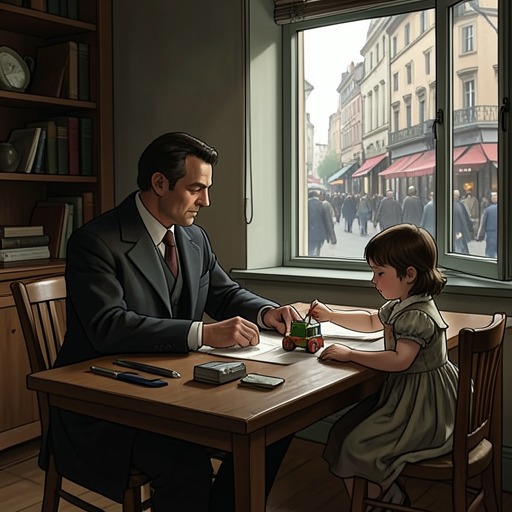
During the 1527 outbreak, Liz Wykys falls ill while Cromwell is away. He returns at dusk to find the household grieving and initially fears for his son Gregory; then he understands that Liz is dead. The account of her last day comes from Mercy, who recounts events in sequence: Liz became dizzy during the day, grew ill, asked whether Rafe Sadler was in the house, and called for a priest. She confessed and received absolution before dying that afternoon.
Liz’s rapid death leaves little room for ordinary preparation. Because victims of the sickness must be buried quickly, Cromwell cannot summon Gregory or gather the family for a customary farewell. The household must mark itself as infected and observe forty days of restricted movement. Grief is thus forced into the same administrative pattern as containment: the family must follow a public rule at the precise moment it longs for private ceremony.
The loss continues after the epidemic’s immediate crisis. Cromwell spends a month at home reading, including his Testament and Petrarch, and thinking about Liz’s death. When the sickness comes back, he remembers her as the person whose absence altered the household, not merely as one name among its victims. Disease makes the familiar bedroom and family routine into the setting of an abrupt separation, and the grief remains present beyond the period of quarantine.
Anne and Grace: succession’s intimate cost
A later outbreak finds the family divided over whether to send the children away. Cromwell asks Mercy and Johane what they think; Mercy doubts that anyone can outrun the sickness. They take comfort in the belief that, after so many deaths in the previous year, the disease may be less severe this time, though Cromwell does not trust that reasoning. He also recognizes the danger of imagining that plague behaves like a rational predator that can be anticipated and avoided. The family stays at home, and the decision proves disastrous.
Anne becomes ill first. Mercy and Johane try to keep her awake because they believe sleep may be fatal, while Cromwell holds her hand and watches her struggle through the illness. She briefly rallies at dawn, asks for the copybook in which she has written her name, and recognizes her father. The interval of hope is short: her fever rises again, and she dies. Cromwell is not beside her at the moment of death because Grace has also fallen ill and is being put to bed. Anne’s copybook makes her loss specific and personal; the child who was learning Greek and writing her name is remembered through both her studies and the small book she wanted near her.
Grace dies in Cromwell’s arms. He thinks he never truly knew her, although she was his daughter, and remembers that she had been named Grace rather than given the name the parents had first considered. Her death follows Anne’s within the same outbreak, turning the infection of one household into the loss of both daughters. The sequence also echoes the earlier history of royal childbearing: in Wolsey’s recollection, Henry VIII and Katherine of Aragon have lost several children, including a son who lived only fifty-two days and a daughter who survived for only a few days. The illness and its consequences place the survival of children, both royal and ordinary, at the center of the book’s concern with inheritance.
Political and religious meanings
The epidemic repeatedly touches the royal succession because infection threatens women and children whose health carries political consequences. In 1528, Anne Boleyn’s illness at Hever Castle briefly raises concern about her health and appearance. Years later, Henry VIII argues that the loss of his children is evidence that his marriage to Katherine of Aragon has been punished by God; the epidemic belongs to a wider narrative in which childbirth, child death, and the question of a living male heir are treated as matters of state as well as family life.
The deaths in Cromwell’s household also expose the limits of religious language. After Anne and Grace die, Cromwell thinks of his daughters as being in Purgatory and asks where the Gospels speak of it. The contrast between doctrinal claims and bereavement is not resolved by a neat answer. The story instead places the epidemic’s bodily and familial consequences beside competing interpretations of scripture, consolation, and divine purpose.
Across its returns, English sweating sickness is therefore both a historical condition and a narrative pressure. It drives people from homes and cities, makes rules of separation part of domestic life, and repeatedly exposes the fragility of children and heirs. Its most decisive consequence is not a political settlement but the emptying of Cromwell’s household: a wife and two daughters are taken by a disease that neither precaution nor faith can reliably keep at bay.