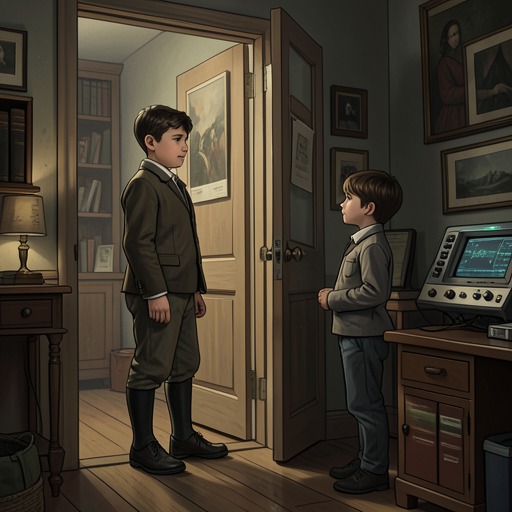
Execution of Joan Boughton
Wolf HallThe execution of Joan Boughton is presented as a childhood memory that Thomas Cromwell has never told anyone. Pulled into a crowd watching an elderly woman burned for her religious beliefs, he first encounters public punishment as spectacle, then sees Boughton’s friends quietly gather what remains. The memory endures not only as an image of state violence but as a lesson in the unstable boundary between the crowd’s account of a victim and the human being whom that account erases.
The child in the crowd
Cromwell’s recollection begins amid a childhood he cannot put in order. He remembers being about nine, afraid of his father Walter and unwilling to go home, but cannot recall precisely why he had run off that day. In the crowd he asks what the old woman’s crime is and is told that she is a Loller, someone who denies that the consecrated bread is God. The adults around him present the execution as instruction: they say that watching will make him obey his priest, and one woman claims that bringing fuel earns release from Purgatory. Their explanations turn a killing into a public lesson in religious conformity. The woman’s age and frailty contrast with the crowd’s appetite for the spectacle. People jeer and speculate about her, while a woman who has drawn Cromwell close urges him to watch. Officials bind Boughton to a stake, and clergy call on her to recant. Cromwell can see her lips move but cannot hear what she says. The gap between the crowd’s confident claims about her and the silence of the person condemned is central to the memory: the people interpret her words and beliefs for him, while the child has no access to her own account.
The execution and its aftermath
As the fire is lit, the crowd surges forward and then recoils behind the officers’ barrier, returning to press for a view. Cromwell holds his breath. The woman beside him describes what she believes is happening, and the onlookers jeer at Boughton even as she cries out. The execution takes longer than the spectators expect. When it is over, officials tend the site and the crowd disperses, carrying away ash on their faces; Cromwell remains, still uncertain how far he is from home and afraid of what Walter may do when he returns. The refusal to participate in the crowd’s treatment of the remains marks a turn in the scene. When one of the men working among the bones invites him to strike, Cromwell backs away. He picks up an iron bar only as a possible weapon while he waits in the rain. He then prays for the woman, though he does not know whether she is in Hell or still present as a ghost. His response is tentative and childlike, not a settled theological position: prayer, fear, and the need for shelter coexist with the violence he has just witnessed.
The recovery of Boughton’s remains
At dusk, a small group gathers around the stake. Cromwell first mistakes them for people praying; then he understands that they are Boughton’s friends, searching through the remains. A watchman stands apart to warn them if officers approach. The group is collecting fragments in an earthenware pot, and Cromwell joins in, finding pieces for them. The contrast with the earlier crowd is stark: the spectators came to watch and judge, whereas this group risks returning to the site in order to recover the dead woman. One of the women asks Cromwell for his hand and smears it with mud and ash from the pot, naming what he carries as Joan Boughton. The brief gesture makes the child a participant in an act of remembrance rather than an observer of punishment. What remains is not a complete body or public monument, but a trace transferred to his skin and a name spoken among people trying to preserve the dead from abandonment.
A private memory and its later meaning
Cromwell later admits that he has never told this story. He can speak to Richard Williams and Rafe Sadler about his past, but not without limits; he does not want to give away pieces of himself. His account also remains fractured: he cannot remember how he got home, what Walter did, or even exactly why he had left. He imagines that fear over a neglected task at the forge may have led him to run off, but presents this only as a possibility. The uncertainty does not resolve the memory; it shows how the event persists alongside gaps in his childhood recollection. The remembered execution also informs the novel’s concern with who controls the stories of the dead. Later, Cromwell reflects that the living rewrite the lives and deaths of those who came before, and recalls that Thomas More spread a claim that Thomas Bilney had recanted as the fire was being set. In this context, Boughton’s friends’ recovery of her remains and the name spoken over the earthenware pot offer a small counter to public spectacle and official interpretation. The scene’s force lies in its difference between the crowd that turns punishment into instruction and the child who refuses the offered iron bar, prays, and helps carry away a fragment of the woman it condemned.