Hatfield
Wolf HallHatfield is where Mary Tudor lives after being excluded from the succession, in a household that restricts her title, meals, and independence. For Thomas Cromwell, the house also carries memories of his own childhood and the violence he associates with its staircase. Those overlapping histories make Hatfield more than a setting: it is a place where royal policy becomes intimate and where the past intrudes upon the present.
Mary at Hatfield
When Cromwell arrives with Gregory Cromwell, the house’s arrangements make Mary’s diminished position visible. Her former servants remain, but their clothing bears the king’s badge where Mary’s livery badge has been removed. Lady Shelton explains that Mary refuses to dine below the young princess and is not allowed to have food carried to her room, apart from the bread provided for breakfast. Mary is therefore caught between her former rank and the household’s insistence that she accept a lower one.
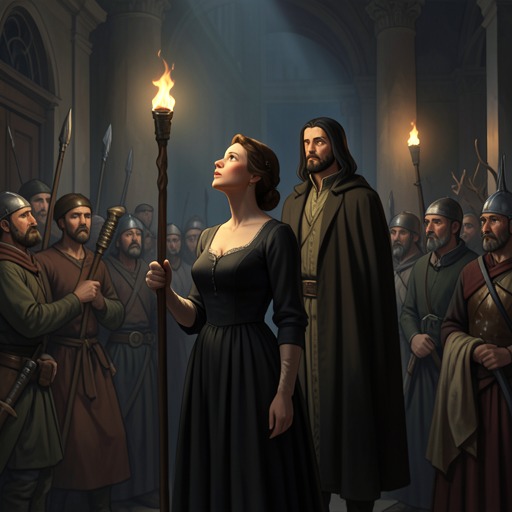
Cromwell finds her in a long, nearly empty room. Its blue tapestries have been taken down, and Mary sits beside a nearly extinguished fire. She is eighteen, and when she rises to greet him she nearly stumbles over her dress. Gregory helps her before she can sit on empty air. The encounter gives a physical shape to her isolation, while her brightening at the sight of Cromwell suggests that she remembers their earlier meeting at Windsor.
A contested title and a practical offer
Mary insists that the servants’ refusal to call her princess does not settle the question of who she is. She says she remains Princess of Wales, the title she held at Ludlow, and asks Cromwell how Parliament can lawfully exclude her from the succession. He answers that Parliament can make it lawful; Mary counters that God’s law stands above Parliament and invokes Bishop Fisher. Their exchange sets her religious and dynastic claim against Cromwell’s reliance on parliamentary authority.
Cromwell does not answer her argument by promising to restore her place. Instead, he offers a physician and proposes that a doctor could prescribe a substantial breakfast in her room as part of a health regimen. When Mary asks whether the food would include meat and who the physician would be, he names Dr Butts, whom she knew at Ludlow. The suggestion is a limited, practical intervention: it could improve her daily circumstances without resolving the political dispute or requiring her to yield her title.
Cromwell’s childhood memory
The visit draws Cromwell back to his own childhood at Hatfield. He remembers that boys carrying wood or coal were not permitted to use the great staircase and had to take a back stair. Once, after breaking the rule and reaching the top, he was struck by a fist from the darkness. He touches the stone at the foot of the staircase, and the memory returns as a question about who might have been waiting above; the narrative gives no certain answer.
That remembered blow connects the house’s present hierarchy to the discipline Cromwell experienced there as a boy. Mary’s restricted place in the household and his own recollection of being barred from the main staircase are distinct experiences, but both are registered through the house’s rules about rank, access, and who may occupy its rooms.
Political and personal significance
Hatfield brings the succession settlement down from the level of statutes to the ordinary conditions of Mary’s life: what she is called, where she eats, and whether she can receive food in her room. Cromwell’s answer to her legal challenge remains political, but his offer of a doctor shows a form of care that can operate within the limits of the existing arrangement. His sympathy does not erase their disagreement over the authority of Parliament or the law of God.
The place also serves as a point of return for Cromwell’s memory. Later, while considering the future of his own household, he recalls looking upward at Hatfield and listening for the sounds of Cardinal Morton’s household; he wonders whether Thomas More, too, might once have climbed its stairs. Hatfield thus holds together the present confinement of Mary, Cromwell’s remembered childhood, and the unresolved histories he imagines inside the house.