Henry Wyatt
Wolf HallHenry Wyatt is a seasoned courtier whose life links the violence of Richard III’s reign with the Tudor court that followed. In the novel, he is at once a survivor, a storyteller, and a prudent elder: he offers Thomas Cromwell counsel, appoints him executor of his will, and asks him to watch over his son, the poet Thomas Wyatt.
Identity and Background
At Austin Friars, Henry Wyatt is welcomed as a fatherly figure by the household’s children. He has served in the treasuries of both Henry VII and Henry VIII; the narrator observes that the Tudors’ financial difficulties were not his fault. A year after Cardinal Wolsey’s departure, Wyatt looks at the blank space where Wolsey’s arms have been painted out and reflects on how differently time passes in old age. His presence makes the loss of a former court order tangible, while his long service gives him standing in the new one.
Wyatt tells the children that Richard Plantagenet—Richard III—imprisoned him in the Tower. He presents the account as his own tale, but the novel distinguishes its theatrical embellishments from the remembered violence: Wyatt was not simply forgotten in his cell, and Richard was present during his mistreatment. The story’s altered ending, in which Henry VII finds Wyatt and promises a reward, turns survival into a Tudor family legend rather than a strictly literal account.
Stories and Survival
In Wyatt’s account, a black-and-white London cat brings him a pigeon while he is confined in a damp cell. The children eagerly supply the details, but the young men listening understand the suffering behind the episode. The cat’s unexpected gift becomes the turning point of the story: Wyatt survives to hear the bells announcing a Tudor victory and to be released. The narrative does not erase the brutality of his captivity; it shows how he has recast it for an audience gathered around him.
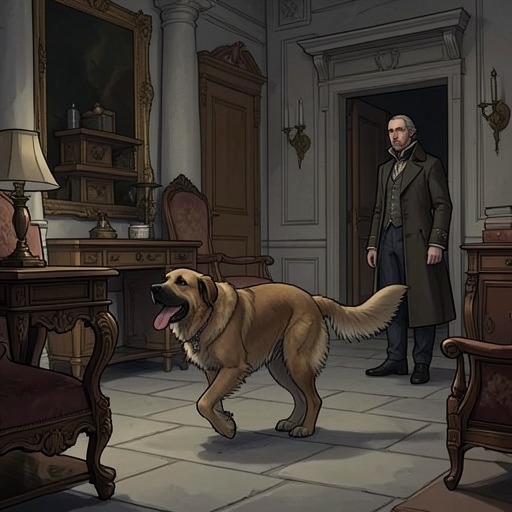
Wyatt also tells of Leontina, the lion cub he raised at Allington Castle. When the grown lion turns on him, his son Thomas distracts her, giving Wyatt time to retreat; grooms then use nets and arrows to bring her down. Wyatt’s comic final detail is that his son, celebrated as the hero, was sick into a bush afterward. The household applauds, and the story’s courtly afterlife is recalled in Henry VIII’s continuing recognition of Thomas as the man who tamed a lion. Wyatt’s tales mix danger, family memory, and performance, making the children participants in stories that have already become part of court reputation.
Counsel and Trust
In private, Wyatt advises Cromwell to seek the post of Keeper of the Jewel House, explaining that the office had once given him an overview of royal revenue. He recommends that Cromwell enlist Anne Boleyn’s help in asking for it. The advice reflects Wyatt’s practical understanding of how formal office and personal access work together at court.
Wyatt then asks Cromwell to serve as executor of his will, saying there is no one he would rather trust with his affairs. He also asks him to keep an eye on Thomas Wyatt and act as a father to him. Cromwell points out that Thomas is twenty-eight and may not welcome another father, but Henry believes Cromwell could do no worse than he had. His request makes trust a matter not just of business but of a family duty he fears he has failed to fulfill.
Family Regret and Narrative Role
Wyatt explains that he arranged his son’s marriage when Thomas was seventeen, hoping to maintain his position among the Kentish gentry through an alliance with Baron Cobham’s family. He regrets the decision: Thomas did not want the marriage, and Henry says his daughter-in-law was unfaithful. He describes his son’s later relationships, travel, imprisonment in Italy, and difficulty managing money, while still insisting that no boy is braver. His concern is affectionate but unsentimental, and the request to Cromwell acknowledges both his own limits and his son’s need for care.
The novel places Wyatt’s private recollections beside Cromwell’s political work. Elsewhere, Cromwell confronts Norfolk over war and negotiation, while Parliament divides over suspending annates paid to Rome and the king watches to see who supports the measure. Wyatt’s stories offer a parallel view of power: survival depends on fortune, but reputation is shaped by how an experience is retold and who is trusted with what follows. His final question to Cromwell—how he grew old—leaves the weight of that long passage between imprisonment, service, family regret, and impending retirement unresolved.