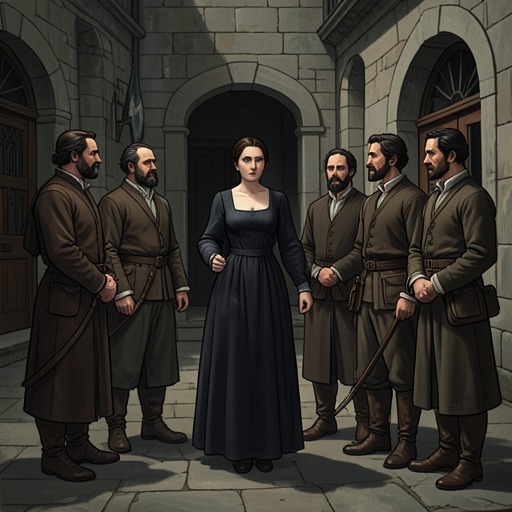
Katherine of Aragon
Wolf HallKatherine of Aragon stands at the center of Henry VIII’s effort to end their marriage: a queen whose insistence on her rights forces the king’s private desire into public conflict over law, faith, and succession. Through the recollections of Thomas Wolsey and the encounters of Thomas Cromwell with the queen and her daughter Mary Tudor, she emerges as a formidable political presence, not merely the object of a royal decision. Her marriage is contested by rival authorities, but her resistance makes clear that the people affected by those arguments cannot be reduced to clauses in a case.
Identity and Background
Katherine’s place in England was shaped long before Henry sought to repudiate their marriage. Wolsey recalls her arrival as a young bride: weather delayed her ships, and she proceeded slowly toward London in November rain. When Henry VII came to see her, her Spanish household tried to preserve the custom that she remain veiled until the wedding. The old king refused to wait. He entered her chamber, and at the sight of her forgot his Latin and backed away, tongue-tied. At court she danced with one of her ladies because no one knew the Spanish dances; Wolsey remembered the turn of her head as her red hair slipped over one shoulder. The tale is filtered through his retrospective, romantic gaze, but it establishes how early Katherine’s body and appearance became part of the dynastic story told around her.
After Prince Arthur died, Katherine spent years in poverty and uncertainty. Henry VII would not allow her to return to her father, claiming money remained owing, while he also withheld the widow’s portion that would have allowed her to leave. Katherine later tells Cromwell that she could not pay her servants and that her household had to buy stale food and yesterday’s fish. She recalls this not as incidental hardship but as a humiliation imposed on the daughter of Spain, a lesson in how royal status could be invoked without providing material security. When Henry VIII married her, she was older than he was and had been sobered by years of anxiety; he, by contrast, was eighteen and had cherished the image of her since he was a boy at Arthur’s wedding.
The king’s account of their marriage makes her a figure in his own remembered romance. He told intimates that Katherine had always loved him, that she had been intended for him rather than Arthur, and that he had married not only a virgin but an alliance with her Spanish relatives. Wolsey’s recollection complicates that idealized story: Katherine’s life had been subject to negotiations over dowry, widowhood, and dynastic advantage before Henry claimed her as his wife. The novel places the king’s conviction beside the history of dependence and bargaining that shaped her actual position.
Marriage, Children, and the Succession Crisis
The marriage’s political pressure is inseparable from its pregnancies and losses. Wolsey recalls six occasions, to the world’s knowledge, when the king and queen hoped for an heir. Their first son, born prematurely around the turn of the year, lived only fifty-two days. Wolsey remembers holding the child while sleet fell outside and the chamber glowed with firelight; the court called him the New Year’s prince and imagined that his survival would end their pain. Another boy died within an hour. Mary Tudor survived, born in 1516, while a later male pregnancy ended in miscarriage; another daughter, who would have been named Elizabeth after Henry’s mother, lived only a few days.
Henry’s question about why he has been left with one frail daughter turns those losses into an argument against Katherine’s continued place as queen. He compares his own parents’ several children with the single surviving child of his long marriage and asks what he has done to deserve this outcome. The novel does not make Katherine responsible for answering the king’s dynastic fear. Instead, it shows how the losses become evidence in a political case, while the queen’s body and the future of the succession are treated as matters over which men claim jurisdiction.
The account of the secret inquiry at York Place in May 1527 makes the unequal terms of the proceeding plain. Henry is summoned to produce the dispensation that had allowed him to marry his brother’s widow; Katherine is neither required to appear nor to be represented, and is not even supposed to know the inquiry is taking place. Wolsey hopes the document may be found defective, but recognizes that the matter cannot be settled so simply: Katherine is likely to appeal to Rome. The procedure begins as an effort to manage the marriage without her participation, yet its very secrecy cannot prevent the wider world from knowing about it.
Henry’s private appeal in June 1527 is framed in gentleness and regret. He tells Katherine that, if he were free of impediment, she is the woman he would choose, and that he would gladly marry her lawfully all over again. His stated obstacle is that she was his brother’s wife and that their union offended divine law. Katherine’s answer, as the narrative represents it, fills the room and travels in its imagined reach from Calais and Paris to Madrid and Rome. The contrast between Henry’s soft, persuasive voice and her far-reaching insistence makes the scene a collision between a king’s effort to define the marriage and a queen’s refusal to let him define her rights for her.
Political Agency and Resistance
Katherine’s political experience is recognized even by those working against her. Wolsey observes that years of uncertainty in England gave her extensive diplomatic contacts and expertise in playing one interest against another. He also remembers her as regent while Henry was away at war: after the Scots were defeated at Flodden and their king was killed, Katherine proposed sending the king the severed head in a bag. Others dissuaded her, calling the gesture un-English; she sent instead a letter with the dead king’s blood-stiffened surcoat. The episode overturns the image of a merely delicate queen and shows her acting within the hard, symbolic language of power.
At the secret hearing, Katherine directs her accusation at Wolsey. She claims that since his rise in royal service he has tried to displace her as Henry’s confidante and adviser, obstructed her access to the Spanish ambassador, and filled her household with spies. Wolsey denies favoring either France or the Emperor and describes his actions as efforts to preserve peace and check what the ambassador might tell her in private. He says Henry had once repeatedly wanted Katherine included in matters and that no woman knew her husband’s needs better. Yet the queen now refuses the compliance that had once made her useful to the king. Her resistance exposes the difference between being valued as a wife and being expected to obey when obedience would cost her the status of wife.
Cromwell’s image of Katherine likewise joins royal display to deliberate self-presentation. He sees her in richly jeweled gowns and a gable hood, her auburn hair faded and streaked with grey. Beneath the gown, she wears the habit of a Franciscan nun. That hidden garment gives physical form to the divide between the public queen and the religious identity she carries underneath, and recalls Wolsey’s counsel to look at what people wear beneath their clothes. Her outward position may be challenged, but her conscience and her account of herself are not simply visible to the court or at its disposal.
Competing Laws and the Limits of Royal Power
The dispute over Katherine’s marriage is also a dispute about which authority can decide what counts as a marriage. During a later discussion with Katherine and Mary, Cromwell argues that Henry’s title as head of the church in England has been qualified by the phrase “as far as the law of Christ allows.” He treats the wording as a way to define a royal position through precedent. Katherine replies that those precedents have been invented only in recent months, and Mary asks whether what has been defined can be redefined. Her question finds room for negotiation in the very formula meant to secure the king’s authority.
Catherine rejects the suggestion that the new settlement is harmless or final. She tells Cromwell that if she yields and leaves the estate of queen and wife, the wording could be used again, this time in favor of the church. Her argument understands law as something that can be changed by those who control its interpretation; the qualification does not reassure her because it offers no lasting protection against a new definition. She also insists that Bishop Fisher is the only one who has remained constant in defending her and telling the truth, while the Commons is full of heathens in her judgment.
When Cromwell later visits her at Ampthill, Katherine refuses to attend the Dunstable court. She does not recognize its authority, since her case remains at Rome awaiting the Holy Father. She calls Thomas Cranmer a heretic and the king a schismatic, while Cromwell maintains that Henry would submit to the judgment of a general council. Katherine warns that such submission may come too late if Henry is excommunicated and put outside the church. Her appeal to the principle that there is no salvation outside the church is not an abstract debating point: it places the king’s new jurisdiction inside a spiritual order she believes neither king nor parliament can simply replace.
The novel later sharpens this conflict through Richard Riche’s account of a conversation with Thomas More. More distinguishes temporal jurisdiction, which Parliament may alter, from spiritual jurisdiction, which lies outside the realm. The distinction echoes the limits Katherine has asserted: the king may command within a political order, but that does not prove that his authority can determine spiritual truth. Across these encounters, the dispute is not simply whether a particular court is fair. It is whether royal and parliamentary power can make itself the final court of appeal over a marriage whose validity Katherine believes belongs to a higher religious authority.
Negotiation, Memory, and Significance
Cromwell tries to persuade Katherine that yielding might preserve a route back to Henry. At Ampthill he argues that Anne Boleyn’s pregnancy guarantees nothing and asks Katherine to consider Mary’s possible future as heir if Anne has no children. He also offers the prospect of honors and a great estate. Katherine’s response is to recount the poverty she endured after Arthur’s death: the unpaid servants, cheap and stale food, and the refusal to let her return to her father. She will not accept another assurance of royal favor without measuring it against the earlier humiliation that royal power imposed on her. When Cromwell asks why she would want to taste that again, the two face one another without resolving the gulf between his offer and her memory.
Katherine’s story therefore persists in two forms: the king’s account of a marriage once chosen for love and alliance, and the queen’s account of a life repeatedly exposed to other people’s decisions. The first can be used to make her a beloved figure from whom Henry now claims release; the second makes visible the costs of treating her status as something that can be granted, withheld, and renamed. Her refusal to attend the Dunstable proceedings and her insistence on Rome keep alive an alternative legal and spiritual judgment, even as the English government builds a competing one.
The consequence is not a settled reconciliation but a continuing contest over who may define Katherine: wife, queen, widow, or subject. Her presence forces political actors to confront the human stakes of laws framed in the abstract, while her memories challenge claims that a royal promise of comfort can erase earlier dispossession. In a novel preoccupied with the power of words and institutions, Katherine’s resistance matters because she speaks from within the dispute rather than merely being spoken about. She cannot make the competing authorities agree, but she denies them the ease of treating her silence as consent.