Lions
Wolf HallThe Lions associated with the Wyatt family appear in a story told by Sir Henry Wyatt about Leontina, a lion he raised at Allington Castle. When the animal escaped her cage and threatened him, his son Thomas distracted her while the household brought her under control. The episode makes the lion at once a dangerous animal, the center of a family legend, and a measure of the gap between taming a creature and truly possessing it.
Leontina at Allington
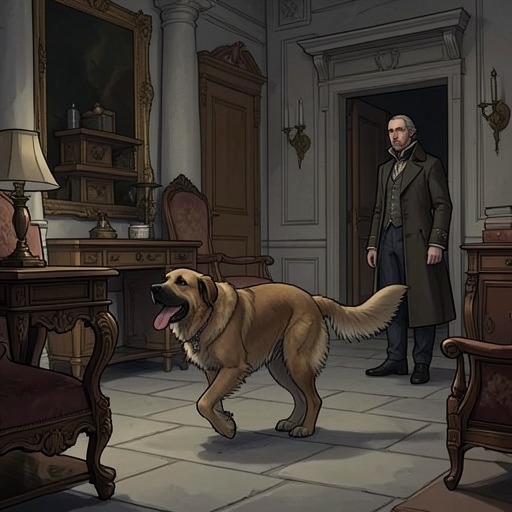
Sir Henry says that, after he recovered from imprisonment, an admirer sent him a lion cub. He raised her at Allington Castle as if she were his child. The affection in that account is immediately qualified by the animal’s independence: one careless day, she escaped her cage, and Sir Henry realized that his attachment did not make him her father. Faced with her, he understood himself instead as potential prey.
Thomas Wyatt and the Rescue
Sir Henry’s son Thomas happens to enter the courtyard as Leontina threatens his father. He calls to the lion, drawing her attention away from Sir Henry, who is then able to step back. Thomas’s bright clothing, loose sleeves, and fair, long hair make him conspicuous as he stands still and speaks to her; the story presents his calm as the interval that gives the household time to act.
Thomas’s appeal does not tame Leontina. She remains dangerous, and the grooms move in with nets while arrows are used to bring her under control. Sir Henry’s account makes Thomas the hero of the crisis but gives him no miraculous mastery over the animal: after the danger has passed, Thomas walks away and is sick into a bush. The private collapse punctures the heroic pose without undoing his courage.
The Family Legend
The story has reached court, where Henry VIII still remembers Thomas as a man who could tame lions. The phrase turns the incident into a portable reputation, simplifying the episode into a striking feat. In the household, however, the children ask for the lion tale again, applaud it, and then turn it into their own play: Rafe acts as Leontina while the others encourage him. Retelling makes the animal a character that can be performed, even though the original danger remains part of the account.
Sir Henry invites the young women to visit and see Leontina’s pelt at Allington. The trophy gives the story a material remainder of the animal, while his invitation presents the tale as both family memory and something offered for inspection. The children’s play, by contrast, reshapes the story for amusement rather than treating it as a fixed account.
Memory, Danger, and Control
The lion story sits beside other stories of animals and danger in the household’s entertainment, but Leontina’s central significance lies in the limits it places on human control. Sir Henry’s parental language cannot make a lion into a child; Thomas’s prayers do not save her, and the household’s weapons and nets, rather than spiritual intervention, end the immediate threat. The story therefore lets courage and affection coexist with practical force, without confusing either for mastery.
Its shifting forms also matter. Sir Henry tells the children a personal rescue story; court preserves Thomas’s reputation in a compressed saying; and the household converts the episode into a comic performance. The pelt, the remembered rescue, and Rafe’s impersonation each preserve a different version of Leontina. Together they show how the lion becomes more than the subject of an adventure: she is the danger that gives the tale its shape and the absent presence around which the Wyatt family’s acts of memory gather.