Morgan Williams
Wolf HallMorgan Williams, Kat Cromwell’s husband, is both a family protector and a practical ally to Thomas Cromwell at a turning point in Thomas’s youth. In Putney, he responds to Thomas’s conflict with Walter Cromwell by offering money and urging him to leave; years later, he appears among the mourners at the Cromwell household. His brief but consequential presence links Thomas’s escape from his father’s household to a broader web of family loyalty, local standing, and political connection.
Identity and Family
Morgan is married to Kat, Thomas’s sister, and belongs to a prominent local family associated with Putney and Wimbledon. He is also connected to Bet Cromwell Wellyfed, Thomas and Kat’s sister, and her family. The Williamses’ standing matters in the crisis at Putney: Kat recognizes that their resources and influence make Morgan’s offer of help consequential, even as they cannot erase the danger posed by Walter.
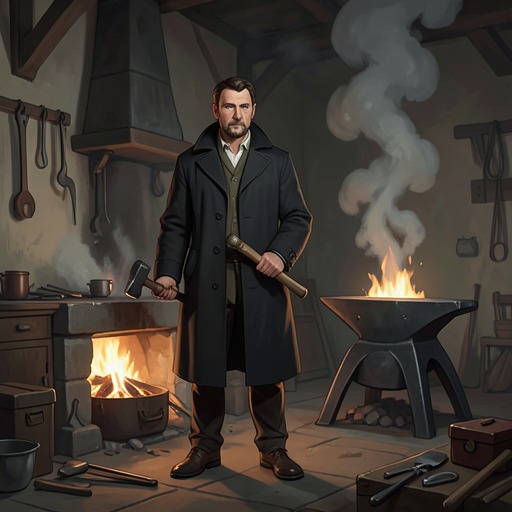
The novel presents Morgan through concrete gestures rather than extended biography. His town coat, his purse, and the coins he sets down establish a man able to act materially when Thomas has few safe options. His affection for Kat is also visible in the life he offers her: he would have her leave the household’s work to the girls and spend her time sewing and praying. Kat does not simply accept this arrangement; her own sense of family obligation and connection to Putney remains part of the scene.
The Putney Crisis
After Walter has attacked Thomas, Morgan arrives at Kat’s home having heard the news. His first response is anger on Thomas’s behalf. He makes a fist and declares what Walter would have received from him, but Kat advises him to stand back rather than risk becoming involved in the aftermath. Morgan then reconstructs the reported sequence: Thomas had come home with torn clothes and scraped knuckles, and Walter had later beaten him. The details have already spread through the parish; people were calling the news to Morgan as his boat came in.
Morgan’s anger turns into a practical plan. He offers ready money and tells Thomas that leaving is preferable to remaining in danger. Kat worries that Walter may return while Morgan is away, and Morgan judges that Thomas should not stay the night: Walter might come back after drinking and could set the place on fire if he thought Morgan was inside. The decision is therefore shaped by immediate risk, not by an abstract wish for adventure. Although Kat would rather Thomas wait, Morgan insists that departure is the safer course.
Thomas takes the money and thanks Morgan in Welsh, asking him to look after Kat and his business and saying that they may meet again. Morgan is surprised by Thomas’s farewell. Thomas’s past time among the Williams households, Morgan realizes, had not been merely a matter of accepting meals. The exchange gives their connection a reciprocal dimension: Morgan provides the means to leave, while Thomas’s words acknowledge a relationship and obligation that extend beyond that single act of assistance.
Later Family Connection
Morgan appears again at Austin Friars during the mourning after Thomas’s wife has died. He is described as diminished and harassed, grieving alongside a gathering that includes Thomas’s sisters, children, and other relatives. He acknowledges that Thomas had been happy with his wife and asks why the best people are taken. The scene places Morgan within the family’s continuing circle of affection: his support for Thomas was not confined to the crisis in Putney, but persists into the later household’s grief.
The contrast between these appearances is significant. In Putney, Morgan’s forceful anger and financial help open a route away from danger; at Austin Friars, he is himself worn down by loss. The earlier scene shows how family resources can create a way forward, while the later one shows that wealth and social position cannot prevent bereavement.
Connections to Thomas’s Political World
Morgan’s importance is not limited to kinship. Thomas later recalls that he had spent time in the Williams households, and the novel presents Morgan’s family as part of the relationships through which Thomas’s life and prospects take shape. The connection is distinct from formal office or court appointment: it rests on marriage, local standing, hospitality, and practical support.
The political narrative also shows Thomas navigating patronage and information networks that depend on personal trust. When Rafe Sadler secures Thomas a seat in Parliament, the arrangement involves the king and Thomas Howard, while Rafe investigates the duke’s intentions. Morgan is not identified as a participant in that parliamentary maneuver, but his earlier assistance helps establish the wider social world from which Thomas comes: influence travels through families and personal ties as well as through institutions. Morgan’s role remains modest in scale, yet his intervention at the moment of departure has a lasting consequence for Thomas’s trajectory.