Southwell
Wolf HallSouthwell is the archbishop’s palace and a principal stop on Thomas Wolsey’s northward progress after his fall from power. Planned as a comfortable base from which Wolsey could proceed toward York, it becomes a place where hospitality, public reputation, political surveillance, and Cromwell’s loyalty converge.
A planned northern residence
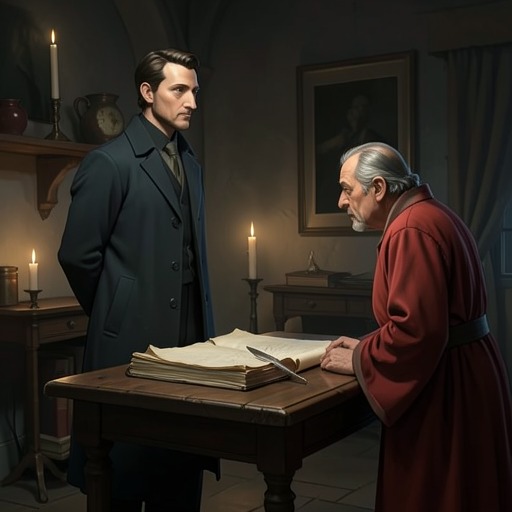
As Wolsey prepares to travel north, Cromwell coordinates the arrangements for his stay at Southwell. He tells his household to make the cardinal comfortable on the road, with the aim of bringing him to Peterborough for Holy Week and then moving him by stages to Southwell, where he can plan the further journey to York. The palace has good rooms, but Cromwell anticipates that builders may still be needed. The journey is not simply a change of residence: it gives Wolsey a public progress, allowing people to see him as he moves through the country.
Cromwell’s preparations are practical and exacting. He later sends Rafe Sadler ahead with instructions to have the archbishop’s palace scrubbed, arrange for Wolsey’s own bed, bring in kitchen staff from the King’s Arms, inspect the stabling, and hire musicians. Pigsties stand against the palace wall, so Rafe is to identify their owner, pay him, and have them demolished. Cromwell even warns him against drinking at the Crown, whose ale he judges worse than his father’s. These details make the palace a working household to be prepared, not merely a symbolic destination.
Wolsey’s reception and Cromwell’s service
During Holy Week, reports reach Cromwell that more people have gathered at Peterborough to see Wolsey than anyone there can remember. He follows the cardinal’s progress on the map of the islands he carries in his mind: from Stamford through Grantham and Newark, until the travelling court reaches Southwell on 28 April. He writes both to reassure Wolsey and to warn him, fearing that the Boleyns, the Duke of Norfolk, or both have placed a spy among the cardinal’s attendants.
Cromwell cannot accompany Wolsey himself. Although Parliament is prorogued, he fears what may be said against his former master in his absence, and must also remain available to the king or Anne Boleyn. He sends Rafe north with messages too secret for letters. In writing to Wolsey, Cromwell insists that physical distance does not mean abandonment: he remains with him in heart, spirit, prayer, and service. Wolsey answers by calling Cromwell his trusted refuge in calamity and his entirely beloved servant. Their exchange gives Southwell’s place in the journey an emotional as well as political meaning: Cromwell is absent from the palace, yet continues to serve and defend the man residing there.
Architecture and the work of memory
Cromwell imagines Wolsey in the chapter house among the canons, seated beneath its high vaulting like a prince in a woodland glade. The stonework seems almost alive: leaves and flowers climb the columns and ribs, berries and roses crowd the capitals and shafts, and carved faces of dogs, hares, goats, and people appear to look down at the cardinal. The image turns the chapter house into a vivid mental scene, poised between ecclesiastical architecture and an enchanted landscape.
That vision is connected to Cromwell’s Italian training in the art of memory. He builds ordered mental places and populates them with striking figures and incongruous objects so that they can hold words and numbers for recall. His mind’s gallery, full of images drawn from landscapes, religious history, and classical stories, makes Southwell’s unusually animated carvings especially suggestive: the palace’s foliage and faces seem ready to join the remembered world he constructs within himself. The passage presents the building not only as Wolsey’s residence but also as material that Cromwell’s imagination transforms and stores.
A residence within a political struggle
Southwell does not remove Wolsey from the king’s reach. Cromwell fears that the cardinal’s retinue may be watched, while the king asks why Wolsey delays on the way to York. Henry VIII also wants the wealth, plate, books, revenues, and lands of the colleges Wolsey endowed at Oxford and Ipswich, foundations supported by proceeds from monasteries suppressed with papal permission. The palace therefore stands within a larger contest over Wolsey’s future and the resources attached to his former power.
The king’s suspicion that Cromwell remains loyal to Wolsey is explicit: he notes that Cromwell sticks by his former master and asks whether he has another. Cromwell replies that Wolsey has shown him nothing but kindness. Southwell is thus more than a stop on a route. It is the distant household Cromwell continues to organize and defend while serving at court, a place where the physical separation of patron and servant sharpens rather than ends their allegiance.