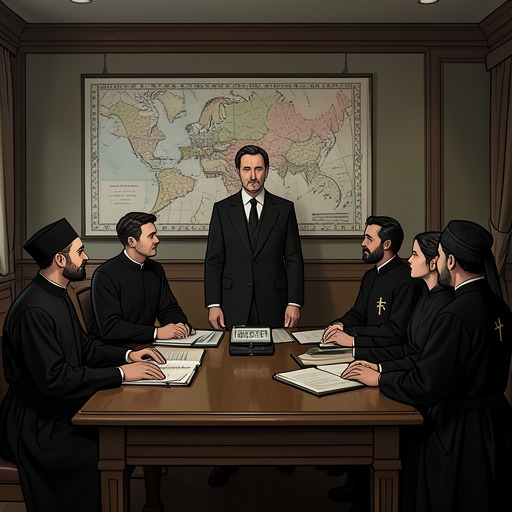
Submission of the Clergy
Wolf HallSubmission of the Clergy was the bishops’ formal acceptance of limits on their independent legislative authority in 1532. In the novel, its terms make the broader contest over church government concrete: the clergy are required to seek royal permission before legislating, while existing church laws are opened to review by a commission that includes laymen and royal appointees.
Terms and Immediate Effect
On 15 May, the bishops sign a document of submission to the king. They agree not to make new church legislation without his licence and to submit existing laws to review by a commission that includes members of Parliament and the king’s appointees. They also agree not to meet in Convocation without the king’s permission. The submission therefore reaches beyond a general declaration of loyalty: it places legislation, legal review, and even the clergy’s assembly under royal oversight.
The Political Context
The document forms part of the effort to extend royal authority over the church while Henry VIII’s marriage to Katherine of Aragon remains contested. Katherine distinguishes between opposing Wolsey’s power and defending the church, and challenges the new direction of policy as an attack on ecclesiastical authority. The novel presents the settlement as politically calculated: in discussion with her, Cromwell argues that the king cannot simply be led, while Katherine answers that he can be enticed. Her exchange with Cromwell also turns on the qualification that the king is head of the church in England only “as far as the law of Christ allows.” Mary Tudor questions what that qualification means; Cromwell insists that it means everything, because it leaves room for the claim to be defined and redefined.
A Contest Between Legal Authorities
The submission belongs to a conflict over which institution may make and interpret church law. Katherine maintains that the Pope’s authority flows from the throne of Saint Peter and that the lawfulness of government depends on it. Cromwell, by contrast, advances a case for the king’s authority within England. Later, he presents Henry VIII with Marsiglio of Padua’s arguments that Christ did not grant the clergy power to rule, make laws, or levy taxes, and that priests remain subjects of the secular ruler. In this account, the submission is not an isolated concession but one step in transferring the practical authority to govern the church from clerical institutions to the Crown and Parliament.
Consequences in the Wider Struggle
The submission is followed by further efforts to make royal authority effective through legislation, appointments, and oaths. Cromwell describes laws as instruments that must make things happen in the real world, and prepares an oath intended to reach people throughout the realm. The political meaning of such measures remains contested: Thomas More argues that Parliament can establish temporal jurisdiction but cannot exercise spiritual jurisdiction, which he regards as belonging outside the realm. The submission thus anticipates the sharper dispute over whether parliamentary and royal acts can determine the church’s authority, or whether that authority remains beyond their reach.
Significance
The document’s significance lies in the way it turns a dispute about sovereignty into an administrative arrangement. By requiring royal licence for new church legislation, review of existing laws, and permission for Convocation to meet, it brings clerical governance within the king’s supervision. The novel places this change among the successive legal and political measures that loosen Rome’s hold on England, while showing that the new authority depends not only on royal claims but on procedures, institutions, and the enforcement of words.