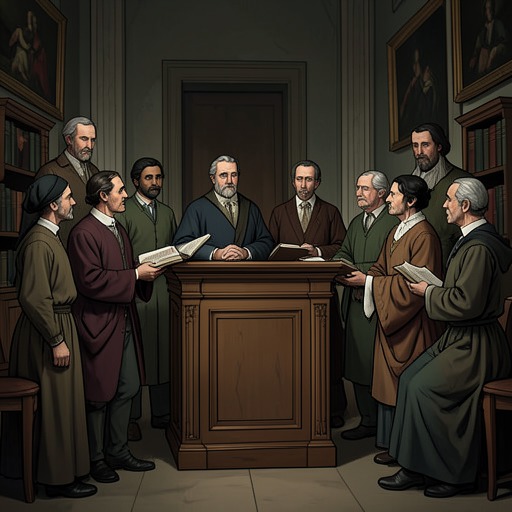
The Vernacular Gospel
Wolf HallThe Vernacular Gospel names the effort to make Christian scripture available in English, and its significance in the novel reaches beyond translation: the text becomes a test of religious authority, a means of opening new forms of reading, and a political challenge to Rome’s jurisdiction in England. It travels in cheap printed books and concealed papers, while rulers and churchmen struggle over who may authorize, interpret, or prohibit it.
Texts, Translation, and Risk
The Gospel’s material life is inseparable from its danger. A Testament kept in a chest is an Antwerp edition of William Tyndale’s translation, printed on cheap octavo paper. Its title page bears the defiant colophon “PRINTED IN UTOPIA” where a printer’s address should be. The small book contrasts with official efforts to suppress English-language printing: Thomas Wolsey has ordered books burned at St Paul’s Cross, a public destruction of texts that does not end their circulation.
Tyndale’s work moves through networks of refuge and clandestine exchange. Before leaving London, he lodged for six months with Humphrey Monmouth; books and news also enter by way of the Channel ports and East Anglian inlets. Readers do not encounter scripture only as an abstract doctrine: they carry, hide, and risk discovery for particular printed pages. During a search of John Petyt’s house, Petyt hides papers while his wife, Lucy, distracts Thomas More and his officers. The search turns up nothing, but More nevertheless takes Petyt into custody. The episode makes possession itself consequential: a hidden Testament can draw state scrutiny even when the search fails to find it.
What the English Scriptures Teach
The movement’s claims are presented as a reordering of religious understanding. Tyndale’s teaching rejects the idea that saints can secure salvation, that prayers and candles enlist them as protectors, or that priests must stand between a person and God. Salvation rests on Christ, rather than on human merits or the services of religious intermediaries. The emphasis falls on the living Christ and on scripture as the ground on which belief can be examined.
The English text also changes what readers can know. Cromwell reflects that people have learned familiar religious stories through church paintings and carvings, but may not know the miracles and sayings of Christ or the deeds of the apostles. English scripture enlarges the story available to them: it is not only something to receive from images, ritual, or clerical explanation, but something to read and think through. Cromwell connects that reading to action, likening the use of a page in an account book to the active engagement scripture demands: study, reflection, and a changed relation to other people.
Competing Authorities
The conflict over English scripture unfolds alongside a dispute over jurisdiction. Katherine insists that the Pope is head of the Church and the source of legitimate ecclesiastical authority; Cromwell argues that the king’s authority over the English Church can be understood through ancient precedent and defined in law. The qualifying phrase “as far as the law of Christ allows” becomes a point of contention: Mary Tudor asks whether a position that has been defined can later be redefined, while Cromwell treats the wording as leaving room for negotiation.
The opposing accounts are not merely arguments about language. Katherine warns that an English settlement may lead to the taking of Church lands, while Cromwell presents reform as a recovery of authority for the king and a correction of what needs changing. In his account, scripture in English helps make that transformation intelligible: it gives readers access to Christian teaching while weakening the claim that spiritual knowledge must depend on the established clerical hierarchy. Katherine’s insistence that salvation lies within the Church marks the depth of the division; for Cromwell, the new scriptural reading and the king’s authority can be made compatible.
A Political and Reading Public
The novel links vernacular scripture to a wider idea of public participation. When Cromwell discusses Parliament and an oath to uphold the succession, he argues that one Christian’s oath is as good as another’s and imagines that people who are then unable to read might learn to take up books within a generation. His declaration that England can be otherwise joins religious access to social and political possibility: the ability to read is not reserved for bishops or courtiers.
That possibility is contested through law and enforcement. More’s officers search for English books, and the authorities imprison people associated with their circulation. Cromwell can sometimes improve a prisoner’s conditions, as he does for John Frith, but his intervention does not resolve the larger conflict over whether English religious writing will be permitted. Tyndale himself offers to return if the king will allow scripture in the mother tongue, even proposing that the king choose a translator; Henry has not given that permission. The space between a possible royal approval and an actual ban keeps translation politically uncertain.
An Unfinished Transformation
The Vernacular Gospel is therefore both a text and a process: a translation printed abroad, carried into England, hidden in houses, read amid danger, and invoked to question inherited authority. Its appearance does not settle the disputes it raises. Instead, it changes what can be contested, who can claim access to religious teaching, and how the relation between Church, king, Parliament, and reader can be imagined.
The novel’s treatment holds promise and danger together. English scripture may open a larger Christian story to readers who have known it chiefly through images and clerical mediation; it also provokes searches, imprisonment, and political struggle over the right to define religious truth. Its power lies not only in what the translated words say, but in their passage through print, concealment, reading, and law.