The dead and their burial
Wolf HallThe dead and their burial form a recurring concern in Wolf Hall, where mourning is inseparable from the living’s struggle over memory and authority. Cardinal Wolsey’s death turns a planned journey to York into a guarded journey south and a plain burial at Leicester; later, Henry VIII’s dream of Arthur makes the dead brother an imagined witness to the king’s marriage and kingship. The question of what the dead can mean becomes political: their bodies, remembered words, and burial places may console the living, accuse them, or be enlisted to justify rule.
Wolsey’s death and the failed future
On 1 November 1530, Wolsey is arrested at Cawood before he can reach York for his investiture. Harry Percy takes him under guard through Pontefract Castle and Doncaster to Sheffield Park, where he falls ill; on 26 November, the Constable of the Tower arrives with twenty-four men-at-arms to escort him south. He dies three days after reaching Leicester Abbey. The route that should have led to a public advancement therefore ends in confinement and death, while the archbishop’s robes and crozier that Cavendish had prepared for York become remnants of an unfulfilled future.
George Cavendish recounts Wolsey’s arrest to Thomas Cromwell. At dinner, Percy arrives mud-spattered, with the porter’s keys and sentries already placed on the stairs. Wolsey asks for the commission and, when Percy refuses to show parts of his instructions, withdraws to his chamber rather than surrender at once. He masters himself there and tells Cavendish, “look at my face: I am not afraid of any man alive.” Cromwell turns away while hearing the account, unable to watch Cavendish’s distress; the memory of Wolsey’s composure at the moment of arrest becomes inseparable from the illness and death that follow.
Cavendish remembers the people who gathered along the route. At Cawood, townspeople kneel and weep as Wolsey is taken away. In Doncaster, they stand through the night, shoulder to shoulder, holding candles in the street until daylight. Their vigil offers a public expression of loyalty, but it cannot alter the journey’s outcome. Cavendish later tells Cromwell that Wolsey had gone a week without eating before accepting a little of the spiced warden pears he ordered. Wolsey complained of a cold, hard weight in his chest; an apothecary prepared a powder, and Cavendish and the apothecary each drank a cup before Wolsey took the third. The pain eased for a time, but the reassurance did not last.
When the Constable, William Kingston, arrives, Wolsey repeats his name and tells Cavendish that he knows what death is prepared for him. After a night without sleep, he becomes too weak to stand. During the illness he continues speaking: when he sees a shadow leap across the wall, he asks whose it is and calls for Cromwell, whom Cavendish falsely says is on the road. The next morning Wolsey refuses chicken broth because it is a meatless day. He dies at eight the following morning, after eight days of illness. The narrative gives no certain explanation for his condition; it records his fear, his religious observance, and Cavendish’s witnessing rather than resolving the cause of death.
Burial, witness, and political memory
Cavendish washes Wolsey’s body and prepares it for burial. Beneath the cardinal’s fine holland shirt, he finds a hair shirt, which he believes Wolsey began wearing while among monks at Richmond. The monks at Leicester keep it. The intimate object complicates the public image of the fallen statesman: it points to a private devotional practice that Cromwell dislikes, yet which Cavendish cannot omit from his account of the dead man.
The burial itself is markedly plain. Wolsey receives a coffin of unadorned boards, a stark contrast to the grand tomb that Cromwell recalls a Florentine sculptor making for him, with black marble, bronze, and angels at head and foot. Cavendish dresses him in his archbishop’s robes and places his crozier in his hand, imagining the investiture at York that had been only two days away. The vestments preserve the dignity of the office, but the coffin and the interrupted journey disclose how completely that expected future has disappeared.
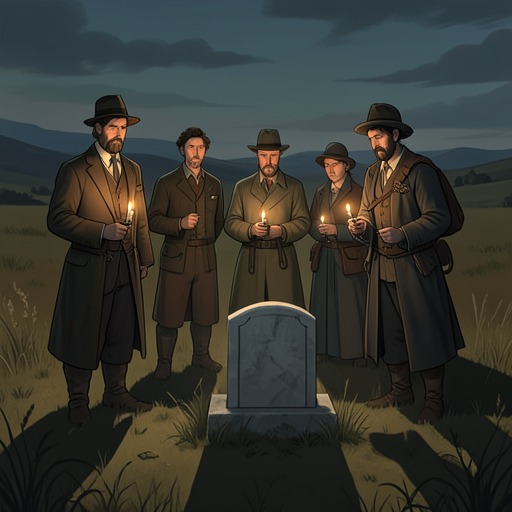
Cavendish and the household arrange for the mayor and city officials to see Wolsey in his coffin, so that no false report can claim he is alive and has escaped to France. They keep vigil by tapers until four in the morning, then hear Mass and lay him in the crypt at six, on the feast of Saint Andrew the Apostle. The ceremony gives the death a witnessable public form: the officials see the body, the household performs the vigil, and the burial fixes Wolsey’s fate in place. Yet burial does not settle what can be said about him. At Hampton Court, Cromwell tells Cavendish to disclose nothing about Wolsey’s last days, warning that Norfolk may twist any account into treason. The dead man’s story remains vulnerable to political handling even after his body is laid in the crypt.
Cromwell’s grief is joined to a practical reckoning. At Austin Friars, he begins by holding a prayer book and crying; when Cavendish gives him the accountancy problem of paying the household, he turns to arranging a quarter’s wages and a retainer for Wolsey’s servants, in hope of the cardinal’s restoration. He also asks what Cavendish was paid and learns that the servant earned ten pounds a year while three-quarters of his wages were in arrears. The effort to provide for the living keeps faith with Wolsey, but it also makes clear the material consequences of his fall. Later, Cromwell thinks of the king’s failure to spend even twenty thousand pounds to recover Wolsey, and wishes for sight of the nation’s accounts: remembrance becomes inseparable from judgment of the financial power that has replaced the dead patron.
Arthur’s dream and the living king
A different encounter with the dead occurs during the Twelve Days of Christmas, between Christmas Day and Epiphany. Henry VIII tells Cromwell that his dead brother Arthur has appeared in a dream, pale and thin, surrounded by white light. Arthur died at Ludlow in winter; the roads were so difficult that his coffin had to be carried in an ox-cart, a detail Henry still regards as an indignity to a prince. He was buried at Worcester, but Henry says he never saw the body and has never seen Arthur’s face until this dream. The vision therefore gives form to an absence that has remained unresolved in the king’s memory.
Cranmer, present in the room, distinguishes the dreamed image from Arthur’s body, calling it an image formed in Henry’s mind and invoking Augustine. Henry nevertheless reads the brother’s sad expression as an accusation: Arthur seems to tell him that he has taken his place and used his wife. The dream connects the dead prince to Henry’s disputed marriage to Katherine of Aragon and to the question of whether the king has wronged both his brother and the divine order. Cranmer acknowledges the religious issue but tries to redirect the king’s interpretation, asking whether Arthur spoke or made any sign. Henry admits that he did neither; the accusation is an inference drawn from the image, not a message delivered in words.
Cranmer turns that uncertainty into an argument about succession and sovereignty. He invokes the lawyers’ principle “Le mort saisit le vif”: the dead seize the living, because a prince’s power passes at the moment of death without a gap in the succession. Arthur’s appearance, in this interpretation, need not condemn Henry; it may remind him that he bears the authority inherited from both the living and the dead. Cranmer then connects Arthur’s tomb inscription, “Rex quondam rexque futurus,” to the Tudor story of a claim recovered and made secure. The dead brother becomes less an accusing witness than a figure through whom Henry may understand his own kingship as an obligation to hold and secure the realm.
The interpretation also serves a present political purpose. Cromwell tells Henry that this is the moment to become the ruler he should be and to be sole and supreme head of his kingdom, adding that Anne will say the same. Henry confirms that she opposes continued submission to Rome. The dream thus moves from private fear about Arthur, Katherine, and judgment to a public claim about royal authority. Cranmer cautions against heeding dreams, but Cromwell answers that “the dreams of kings are not like the dreams of other men.” In the scene, the dead have no independent voice: their meaning is disputed by the living, and the king’s counsellors shape that meaning toward political action.
Memory, evidence, and the unquiet past
The novel places these scenes within a wider interest in how the dead are remembered and identified. It recounts the story of Simonides, who leaves a banquet shortly before its roof collapses. Because he remembers where each diner sat, he can identify bodies too damaged for relatives to recognize. The seating arrangement becomes a map that restores names to the dead. Told through Cicero’s account, the story presents memory as a practical means of giving the dead back to their relations, but also as an art of arranging images and places in the mind.
That concern with memory recurs in the novel’s account of portents and historical knowledge. At Austin Friars, Cromwell discusses the comet with Nicholas Kratzer, whose references to earlier celestial signs bring war, religious upheaval, and the sack of Rome into the present conversation. The episode does not establish that the dead return or speak; instead, it shows how people read present danger through remembered events and inherited accounts. In a later conversation about Guido Camillo’s theatre, a system of nested shelves and drawers is described as a memory structure in which knowledge is arranged around a central observer. The imagined theatre, like Simonides’ seating plan, makes the past retrievable by assigning it a place.
The dead therefore remain active in the novel without becoming reliable narrators of their own histories. Wolsey’s coffin is shown to officials to prevent rumours of escape, while his burial objects and Cavendish’s testimony preserve details the court might suppress or distort. Arthur’s dream, by contrast, supplies no verifiable message: its force lies in how Henry and his advisers interpret it. Across these contrasts, burial confirms that a body has died, but it cannot settle what the dead mean. That work belongs to the living, whose grief, memory, and political interests continually reshape the past.