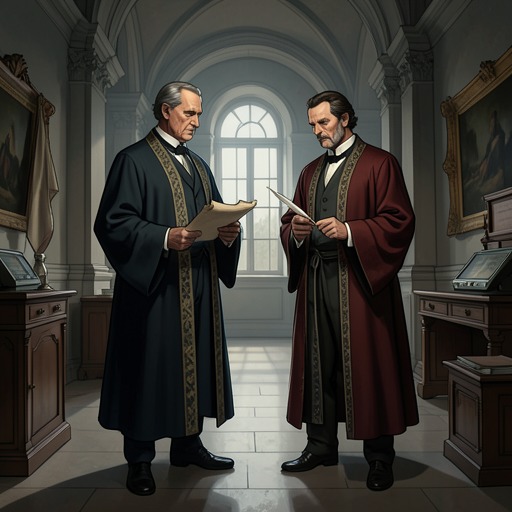
Thomas Audley
Wolf HallThomas Audley is a lawyer who becomes Speaker of the House of Commons and then Lord Chancellor, serving as one of Thomas Cromwell’s most consequential political allies. Prudent, ambitious, and careful with words, he helps translate the king’s wishes into parliamentary measures and legal proceedings. His role grows more perilous as disputes over royal authority, succession, and conscience bring Thomas More before the government he serves.
Identity and political character
Audley enters the story as a parliamentarian and gentleman of the Inns of Court and London’s livery companies, part of the circle that gathers around Cromwell. Cromwell regards him as a prudent lawyer, able to sift a sentence as carefully as a cook sifts rice for grit. Audley speaks eloquently and holds tenaciously to a point, but his religious convictions appear flexible. He believes in Parliament and in the king’s power exercised through Parliament, while his career remains an important concern.
That mixture of caution and ambition makes Audley useful in a court where formal authority and personal influence continually overlap. He is neither simply a mouthpiece for Cromwell nor an independent counterweight to him: he has his own professional aims, yet understands how to make himself useful to the king and to the political programme taking shape around them.
From Speaker to Chancellor
As Speaker, Audley presides over the proceedings in which Harry Percy is required to swear that he had neither a marriage contract with Anne Boleyn nor unlawful relations with her. The king and council attend. When Percy has sworn, Henry directs Norfolk to stop troubling him and asks that the elderly Archbishop Warham be assisted. Audley’s place in the proceeding shows how parliamentary and religious forms are being brought to bear on the political question of Anne’s marriage and status.
Audley’s advancement follows Thomas More’s departure from the chancellorship. At Whitehall, Cromwell advises Anne that the king should appoint the Speaker on a provisional basis: Audley is a good lawyer, his own man, and someone who understands Cromwell. Audley then appears as acting Lord Chancellor, leading Percy through his denials. The movement from Speaker to the highest legal office makes him a hinge between parliamentary procedure and the king’s executive power.
His practical understanding of government is also visible in private discussion. Cromwell describes him as a man who can sift a sentence for grit, and his counsel repeatedly turns on what can be made workable within the law. He is not portrayed as a great theorist; his strength lies in the procedural and verbal discipline needed to carry policy through institutions.
Working with Cromwell and the king
Audley shares political work and meals with Cromwell, Thomas Cranmer, and Rowland Lee. Cromwell tests the people around him for reliability and weaknesses, and Audley’s prudence makes him a valued colleague. Their alliance is close, but not frictionless: at moments Audley’s careful, career-minded manner appears almost comic beside Cromwell’s forceful impatience.
When Cromwell proposes suspending annates paid to Rome, he asks for a division in the Commons, an unusual procedure that makes members publicly reveal their position. The king watches and learns who supports him. In the Lords, the same tactic will not suffice; Henry must attend personally and argue his case. The episode illustrates the complementary functions of parliamentary management and royal pressure in the political method that Audley’s circle serves.
The same partnership appears in the drafting of the succession measure. Audley is present with Henry, Cromwell, and Stephen Gardiner as the draft is discussed. Anne objects to provisions that contemplate her death and to the preference given to a lawful male heir; the text also leaves Mary Tudor outside the succession. Cromwell explains that the bill is deliberately phrased without personal declarations, while Gardiner pointedly observes that the consequences are plainly personal. Audley’s presence places the Lord Chancellor inside a debate where legal language must make dynastic choices enforceable.
Cromwell proposes that subjects affirm the parliamentary settlement by oath, defending Parliament’s competence against claims that the matter belongs to Rome. In the same political climate, the king and his councillors debate a measure limiting large flocks, with its stated purpose of protecting ordinary people displaced by sheep farming. These initiatives show the wider range of government business in which Audley’s parliamentary and legal expertise operates.
Thomas More and the limits of procedure
Audley is involved in the effort to secure Thomas More’s compliance with the Oath of Succession. After Cromwell, Norfolk, and Audley kneel before Henry and ask that More be omitted from the bill of attainder, the king grants the request. Audley and Norfolk help the duke rise after his elderly knees fail him. The reprieve is an act of royal mercy, but it does not resolve the conflict of conscience that brought More into danger.
When More is pressed again, he says he cannot swear the oath, but will neither speak against it nor dissuade anyone else from taking it. Audley insists this is insufficient. Cranmer suggests that More might swear privately, or be asked what oath he could accept; Audley judges that secrecy would defeat the king’s purpose. The exchange reveals the narrow space in which he works: a compromise may seem humane or practical, but it must still satisfy a political demand for public assent.
In a later confrontation, Audley sits with Cromwell and Cranmer as More explains why he distinguishes Parliament’s authority over temporal jurisdiction from its authority over spiritual jurisdiction. More argues that Parliament can alter a temporal settlement, but cannot assume a spiritual power that lies outside the realm. Cromwell treats the distinction as a challenge to the king’s title, while Audley remains comparatively composed. When More is not permitted to return home, Audley supports placing him in the custody of the Abbot of Westminster rather than committing him immediately to the Tower.
Audley recognizes the practical danger of More’s silence. He suggests that, if More would identify the objectionable part of the oath, the government might draft language to meet it. Cromwell counters that More cannot safely state his reasons, because doing so would expose him to prosecution. The episode makes Audley’s legal caution both a resource and a limit: he can imagine an accommodation, but cannot make the underlying conflict between royal and religious jurisdiction disappear.
Evidence, prosecution, and consequence
The struggle becomes more dangerous when Richard Riche reports a conversation with More in the Tower. In Riche’s account, More distinguishes a parliamentary act establishing a king from one naming the king head of the church: Parliament can determine temporal authority, he says, but not spiritual jurisdiction. Audley is present as the account is discussed. Cromwell considers whether the statement can be used to prove treason, while also questioning whether More’s words can be shown to have been malicious. Riche’s memorandum is based on his recollection, and no independent witness is available to confirm the exchange.
At the trial in Westminster Hall, Audley is among those preparing the case before More faces a jury of London merchants. The early charges, concerning words spoken at different times and an alleged conspiracy with John Fisher, are expected to be abandoned; the prosecution will rely on Riche’s evidence. Audley voices concern about including John Parnell, who had previously pursued More after a Chancery judgment, but Cromwell rejects the suggestion that a jury elsewhere would be preferable. Audley’s presence at this stage marks the distance between his earlier interest in compromise and the government’s later dependence on contested testimony and carefully selected procedure.
Audley’s character is defined by that distance. He is a skilled, cautious lawyer who helps turn political decisions into statutes, oaths, and proceedings, yet the law he administers is also the instrument through which the king’s authority is asserted over church and conscience. His career rises with the new order, while his dealings with More expose the human and legal costs of making that order binding.