Thomas Avery
Wolf HallThomas Avery is a young clerk in Thomas Cromwell’s household, trained in private finance and sent abroad to learn the merchants’ practice. His movements connect the intimate rhythms of Austin Friars with the perilous circulation of William Tyndale’s writings; his education, meanwhile, gives concrete form to Cromwell’s conviction that careful reading and accurate accounts should lead to action, not merely to clerical routine.
Identity and Training
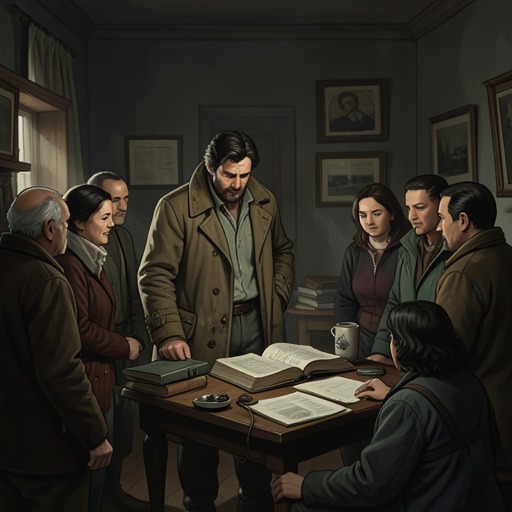
At Austin Friars, Avery works in the counting house, where Cromwell is training him to take a grip on his private finances. He is one of the household’s younger members, learning a trade that joins arithmetic to judgment and trust. Cromwell’s purpose is not simply to have a boy add columns for him: he expects Avery to understand what the figures mean and what decisions they make possible.
Cromwell sends Avery to Antwerp to learn the practice of merchants under Stephen Vaughan. The journey places him among Cromwell’s wider network, where commercial knowledge, correspondence, and personal connections travel together. Vaughan’s household is stern and businesslike. Avery recounts that Vaughan asks about his late nights, whether he has written to his master, and whether he has been to Mass; Avery mocks the questions as a concern for his bowels rather than genuine devotion. In contrast, Cromwell promises that he may come home the following spring.
Return to Austin Friars
When Avery returns, he enters Austin Friars with a travelling chest containing everything he owns. He throws off his jacket, sits at his desk, and is ready to resume work. Before settling in, however, he pauses at the doorway, transfixed by a tapestry depicting the Queen of Sheba visiting Solomon. The king had given the tapestry to Cromwell; it had belonged to Cardinal Wolsey, who knew Cromwell admired it. Avery’s immediate question about the lady and his notice of the tapestry’s value disclose both his curiosity and the accountant’s eye taking shape in him.
His homecoming is also a family-like reunion. He opens his arms to embrace Cromwell, who sets aside the many people waiting to see him so Avery can first tell him how everyone across the sea is. Avery has brought comfits and novelties for Mercy, Johane, and the little girls. He greets Richard, Rafe, and Gregory with punches, a rough form of affection, while keeping his small bag tucked beneath his arm. The bag is not merely luggage: it contains a message whose presence turns the household welcome into a moment of political and religious risk.
Tyndale’s Letter and the Risk of Secrecy
The letter is concealed in the lining of Avery’s woollen jerkin. Cromwell notices the neat stitching, takes a small pair of scissors, and opens the seam to retrieve the folded paper. Avery blushes when Cromwell asks who made the stitching: Jenneke, he says, a girl in Vaughan’s household. Their exchange hints at Avery’s attachment to her, but he will not have Cromwell write to her father. He explains that she is an orphan in Vaughan’s care and that they are teaching her English. The private question of whether she might have a dowry sits alongside the letter’s far more dangerous contents.
Avery has carried the message without reading it, because he would rather not know what it says in case he finds himself Thomas More’s guest. Cromwell reads it: Tyndale fears that he can never safely return to England, even if Anne Boleyn becomes queen. He distrusts a royal safe conduct while More remains in office, because More has argued that promises made to heretics need not be kept. The message makes the threat to Tyndale more than an abstract disagreement about translation. A guarantee from the king might not protect him, and the danger could reach those who carried his words.
Cromwell’s response is protective and angry. He declares that if Tyndale comes near his people, he will drag him from the court at Westminster and beat sense into him about the love of God. Yet he also shares the letter with Avery, telling him that the Lord Chancellor respects neither ignorance nor innocence. Avery flinches but takes the paper. The moment sets the boy’s caution against Cromwell’s fierce, unresolved concern for the man and the scriptures whose message he has just received.
The letter does not remain intact. Because the day is too mild for a fire and the hour too early for a candle, Cromwell tears it up; Marlinspike chews one fragment. The household cat’s contact with the scraps gives the episode an incongruous domestic ending, but not a reassuring one: the message has been read, its danger understood, and its physical evidence destroyed. Avery’s innocent errand has carried a contested text into the heart of Cromwell’s household.
Pacioli’s Book and Cromwell’s Teaching
Avery’s education receives its clearest expression in the book Cromwell gives him: Luca Pacioli’s Summa de Arithmetica. Cromwell describes it as perhaps the only good thing ever to come out of a monastery. The volume has a deep green binding, gold tooling, gilt-edged pages, and dark garnets set into its clasps. Avery is almost afraid to open it. Cromwell urges him to do so, and points out the woodcut of Pacioli with a book and compasses, then the figures illustrating geometry. Avery recognizes the maxim that one should not go to bed until the books balance; Vaughan has quoted it often enough to keep him working until dawn.
Cromwell relates Pacioli’s mathematics to more than bookkeeping. He remembers hearing him lecture in Venice on proportion in building, music, painting, justice, and the commonwealth: on balancing a prince’s power against that of his subjects, and on the wealthy citizen’s duty to keep honest books, pray, and serve the poor. The same principle, Cromwell suggests, governs a printed page, a law, and a face. Precision matters because parts must balance; intellectual beauty is not separate from the ordering of civic and moral life.
Avery turns the leaves with reverent fingers, then looks again toward the tapestry. His attention to both objects places an image of kingship beside a book of numbers: one invites wonder, the other disciplined study. Cromwell sets Pacioli’s volume on Avery’s desk so that it may console him when nothing seems to add up. In doing so, he makes the gift part of Avery’s working life rather than a precious object to be admired at a distance.
Work as a Form of Responsibility
Cromwell’s hopes for Avery exceed accuracy for its own sake. An accountant who merely totals columns, puts them under his master’s nose for initials, and locks them in a chest has missed the point. Cromwell treats an account book as something to be used, as a love poem or scripture is used: it should open possibility and initiate action. His examples are practical and ethical alike—love one’s neighbour, study the market, extend benevolence, and bring in better figures the next year.
This lesson joins Avery’s commercial training to the political work surrounding him. Cromwell brings before Parliament a bill to suspend payments of annates to Rome and calls for a division, so that members’ support and opposition are visible to the king. The king watches and learns who is with him; in the Lords, the same tactic cannot suffice, and he must argue his case in person three times. For Cromwell, as for the book he gives Avery, figures and recorded choices have consequences: they can expose alignments, guide policy, and help turn an idea into action.
Avery’s role remains that of a young learner, not a policymaker, and the narrative supplies no later resolution for him. What it does establish is a relationship of instruction and care: Cromwell trusts him with accounts, sends him abroad, welcomes him home, and gives him a demanding book as a tool for understanding. Avery’s return with Tyndale’s letter shows the vulnerability built into that trust; the lesson of Pacioli shows its promise. At Austin Friars, education means learning how to read a page, a balance, and the obligations hidden within both.