Thomas Bilney
Wolf HallThomas Bilney, the Cambridge scholar and priest known as “Little Bilney,” appears as an evangelical reformer whose confidence in Scripture brings him into conflict with ecclesiastical authority. His encounter with Thomas Cromwell shows both the appeal of his convictions and the danger attached to voicing them: Cromwell warns him that the cardinal’s absence has left opponents free to act, yet cannot make Bilney retreat from his beliefs.
Identity and religious convictions
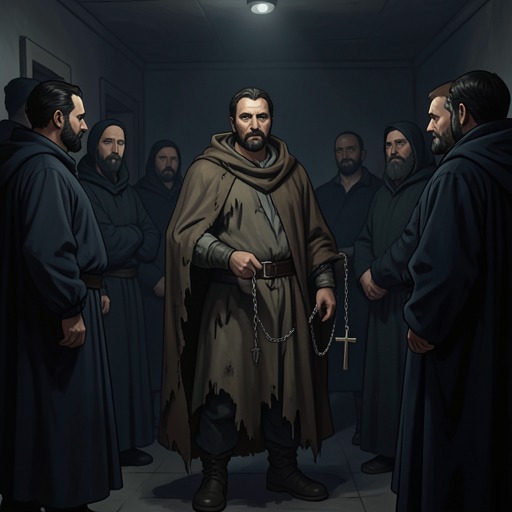
The book identifies Bilney as a scholar burned for heresy and describes him as a priest and fellow of Trinity Hall. The nickname “Little Bilney” refers to his short stature; the narration also characterizes him through his restless movements and the way he twists on a bench. He speaks of his mission to lepers, placing practical religious service alongside his insistence on Scripture.
Bilney’s theology rejects the efficacy of masses, fasting, vigils, and pardons from Purgatory. He presents these practices as useless and sees a direct appeal to the Pope as the remaining way to advance his views. His declaration that Scripture is as honey to him conveys an intense, personal devotion to the Word of God, rather than merely an abstract dispute about doctrine.
Encounter with Thomas Cromwell
At a meeting at Gray’s Inn, Cromwell finds Bilney discussing his mission and religious beliefs. Cromwell warns him not to assume that he can act safely while Thomas Wolsey is away: the Bishop of London and Thomas More, whom Cromwell calls their friend in Chelsea, are able to pursue reformers. His warning is practical rather than a dismissal of Bilney’s convictions; he recognizes that Bilney is exposing himself to danger.
Bilney answers by declaring that the usual religious observances are worthless and that the Pope might be persuaded to agree with him. Cromwell doubts that the Pope would welcome such advice and leaves, remarking that Bilney would go into the fire if invited. The exchange presents Bilney as uncompromising, while Cromwell understands that a challenge to religious authority can have consequences beyond argument.
Place in Cromwell’s religious and political world
Cromwell does not take Rafe Sadler to these meetings and refuses to draw anyone in his household into dangerous company. He describes the household as orthodox and pious, and says its members must be irreproachable. Bilney’s presence thus exposes a boundary in Cromwell’s conduct: he engages with reformist ideas, but he takes care to shield his household from association with reformers.
Later, when Mercy asks where Cromwell was during the household crisis following Liz’s death, he says that he had been with Bilney and had warned him that he would go into the fire. The recollection links Bilney’s religious zeal to Cromwell’s private loss, without suggesting that Bilney caused it. In the wider narrative, Bilney’s fate as a scholar burned for heresy gives weight to Cromwell’s warning and makes the danger of religious dissent concrete.