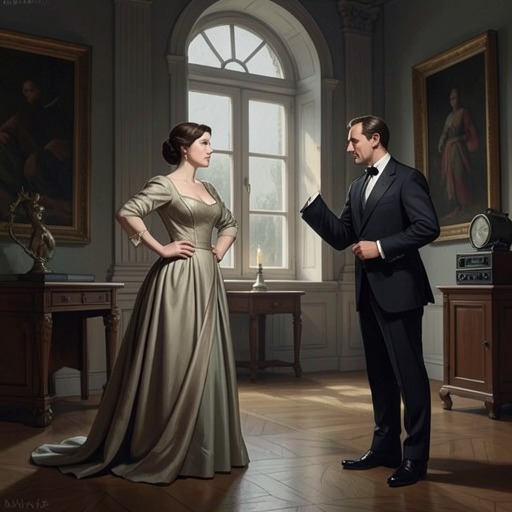
Thomas Boleyn
Wolf HallThomas Boleyn is a diplomat, courtier, and father whose family’s ambitions intersect with the struggle over marriage, rank, and royal succession. His encounter with Cardinal Wolsey over Anne Boleyn’s rumored commitment to Henry Percy defines his political position: he is adept at presenting himself as a worldly negotiator, but neither his daughter’s choices nor the court’s hierarchy are entirely his to command. As Anne rises in favor, Boleyn receives a title and seeks further recognition, his advancement shadowed by Wolsey’s reminder that the Boleyn family’s standing is not equivalent to that of the great noble houses.
Identity and Court Position
The novel identifies Boleyn as a diplomat and the father of Anne and Mary Boleyn. At court, he is associated with the Howard family through his marriage, while the family’s origins in trade remain a point of vulnerability in disputes over status. His titles change as his fortunes rise: after Anne’s position at court advances, he is made Viscount Rochford, and he later lets it be known that he would welcome being addressed as Monseigneur.
These titles matter because courtly standing is not simply a matter of formal appointment. It is measured against ancestry, marriage, access to the king, and the political usefulness of one’s relatives. Boleyn can claim kinship with the Howards and the favor of Henry VIII, but Wolsey can still use the Boleyns’ mercantile past to diminish his pretensions. The discrepancy between a newly elevated title and an older hierarchy shapes the pressure on him throughout the novel.
Anne’s Suitors and Wolsey’s Intervention
When Anne appears at court at Christmas 1521, she attracts attention, and a rumor spreads that she will marry Henry Percy, heir to the Earl of Northumberland. Wolsey summons Boleyn and demands that he speak to his daughter or face the cardinal’s intervention. He says Anne had been brought back from France to marry the heir of the Butlers in Ireland, and insists that the rumored Percy match must be stopped.
Boleyn answers that he has scarcely been in England in recent months and denies having taken part in the arrangement. He presents the attraction between the young couple as a natural consequence of their youth, while claiming that Anne understands the match cannot proceed and knows her place. Wolsey rejects this as inadequate. Percy is not free to choose a wife at will: he is expected to secure the north through a marriage already arranged with the daughter of the Earl of Shrewsbury, a match approved by the king. Wolsey threatens that Percy could lose his inheritance if he defies his father and the political arrangement.
The confrontation intensifies when Boleyn admits that he has heard Anne and Percy may have pledged themselves before witnesses. Wolsey treats the possibility as a threat to the proposed Butler marriage as well as to Percy’s arranged match. He warns that the alleged pledges and witnesses will not protect them, and tells Boleyn to suppress the rumor before Anne is regarded as unmarriageable. He also raises the possibility that Boleyn consulted his Howard relatives, making clear that the matter could implicate a wider family network.
Boleyn’s diplomatic manner helps him withstand the exchange without openly surrendering his position, but it does not change Wolsey’s judgment. When Boleyn asks whether the cardinal has finished, Wolsey calls him back to lecture him on ancestry. He contrasts the Percys’ noble lineage with the Boleyns’ history in trade, recalling that a person of Boleyn’s name had been Lord Mayor of London. Boleyn leaves angry; in passing the clerk, he insults him as a butcher’s dog, while Wolsey laughs at the scene and tells his clerk that powerful families can be made to answer by the standards they themselves uphold.
Titles, Advancement, and Family Ambition
Boleyn’s fortunes later improve alongside Anne’s rise. He becomes Viscount Rochford, and the king gives him Beaulieu, a house he had bought from Boleyn. At court, Boleyn joins private suppers with Henry VIII, the Duke of Suffolk, and the Duke of Norfolk. These signs of favor place him closer to royal power, but they also make his status part of the wider competition among courtiers and relatives.
His new standing does not remove his appetite for recognition. By 1532, he has made known that it would not displease him to be called Monseigneur, a title he considers appropriate to the father of the future queen. He confers with his son and their associates before going to see Anne at Whitehall. The detail makes his ambition visible without turning him into a simple figure of vanity: the title is a personal distinction, but it also expresses how far his family’s position has changed through Anne’s relationship with the king.
The changing fortunes of the Boleyn family are also visible to Thomas Cromwell. Later, Cromwell reflects that Boleyn and his son George have gained wealth from grants of lands once belonging to Wolsey, while questioning whether they show gratitude for the cardinal’s fall. To Anne, Cromwell says that he takes only his conveyancer’s fee. The episode places Boleyn’s advancement within the material consequences of political change: the fall of a patron redistributes lands and influence to those who benefit from the new order.
Political Negotiation and Dynastic Consequences
Boleyn’s role is repeatedly shaped by marriage as a political arrangement. Wolsey’s intervention in the Percy affair treats Anne’s prospective marriage as a matter involving dynastic rank, the Butler alliance, and the settlement of northern power. Boleyn’s claim that young people have acted naturally cannot displace those calculations. His own daughter’s wishes and a rumored private commitment are weighed against agreements made by powerful fathers and the king.
The Percy match is formally repudiated in a later council scene. In the presence of Henry VIII and his advisers, Percy denies a prior marriage contract and denies unlawful relations with Anne. Archbishop Warham requires him to swear on the Bible that he is free of both. The king orders that Percy not be troubled further and says he and Anne will spend the afternoon in reflection and prayer. This scene confirms the public end of the disputed commitment, although it does not make Boleyn the central speaker or establish that he personally controls the settlement.
As Anne’s place at court strengthens, Boleyn’s title and access likewise rise, but the novel does not present this advancement as secure in itself. The family’s position remains dependent on royal favor and on the political uses of marriage. Wolsey’s earlier humiliation of Boleyn anticipates the tension that persists beneath his later honors: a title can mark new power, while ancestry and factional rivalry remain available as weapons against it.
Narrative Significance
Boleyn’s scenes show court politics working through family as well as office. Wolsey does not treat the rumored match as merely a private romance: he connects it to Percy’s inheritance, an agreed marriage, the Butler alliance, and the influence of the Howard family. Boleyn’s responses reveal the practiced language of diplomacy—denial, appeal to circumstance, and composure under pressure—while Wolsey’s remarks expose how little those techniques can do when the cardinal controls the terms of the exchange.
The contrast between Boleyn’s elevation and his contested lineage gives his later honors a double edge. Viscount Rochford and the desired address of Monseigneur signal the family’s ascent; the remembered trade connections and the redistribution of Wolsey’s lands show that status is still made and unmade through political struggle. Boleyn is therefore more than a father standing behind Anne’s royal prospects: his fortunes register the unstable conversion of family connections into rank, property, and influence.