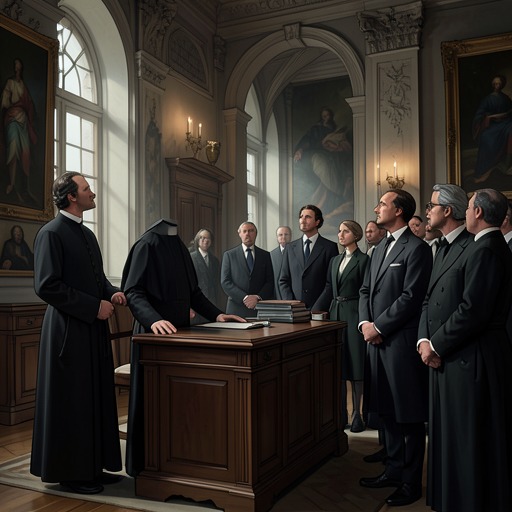
Thomas Cranmer, Archbishop of Canterbury
Wolf HallThomas Cranmer, Archbishop of Canterbury, is both an architect of the break with Roman jurisdiction and a conscientious churchman caught in the human costs of royal policy. His appointment gives the king a means to decide the marriage case in English courts; his private marriage to Margarete exposes him to danger under the same political and religious order he serves. Through his alliance with Thomas Cromwell and his treatment of John Frith, the novel presents Cranmer as a reformer whose institutional power does not remove his moral unease.
Identity and Background
Cranmer enters the political story as a scholar and diplomat serving Henry VIII. He is sent as the king’s ambassador to the Emperor, and on his travels visits scholars in Germany to gather support for the king’s effort to annul his marriage to Katherine of Aragon. His letters from the Low Countries and the Rhine reveal both the practical difficulty of diplomacy and his hope that the Emperor might reach an accommodation with Lutheran princes, whose support he needs against the Turks. He is less at ease with the customary exchange of promises and English gold than the demands of the mission require.
His temperament contrasts with the court’s appetite for display. He prefers books and long stretches of quiet work, and Thomas Cromwell recalls him as a man who might spend six hours bent over his studies. When the possibility of the archbishopric arises, Cromwell predicts that Cranmer will accept it as a duty, despite disliking its pomp. His reluctance is not refusal: the novel makes public office a burden he takes up because he believes it must be carried.
Diplomatic Mission and Appointment
While Cranmer is abroad, Cromwell notices his absence in the gardens and remembers their earlier joking conversation about what to do if the king has a dream. The recollection conveys the closeness of their working partnership: Cromwell expects to manage political improvisation himself, but Cranmer’s counsel and steadiness are missed. Cranmer eventually sends a letter from Nuremberg about the work of the Holy Spirit in the heart. A note in his own handwriting warns that something has happened, cannot safely be entrusted to a letter, and requires Cromwell’s advice. The secret is his marriage, which he has not yet disclosed.
Cranmer returns to England and becomes Archbishop of Canterbury as the king’s marriage crisis reaches a decisive stage. His appointment is politically consequential because, once the new settlement is in place, he can judge the king’s cause in English courts rather than leave it to Rome. The transition is not yet complete: the king still needs papal bulls to install the new archbishop and must borrow money to meet the costs. Cromwell arranges the loan from a wealthy Genoese merchant, using an engraving as part of his persuasion. Cranmer’s elevation thus depends on a temporary accommodation with Roman procedures even as the government prepares to end its dependence on them.
Reform, Law, and the Marriage Case
Cranmer participates in the legal and theological work that recasts Henry’s marital dispute as a matter for domestic judgment. He sits on committees at Westminster and writes for the king on the claim that Henry’s earlier marriage to Katherine was invalid. The argument considers whether the marriage had been consummated and whether the couple’s intention to marry created affinity even if it had not. The committee’s effort to construct legally useful circumstances shows the intimate and speculative reasoning required to make the king’s case; Cranmer’s formal language for Katherine contrasts with the bodily and personal implications of the questions being examined.
His public authority grows alongside the subordination of the clergy to the Crown. When the bishops submit to the king, they agree not to make church legislation without royal licence and to have existing laws reviewed by a commission that includes laymen and royal appointees. They also accept that Convocation cannot meet without the king’s permission. Cranmer’s place in the new settlement is therefore more than ceremonial: he is an archbishop in a church whose lawmaking and jurisdiction are being brought under royal control.
The policy has a human cost that Cranmer cannot simply resolve through office. He examines John Frith at Croydon and speaks with him privately three times. Cranmer considers Frith worthy and gentle, and regrets that he cannot turn him from his convictions. He must nevertheless hand him over to William Stokesley because Frith was apprehended in that bishop’s diocese. Cranmer says he had not imagined that one of his first acts in the new dignity would be to oppose a young man like Frith. His distress does not alter the decision, but it exposes the gap between personal sympathy and the coercive demands of the institution.
Margarete and Private Risk
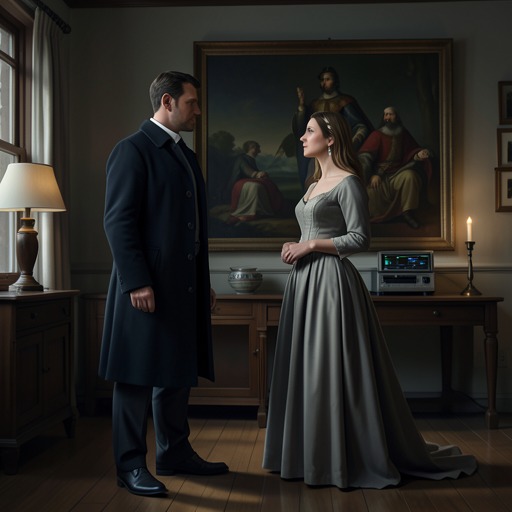
Cranmer’s return brings the secret of his letter into the open. At his lodging during Anne Boleyn’s coronation celebrations, Cromwell finds a young woman reading a tract by Martin Luther. Cranmer identifies her as Margarete, his wife, whom he met in Germany. He had kept her in the country but allowed her to come into the city to see the celebrations. The danger is immediate: a married archbishop could be punished by the king, and Margarete’s presence places Cranmer’s private life inside the religious conflict his office is meant to manage.
Cranmer asks Cromwell for help, calling him his chief friend in the world. Cromwell agrees to keep Margarete’s identity secret and recognizes that she is pregnant. Her pregnancy makes the concealed marriage a living fact, not merely a private commitment that can be hidden indefinitely. Margarete presses Cromwell’s hand to her belly, and he responds by saying Cranmer needs a woman to stay with her. The scene recalls his own experience of loss and turns political protection into a personal act of friendship and care.
The episode also clarifies the cost of Cranmer’s position. His marriage is not presented as a public challenge or a scheme for advancement; it is a relationship he has kept concealed because the rules of the English church make it dangerous. He has gained the highest ecclesiastical office while carrying a secret that could undermine his standing. Cromwell’s protection temporarily shields the family, but the evidence does not resolve what will happen to Margarete or their child.
Political Judgment and Narrative Significance
Cranmer’s conduct during the inquiry into Elizabeth Barton further reveals his preference for legal restraint. When Richard Riche urges that Barton be burned for treason, Cranmer distinguishes her claims from proof of heresy and notes that she has expressed an intention but taken no overt action. He does not endorse her prophecies; he insists that dislike of her words is not itself evidence sufficient to convict her under the category being proposed. The exchange places him between political urgency and the standards of lawful judgment, even as others argue for broader use of words as treason.
His relationship with Cromwell is built on trust, frankness, and a shared reforming project, but it is not uncomplicated. Cromwell can help advance Cranmer’s appointment and protect his wife, yet he also presses him to carry out decisions Cranmer finds painful, including the surrender of Frith. In the oath discussions concerning Thomas More, Cranmer seeks a compromise: he proposes that More might swear privately, or be asked what oath he could take. Cromwell and Thomas Audley reject the suggestion as insufficient for the king’s purpose. Cranmer’s attempt to preserve a path between conscience and compliance cannot settle the conflict.
As the story develops, Cranmer embodies the new church’s contradiction: its independence from Rome is advanced through royal authority, yet that authority can demand actions at odds with personal sympathy and religious conscience. He accepts the archbishopric as duty, writes the arguments that bring the king’s cause into English courts, and serves within a clergy increasingly governed by the Crown. At the same time, his marriage, his appeal for Frith, and his efforts to temper proceedings against Barton keep visible the private loyalties and moral limits that official power cannot erase.