Tyndale’s English Bible translation
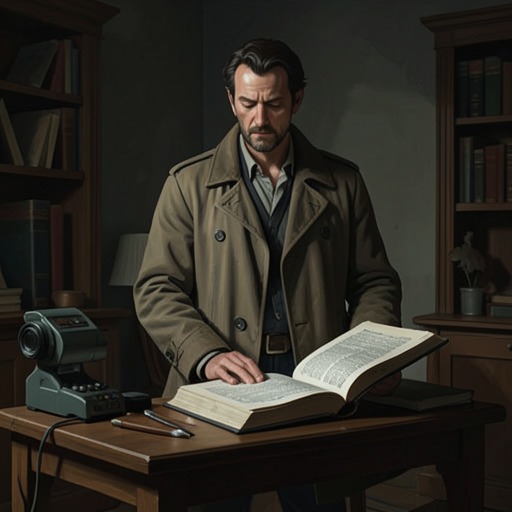
Wolf HallTyndale’s English Bible translation carries the novel’s religious conflict into the material world: it is printed, smuggled, hidden, read, and used as evidence. Its appearance in a chest at Austin Friars and in a London merchant’s warehouse links the appeal of scripture in the mother tongue to the risks faced by those who possess it, while negotiations over its possible authorization reveal the political limits on reform.
A forbidden text in circulation
Thomas Cromwell keeps an Antwerp edition of William Tyndale’s Testament in a chest. It is a pirated octavo printed on cheap paper, with the false imprint “PRINTED IN UTOPIA” where the printer’s address should be. The concealment of the place of printing is part of the book’s meaning: the text crosses borders through uncertain channels, arriving in England despite efforts to control what may be read there.
Cromwell follows writings brought through the Channel ports and East Anglian inlets, and keeps Cardinal Wolsey informed. When opponents of heresy approach Wolsey, he can answer that he is already informed; the cardinal will burn books, though not people. That distinction does not make the translation safe. The English-language books are subject to official suppression, and the novel sets their fragile printed pages against the institutional power to seize and destroy them.
The clandestine book also represents a reading community. Cromwell knows Tyndale and the history of his lodging with Humphrey Monmouth in London, and observes that affection and solidarity have grown among those who read German. More’s attack on vernacular translations is therefore not simply a dispute about wording: it is also a struggle over who may read scripture, who may interpret it, and whether readers can form connections beyond clerical oversight.
More’s challenge and the authority to interpret
In spring 1528, Thomas More questions Cromwell about a possible journey to Frankfurt and the circulation of so-called translations in Antwerp. He describes them as malicious and misleading and considers pursuing their makers for sedition, with extradition as a possible means of bringing them before English jurisdiction. Cromwell asks whether More has actually found sedition in Tyndale’s writing. More admits that he has studied it, but says he did so under licence from his bishop.
Their exchange makes reading itself a contested act. More argues that examining a text does not make the examiner guilty of its contents, comparing the question to whether a priest becomes wanton by hearing a wanton confession. Cromwell turns the argument back on him through a biblical allusion: “he that toucheth pitch shall be defiled.” The translation’s challenge thus reaches beyond a particular doctrine. It tests the authority to judge a text and the distinction between studying forbidden writing and endorsing it.
Cromwell’s own doubts are sharpened by the question of what scripture explicitly contains. He asks where the Bible names purgatory, relics, monks, nuns, or the Pope. When his daughters die, the teaching about purgatory becomes personal: the doctrine places them in a state that he cannot locate in the Gospels, while Tyndale’s version of Paul’s words gives him the phrase “Love never falleth away.” More insists on “charity” instead of “love” and regards Tyndale’s rendering as wicked. The disagreement over a single word carries the deeper conflict between inherited ecclesiastical interpretation and the authority claimed for the translated text.
Possession, search, and protection
The translation’s risks become concrete in Lucy Petyt’s account of a search at Lion’s Quay. During the raid, she distracts More at the door while her husband, John Petyt, hides papers behind a panel. A Testament remains beneath his desk, but the searchers fail to find it. More nevertheless orders John into custody, and he is held in the Tower under harsh conditions. Lucy’s story shows how possession of the books can expose an entire household to scrutiny and punishment, even when a search does not produce the text.
Cromwell offers Lucy help with the practical costs of imprisonment, including money for bribes to gaolers. He also considers appealing to the king or Anne Boleyn, but neither route produces a clear protection for Petyt. Anne says that she herself has put Tyndale’s books into the king’s hands. The translation has reached the royal court, yet royal attention does not amount to permission for the public to read it.
Cromwell and Stephen Vaughan attempt to negotiate Tyndale’s return to England. At a meeting arranged outside Antwerp, Tyndale says he wants to come home and would accept the king’s choice of translator if Henry would permit scripture in the mother tongue; he says he would cease writing and submit to whatever the king decided. Henry has not expressly refused, but neither has he authorized the translation. As summer arrives, Cromwell withdraws from the effort: Henry is too hesitant, Tyndale too unwilling to compromise, and Tyndale will not support Henry’s divorce. The negotiation exposes the tension between a conditional royal promise and a translator’s principles.
From private text to public jurisdiction
The controversy persists in the treatment of other reformers. At the Tower, Cromwell visits John Frith, who is kept above ground with warm bedding, food, wine, paper, and ink. Frith is a scholar of Greek and had previously been confined with other Bible readers in the cellar at Wolsey’s college. His imprisonment connects the handling of vernacular scripture to the broader suppression of reformers, even as Cromwell tries to offer him humane conditions and asks whether he might soften his answers before the king.
By 1534 the dispute over scriptural and ecclesiastical authority has become a question of the realm’s jurisdiction. Cromwell presents Henry with propositions from Marsiglio of Padua: Christ did not make popes or authorize churchmen to levy taxes, and the prince’s authority is exercised through a legislative body. In that account, Parliament can determine temporal matters such as marriage and legitimacy, while the church’s claims to independent power are subject to challenge. The translation is part of a wider crisis in which the question of who may interpret scripture sits beside the question of who may make law.
That boundary appears sharply in Richard Riche’s report of a conversation with Thomas More. More accepts that Parliament might make Riche king, a temporal act, but denies that Parliament can make God cease to be God or determine spiritual jurisdiction outside the realm. Cromwell treats this distinction as politically consequential: a refusal to recognize Parliament’s capacity in spiritual matters may be construed as a denial of the king’s title. In this setting, vernacular scripture is not merely a book to be read or banned. Its circulation presses on the boundary between religious conscience, ecclesiastical authority, and the state’s claim to govern belief.