Westminster
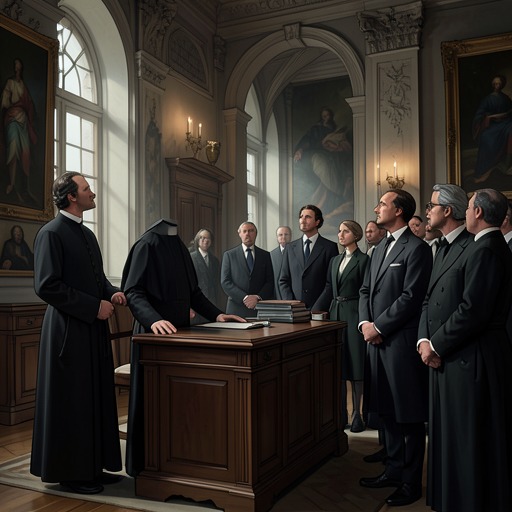
Wolf HallWestminster is the seat of government where Thomas Cromwell’s political work takes institutional form. It is both a place of negotiation and a machinery for making decisions binding: parliamentary bills, oaths, royal instructions, financial oversight, and the management of the king’s household converge there. As Henry VIII’s power over the English Church is asserted, Westminster becomes the setting in which competing authorities—king, Parliament, church, and Rome—are tested against one another, and where their abstract claims acquire practical consequences for particular people.
Government and political access
In the winter of 1529–spring 1530, Cromwell’s return to political life is tied to a seat in the Commons. He has sent Rafe Sadler to find a place for him in the new Parliament, and Rafe secures Taunton, a constituency on Thomas Wolsey’s political terrain. The arrangement depends on approval from both Henry VIII and Thomas Howard, Duke of Norfolk. Westminster is thus not simply a destination for a politician: entry into its business depends on patronage and on navigating the uncertain intentions of powerful men. Rafe’s inquiry also reveals Norfolk’s interest in the treasure he supposes Wolsey has hidden, and his expectation that Cromwell knows where it is.
Cromwell’s place at Westminster is precarious because he remains committed to Wolsey even as the cardinal’s power collapses. He fears that if he is absent, Wolsey’s opponents will speak against him without answer. When Parliament is prorogued, Cromwell still cannot leave freely: Henry or Anne Boleyn may require him, while his presence may be needed to defend his former master. In a letter, he assures Wolsey that although he is not physically with him, he remains with him in heart, spirit, prayer, and service. Wolsey calls him a trusted refuge in his calamity and his entirely beloved Cromwell. Their correspondence makes Westminster the distant center of Cromwell’s divided service: he must serve the king there while sustaining his bond with the fallen cardinal.
Parliament as a workshop of law
By spring 1532, Westminster is where the king’s campaign to reduce the Church’s independent jurisdiction is translated into legislative work. Parliament considers measures that would restrain revenues going to Rome and give practical force to Henry’s claim to supremacy in the Church. The Commons drafts a petition against church courts, challenging both the arbitrariness of their proceedings and the extent of their jurisdiction. Cromwell works through the papers overnight with Rafe and Stephen Wriothesley, making amendments and identifying opposition. Stephen Gardiner, though the king’s Secretary, is drawn into leading the prelates against the measures. The proceedings show that policy is not made by royal declaration alone: it must be drafted, argued over, and carried through institutions.
Cromwell also uses parliamentary procedure to make political allegiances visible. When he brings forward a bill to suspend the payment of annates to Rome, he proposes a division of the House, an unusual procedure that forces members to take sides. Henry attends and observes who supports the bill and who opposes it, then gives Cromwell an approving nod. In the Lords, the same tactic is not enough; Henry must appear in person three times to argue his case. The contrast exposes Westminster’s different centers of power: the Commons can be made to declare its divisions, but the older aristocracy in the Lords remains a formidable body, with families such as the Exeters supporting the Pope and Katherine of Aragon. Cromwell uses the process not only to advance legislation but also to identify and divide his opponents.
The petition against the church courts leads into a still broader contest over whether clergy are fully subject to the king. Henry summons Gardiner and demands to know whether the clergy are his subjects or only partly so, given their oath to support the Pope. After the confrontation, Cromwell arranges assistance for the shaken bishop. His response reflects his view of politics as more than the defeat of adversaries: the debate must be won, not merely its opponents humiliated. At Westminster, personal management and parliamentary argument proceed together, as Cromwell tests the limits of royal authority while keeping potentially useful figures within reach.
Royal sovereignty and rival jurisdictions
The dispute at Westminster is also a conflict among different accounts of law. During an audience with Katherine of Aragon and Mary Tudor, Cromwell is confronted with their objection to the new legislation and to the demand that the clergy pay a large sum under the Praemunire laws. Katherine calls the demand extortion rather than a benevolence. She distinguishes opposition to Wolsey’s personal power from loyalty to the Church, and challenges the political alliance that would make Henry head of the Church in England. Mary insists that the Pope’s authority underpins the lawfulness of government. Cromwell answers that Henry cannot simply be led, while Katherine suggests that he can be enticed. Their exchange exposes Westminster’s legislation as a direct challenge to the authority the queen and princess believe lies beyond the realm.
Cromwell seeks a legal argument capable of turning that challenge into a domestic settlement. In 1534, he presents Henry with propositions from Marsiglio of Padua, arguing that Christ did not appoint the Pope to rule, tax, or legislate, and that priests remain subjects rather than an independent governing power. In this account, secular authority belongs to the prince, while kingship derives through a legislative body acting for the people. Parliament becomes the means by which royal power is defined and exercised. Cromwell also argues that church property and offices belong to secular governance and that the legislature may provide for clergy while using church wealth for the public good. Henry responds by raising the possibility of breaking shrines. Westminster’s political argument therefore reaches beyond jurisdiction to the disposition of religious property and the institutional resources of the Church.
The scene with Mary and Katherine gives a human shape to the conflict between legal systems. When Mary begins to falter during the hot audience, Cromwell places a stool by her mother and helps her sit, while explaining that the king’s supremacy is qualified by the words “as far as the law of Christ allows.” Mary observes that a definition might later be redefined; Katherine likewise sees room for negotiation, but refuses to surrender her standing as queen and wife. Cromwell insists that nothing is irrevocable, while Katherine warns that Henry’s policy may leave her outside the Church’s protection. Westminster’s laws are therefore presented neither as neutral formulas nor as complete solutions: their force depends on what authority people recognize and how far that authority can be enforced.
Administration, finance, and enforcement
Westminster is also the center of work that makes government legible and operational. The king provides Cromwell with lodgings in the old palace so he can remain at work when it is too late to return to Austin Friars. Cromwell spends much of his time at the Tower, overseeing work through difficult weather, checking the paymaster’s accounts, and making a new inventory of the king’s jewels and plate. He visits the Wardens of the Mint and proposes spot checks on the weight of the coinage, aiming to make English coins reliable enough that overseas merchants will not need to weigh them. He also prepares a concise memorandum tracing the king’s yearly revenues and the offices through which they pass. Henry reads it repeatedly, recognizing the value of an account that makes the flow of government income clear.
The legislative program depends on the same administrative principle: rules must reach beyond Westminster if they are to change the realm. Cromwell writes an oath intended to secure allegiance to the succession of Anne Boleyn’s child. He plans to have people swear it in towns and villages, including women with property and widows with inheritances. The undertaking makes the distance between drafting a law and establishing its authority plain. Westminster can formulate the oath, but commissioners must carry it through the country, where people may have only a vague understanding of the succession or even of which Henry is king. The oath is an instrument of government, yet its effect rests on the ability to make distant communities recognize and perform its terms.
Conscience, silence, and the limits of procedure
The struggles over succession bring Westminster into direct contact with the limits of political compliance. Thomas More is asked to swear to the Act of Succession. He says he cannot swear, but will not speak against the oath or dissuade others from taking it. Thomas Audley answers that this is not enough. Cranmer proposes a possible compromise—an oath taken secretly, or an alternative oath—but Audley doubts that either would meet the king’s purpose. More’s position reveals a fault line that legislation cannot simply erase: silence may preserve a measure of outward obedience, but it does not supply the public assent the government demands.
At More’s trial in Westminster Hall, parliamentary and royal authority collide with his claim that Parliament cannot determine spiritual jurisdiction. Richard Riche recounts a hypothetical exchange in which More accepts Parliament’s power to make a king but denies that it can make God or govern the Church’s spiritual jurisdiction. Cromwell considers how the testimony might support a charge of treason, while recognizing the difficulty of proving malicious intent. The trial turns words spoken in conversation into potential evidence against a prisoner. Westminster’s legal machinery can hear, interpret, and punish speech, but the dispute remains over what the words mean and which jurisdiction has the authority to decide.
The setting’s significance is sharpened by the contrast between its administrative routines and their human cost. Cromwell can arrange better conditions for John Frith in the Tower, oversee accounts, and help make laws; he also participates in the political order that imprisons religious dissenters and tries More. On the day More is brought to Westminster Hall, the court is visibly affected by his appearance after imprisonment, even as the officials proceed with the case. Westminster is thus not merely the backdrop to the Reformation’s institutional change. It is where policy becomes procedure, procedure becomes personal consequence, and the competing claims of royal, parliamentary, ecclesiastical, and spiritual authority are forced into the same room.