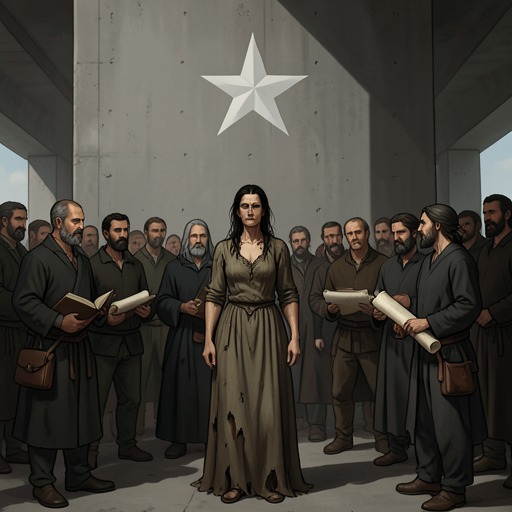
William Warham
Wolf HallWilliam Warham, Archbishop of Canterbury, stands at the edge of the political and religious transformation taking place under Henry VIII: an elderly churchman whose loyalty to the king has become inseparable from his unease at the king’s demands. His final public act is to obtain Harry Percy’s oath clearing Anne Boleyn’s path, but he leaves that council meeting declaring that he has done the last thing he will do for Henry. His death soon afterward gives that withdrawal a finality the court’s shifting alliances cannot soften.
Position and Political Setting
Warham appears in the novel as an established archbishop within a court increasingly intent on bringing church authority under royal control. Henry’s advisers pursue measures against the clergy under the law of praemunire, while Parliament debates the boundaries of ecclesiastical jurisdiction and the king’s authority. Warham belongs to the senior church hierarchy at the moment when its status and jurisdiction are being challenged, but the evidence does not present him as the architect of a counter-program. His position is instead conveyed through his dealings with the king’s government and through the limits he eventually places on his own service.
His name also carries the memory of earlier religious prosecutions. Hugh Latimer, recently released from custody at Lambeth Palace, recalls making a speech to Warham and says the archbishop sent him away with a warning. The recollection links Warham with the enforcement of religious discipline, even as Latimer speculates that the old man may have lost his appetite for burnings. It is a reported judgment, not a settled account of Warham’s private convictions; the scene places him within the institutions that punish reformers while leaving his inner position uncertain.
The Percy Oath and Anne Boleyn
At a meeting of the king’s council, Warham is already visibly frail. His hands and head tremble, and his slow entrance makes his failing health impossible to ignore. Thomas Cromwell nevertheless confronts him with a political and religious question: whether he knows that Elizabeth Barton’s followers say Henry will die within a year if he marries Anne. Warham does not claim to have heard the prophecy himself. He says that his commission found nothing against Barton, acknowledges that Bishop Fisher may have visited her, and describes her as a simple country girl who may be unwise or misled, but who has a gift for discerning the troubles and sins of those who come to her.
The council’s business then turns to Harry Percy, whose earlier statements about Anne’s marriage have become an obstacle to the king’s plans. In the king’s presence, Thomas Audley leads Percy through denials that he had a pre-contract with Anne, made binding promises, or had sexual relations with her. Henry requires more than Percy’s word of honour. Warham, holding out a Bible, asks him to swear before the king and council that he is free from both unlawful relations and any marriage contract. Percy’s hand and voice shake as he takes the oath. The Duke of Norfolk calls the matter finished, and Henry orders that Percy no longer be troubled.
The oath is not a private resolution between two men: it is performed before the king, his council, and the archbishop, and the king directs that it be sealed with Holy Communion. Warham’s participation clears a public obstacle to Anne’s advancement. Yet the act’s political usefulness does not make his subsequent words a simple endorsement of the royal course. The sequence instead places his last service to Henry beside an explicit statement that service has violated his conscience.
Loyalty and Conscience
After Percy has sworn, Henry turns to Warham and asks that some councillors assist him, recognizing that the archbishop is unwell. Warham then tells the king that he has watched him promote people whose principles and morals can scarcely bear scrutiny, and that Henry has made a god of his own will and appetite, to the sorrow and scandal of Christians. He says he has remained loyal even to the point of violating his own conscience, and announces that he has now done the last thing he will ever do for the king.
The declaration gives Warham’s loyalty a defined endpoint. He does not undo the oath he has just administered, nor does the episode show him launching a public opposition to Henry. Instead, he completes the requested act and then names its moral cost. The tension is sharp: the archbishop’s office lends solemn authority to a measure serving the royal marriage, while his farewell insists that obedience has reached a boundary. His withdrawal is personal, but it occurs amid a wider contest over whether ecclesiastical decisions and Christian duty remain answerable to Rome or are to be determined within the king’s realm.
Death and Narrative Significance
Warham dies at Canterbury. The narrative shows his body laid on a slab, with coins placed on his eyelids, as he waits for burial beneath the cathedral pavement near the bones of Thomas Becket. The detail of the coins recalls the king whose service he has just renounced: even in death, the image of Henry remains part of the scene surrounding him. The passage does not present the burial as a public verdict on the conflict, but it closes Warham’s personal story at the center of the religious institution whose authority is under pressure.
Warham’s role is brief but consequential because he connects institutional continuity with an increasingly unsettled royal order. His earlier dealings with Latimer and Barton show an archbishop positioned within the structures of religious discipline; his intervention in Percy’s oath shows him still acting within the king’s council; and his final speech marks the point at which continued loyalty becomes, in his own account, intolerable. The progression—from warning and inquiry, to an oath before the king, to a declared farewell and burial at Canterbury—makes him a measure of the distance between serving the monarch and preserving conscience.