Cherokee
The Cherokee appear in Toni Morrison's Beloved as a people who, though decimated by disease and forced removal, extend crucial aid to Paul D at the lowest point of his flight from the chain gang in Alfred, Georgia. Their intervention—sheltering the escaped prisoners, freeing them from their chains, and directing Paul D northward by the sign of the tree flowers—constitutes a pivotal turn in his journey from bondage toward the free North. In a novel saturated with the ghosts of slavery's dead, the Cherokee stand as a living, if battered, community whose own history of displacement and survival resonates with the experiences of the formerly enslaved characters who cross their path.
The Cherokee Encampment and the Fugitives
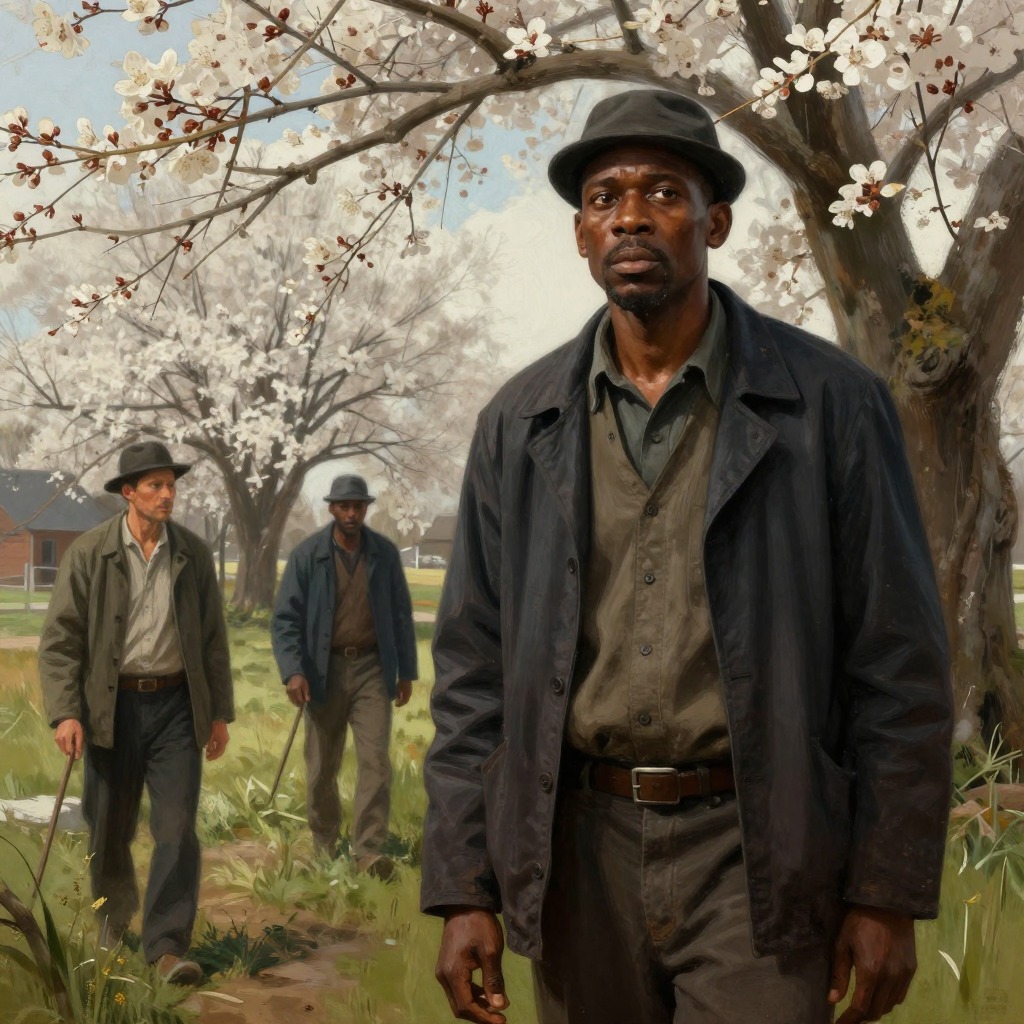
After the catastrophic flood that forced the forty-six prisoners of Alfred, Georgia, to escape their underground boxes, Paul D and his fellow convicts stumbled upon a camp of sick Cherokee "for whom a rose was named." These Cherokee were among those who had chosen a fugitive life rather than removal to Oklahoma, and they were suffering from an illness reminiscent of the one that had killed half their number two hundred years earlier. Despite their own devastation, they protected each other as best they could, sending the healthy some miles away while the sick stayed behind with the dead. When the escaped prisoners sat down in a semicircle near the encampment, no one came at first, but at dawn two men with barnacles covering their beautiful skin approached them. Hi Man raised his hand, and the Cherokee, seeing the chains, went away and returned each carrying a handful of small axes, with two children following behind with a pot of mush cooling and thinning in the rain.
The Buffalo Men and the Breaking of Chains
The Cherokee called the escaped prisoners "Buffalo men" and talked slowly to them as they scooped mush and tapped away at their chains. The prisoners, who had no care for the illness the Cherokee warned them about, stayed, all forty-six, resting and planning their next move. Paul D, who had no idea what to do and knew less than anybody, listened to his co-convicts talk knowledgeably of rivers and states, towns and territories, and heard the Cherokee men describe the beginning of the world and its end. He also listened to tales of other Buffalo men they knew, three of whom were in the healthy camp a few miles away. Weeks later, Paul D was the only Buffalo man left, without a plan, all he could think of being tracking dogs, although Hi Man said the rain they left in gave that no chance of success.
The Guidance of the Tree Flowers
Alone, the last man with buffalo hair among the ailing Cherokee, Paul D finally woke up and, admitting his ignorance, asked how he might get North—the free North, the magical North, the welcoming, benevolent North. The Cherokee smiled and looked around at the flood rains of a month ago, which had turned everything to steam and blossoms. "That way," he said, pointing. "Follow the tree flowers," he said. "Only the tree flowers. As they go, you go. You will be where you want to be when they are gone." So Paul D raced from dogwood to blossoming peach, and when they thinned out he headed for the cherry blossoms, then magnolia, chinaberry, pecan, walnut and prickly pear, until at last he reached a field of apple trees whose flowers were just becoming tiny knots of fruit. Spring sauntered north, but he had to run like hell to keep it as his traveling companion, from February to July on the lookout for blossoms, climbing a tree on a hillock to scan the horizon for a flash of pink or white in the leaf world that surrounded him. He did not touch them or stop to smell; he merely followed in their wake, a dark ragged figure guided by the blossoming plums. The apple field turned out to be Delaware, where the weaver lady lived and snapped him up as soon as he finished the sausage she fed him.
Historical Context and Thematic Resonance
The Cherokee's history, as recounted in the novel, is one of repeated catastrophe and stubborn endurance. They had visited George III in London, published a newspaper, made baskets, led Oglethorpe through forests, helped Andrew Jackson fight Creek, cooked maize, drawn up a constitution, petitioned the King of Spain, been experimented on by Dartmouth, established asylums, wrote their language, resisted settlers, shot bear and translated scripture—all to no avail. The forced move to the Arkansas River, insisted upon by the same president they fought for against the Creek, destroyed another quarter of their already shattered number. That was it, they thought, and removed themselves from those Cherokee who signed the treaty, in order to retire into the forest and await the end of the world. Their presence in the novel thus serves as a powerful counterpoint to the experiences of the enslaved and formerly enslaved: a people who, like them, have been dispossessed, decimated, and driven from their land, yet who retain the knowledge and the will to offer aid to other fugitives. The Cherokee's guidance of Paul D by the natural sign of the tree flowers also connects to the novel's broader use of nature—the sycamores of Sweet Home, the chokecherry tree on Sethe's back, the boxwood bushes of Denver's emerald closet—as a source of both beauty and meaning in a world otherwise defined by human cruelty.