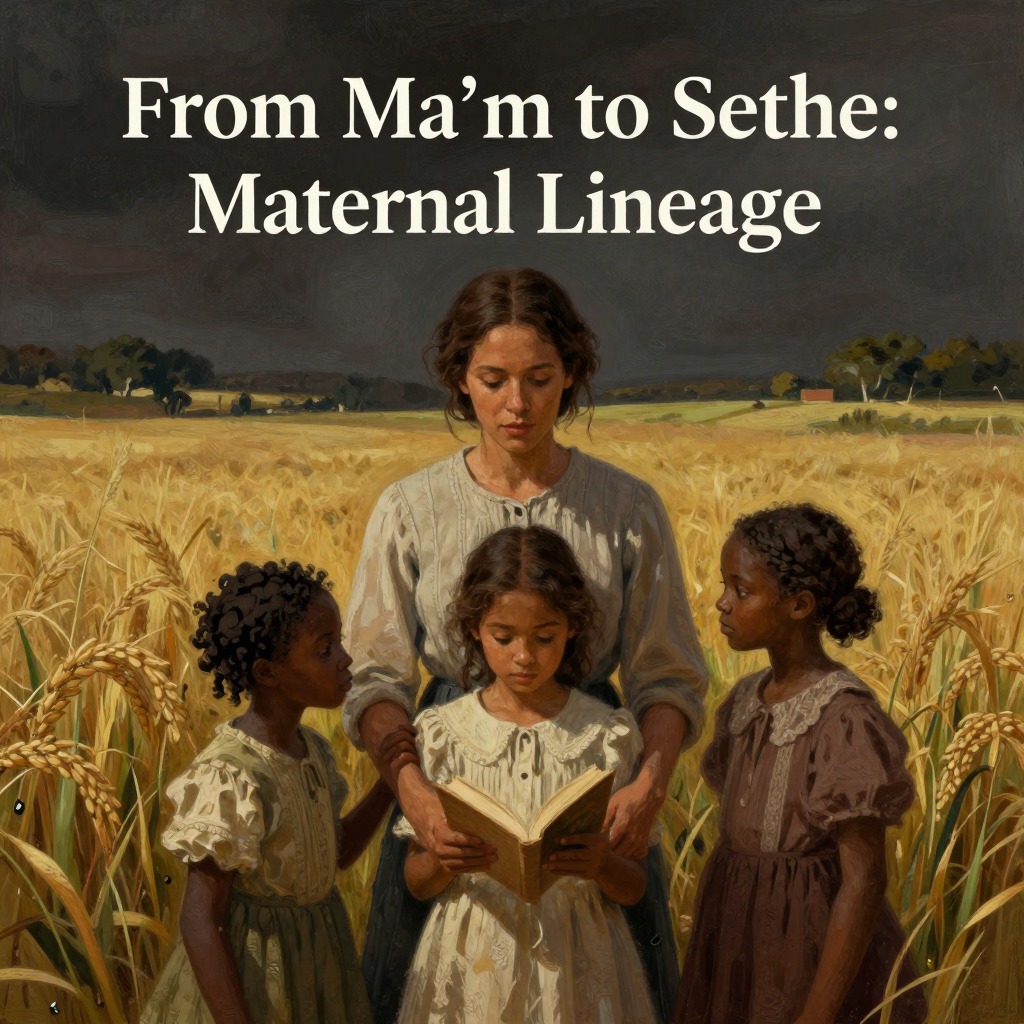
Nan
Nan is a minor but pivotal figure in Sethe's childhood memories, appearing in the novel as the woman who cared for her and who, in a moment of intimate revelation, passed on the story of Sethe's mother. She is remembered as having "one good arm and half of another," a physical marker of the brutal conditions of slavery that also made her a distinctive presence in Sethe's early life. Nan was the one who was "around all day," nursing babies, cooking, and providing the constant, if unremarkable, care that shaped Sethe's earliest years. Her role as a surrogate mother figure is underscored by the fact that Sethe's own mother was often absent, working in the rice fields, and that Sethe was nursed by another woman whose job it was to do so.
The Revelation of Sethe's Mother's Story
The most significant moment involving Nan occurs in a memory that surfaces when Sethe is folding laundry, triggered by Beloved's question about whether her mother ever fixed her hair. Sethe recalls Nan holding her with her good arm and waving the stump of the other in the air, speaking in a language that Sethe understood then but can no longer recall or repeat. Nan's message, which Sethe had forgotten along with the language, was that Sethe's mother and Nan had been together "from the sea," both taken up many times by the crew of the slave ship. Nan told Sethe that her mother "threw them all away but you"—that she discarded the children fathered by the crew and by other white men, giving them no names, but that she kept Sethe, giving her the name of the black man, her father, and putting her arms around him. This revelation is crucial because it establishes Sethe's mother as a woman who actively rejected the products of rape and violence, choosing instead to claim the child born of a relationship with a black man. It also explains Sethe's own fierce determination to protect her children from the dehumanizing forces of slavery, as she inherited a legacy of resistance and maternal choice.
Nan's Role in Sethe's Childhood
Nan's presence in Sethe's early life was a counterpoint to the absence of Sethe's mother. Sethe remembers that her mother was pointed out to her by an eight-year-old child who watched over the young ones, and that she saw her only a few times in the fields, once when she was working indigo. Her mother slept like a stick on Sundays and did not even sleep in the same cabin most nights. In contrast, Nan was a constant figure, and it was Nan who snatched Sethe away from the pile of bodies when Sethe tried to see the mark on her mother's body after her mother was hanged. This act of protection, though brief, was formative, and it is Nan who becomes the conduit for the story of Sethe's mother's love and sacrifice.
The Significance of Nan's Revelation
The story Nan tells is not just a piece of family history; it is a foundational narrative for Sethe's sense of self. Sethe's mother's act of keeping Sethe, of giving her a name and a lineage, stands in stark contrast to the dehumanizing practices of slavery, where children were often separated from their mothers and where paternity was a matter of property, not love. Nan's revelation also connects to the novel's broader themes of memory, identity, and the transmission of trauma and love across generations. Sethe's recollection of Nan's words, even though she has forgotten the language, shows how deeply these truths are embedded in her psyche, shaping her understanding of what it means to be a mother and to claim one's children. In this way, Nan, though a minor character, serves as a crucial link in the chain of maternal legacy that defines Sethe's character and her actions throughout the novel.