handsaw
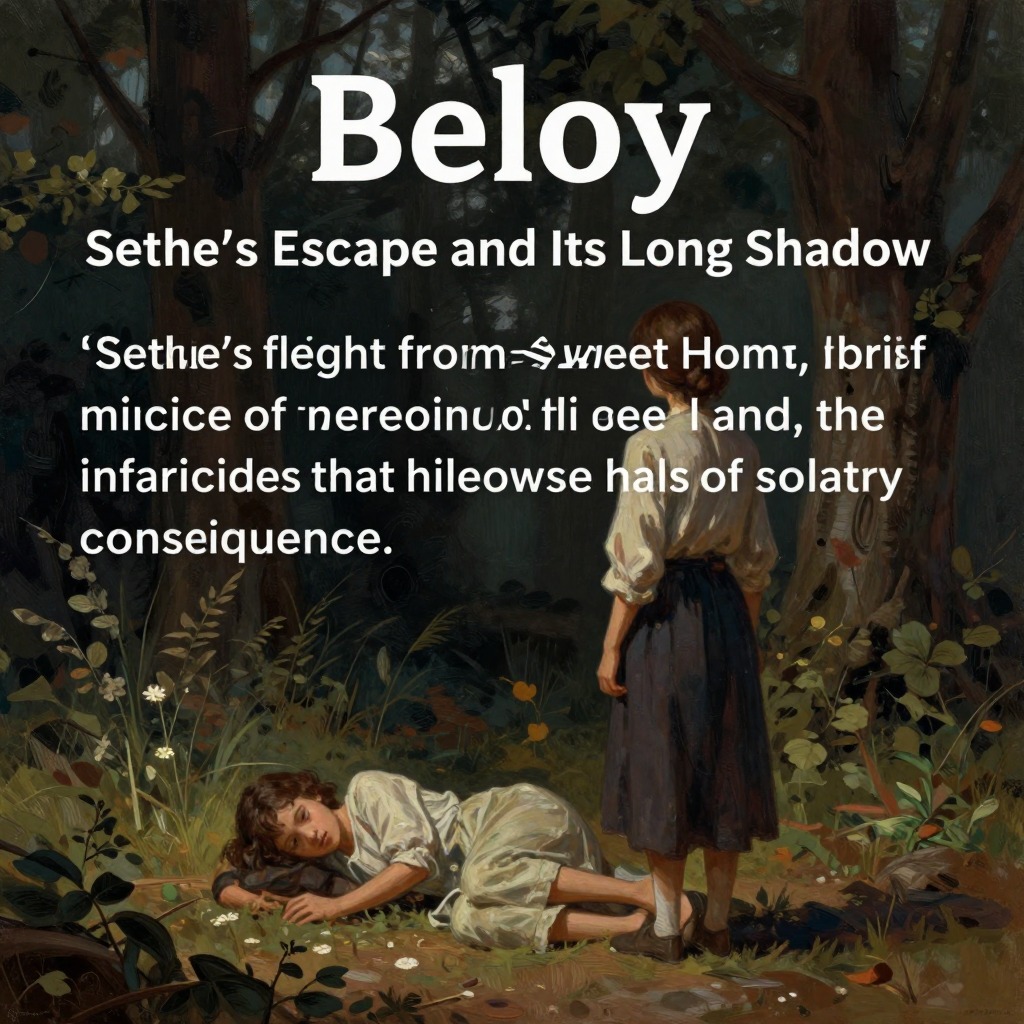
The handsaw is the instrument of Sethe's most terrible act: the killing of her crawling-already? baby daughter in the woodshed of 124 Bluestone Road. It is the physical embodiment of her conviction that death is preferable to the return of her children to slavery under schoolteacher. The saw appears only in memory and retelling, never in the present action of the novel, yet it casts a long shadow over Sethe's life, her relationship with her surviving daughter Denver, and the community's judgment of her. It is the object that transforms Sethe from a woman who 'claimed herself' in freedom into one whom the town regards with a mixture of fear and condemnation, and it is the tool that Paul D, upon learning of it, cannot reconcile with the woman he loves, leading him to accuse her of having 'too thick' a love.
The Act and Its Justification
The handsaw is first invoked in the novel's climactic revelation of Sethe's past, when she explains to Paul D why she killed her child. She describes the moment in the garden when she saw schoolteacher's hat and heard the hummingbirds—'Little hummingbirds stuck their needle beaks right through her headcloth into her hair and beat their wings'—and then 'she just flew.' In that flight, she 'collected every bit of life she had made, all the parts of her that were precious and fine and beautiful, and carried, pushed, dragged them through the veil, out, away, over there where no one could hurt them.' The handsaw is the means of that passage. Sethe's justification is absolute: 'I took and put my babies where they'd be safe.' She tells Paul D, 'It ain't my job to know what's worse. It's my job to know what is and to keep them away from what I know is terrible. I did that.' The saw is thus not an instrument of malice but of a love so fierce it becomes lethal, a love that Sethe believes is the only defense against the 'dirtying' power of white people who could 'take your whole self for anything that came to mind.'
The Memory of the Saw and Its Aftermath
The handsaw's memory is inseparable from the physical and psychological scars it leaves. Sethe recalls the act in visceral detail: 'to drag the teeth of that saw under the little chin; to feel the baby blood pump like oil in her hands; to hold her face so her head would stay on; to squeeze her so she could absorb, still, the death spasms that shot through that adored body, plump and sweet with life.' The saw's teeth become a recurring image of the violence that Sethe both committed and suffered. The memory of the saw also shapes her relationship with Beloved, whom she believes to be her dead daughter returned. In her attempts to explain herself to Beloved, Sethe returns again and again to the saw, trying to make Beloved understand that what she did was an act of love, not cruelty. Yet Beloved's response is to accuse Sethe of leaving her behind, and the saw becomes the emblem of that abandonment. The memory of the saw also haunts Denver, who, as a baby, 'took her mother's milk right along with the blood of her sister.' Denver lives in fear that the 'thing' in her mother that made the saw possible could emerge again, and she watches over the yard to prevent another such act.
The Saw as Symbol and Judgment
The handsaw functions as a powerful symbol of the novel's central themes: the impossible choices forced on enslaved mothers, the nature of maternal love, and the community's moral judgment. When Paul D learns of the act, he is horrified, and his response—'Your love is too thick'—becomes a critique of Sethe's entire philosophy. Sethe's reply, 'Love is or it ain't. Thin love ain't love at all,' encapsulates the novel's exploration of love's limits and excesses. The saw also becomes a marker of Sethe's isolation. The community, which had once celebrated her arrival with a feast, turns against her after the infanticide, and Ella, who had helped Sethe cross the river, later declares, 'I ain't got no friends take a handsaw to their own children.' The saw thus becomes a dividing line between Sethe and the world, a symbol of her pride and her tragedy. In the end, when Sethe lies in Baby Suggs' bed, broken and withdrawn, Paul D returns to offer her a different kind of love, one that does not require the saw. He tells her, 'You your best thing, Sethe. You are,' offering a vision of self-worth that might finally allow her to lay down the sword and shield—and the saw—that have defined her life.