Purchase of the Charm
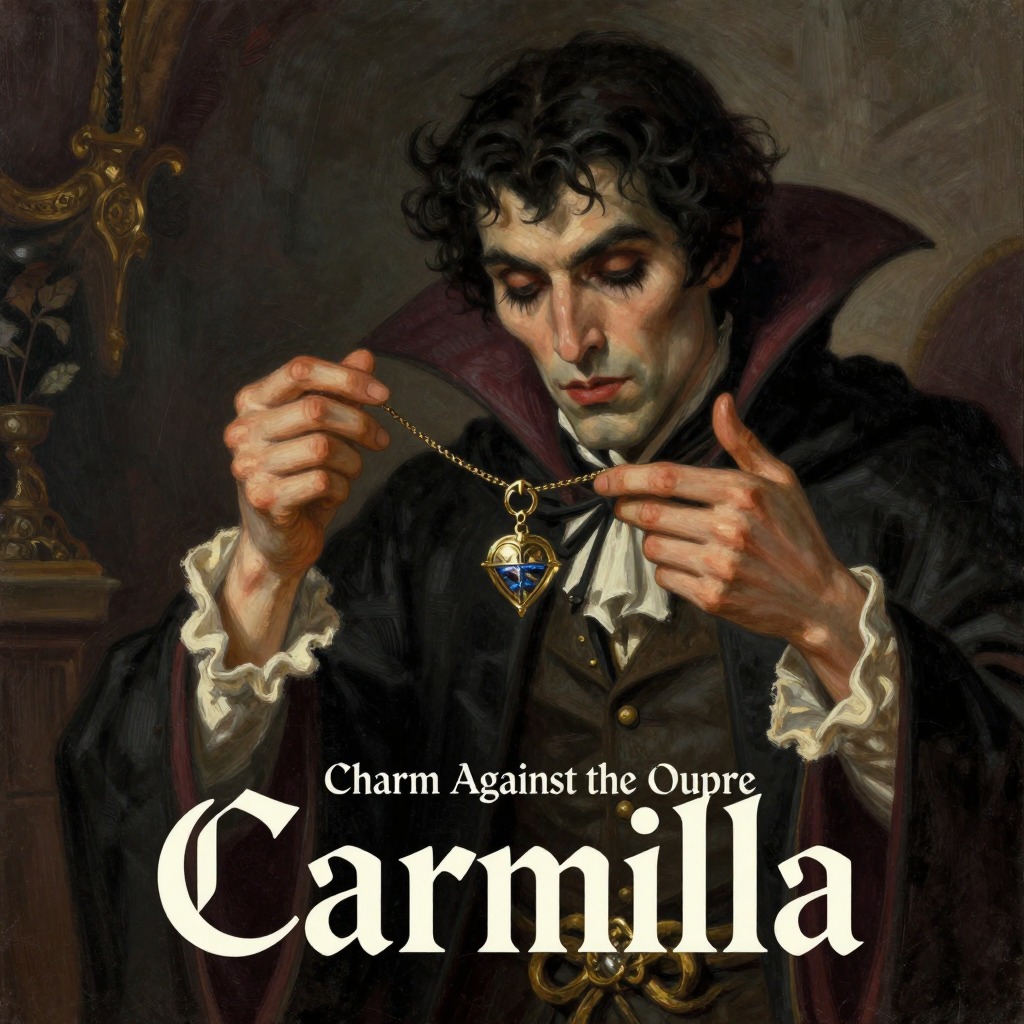
The Purchase of the Charm occurs during a visit to the schloss by a wandering mountebank, a hunchbacked figure laden with curiosities and entertainments. Standing in the courtyard, he offers his wares to Laura and Carmilla, who watch from a window. Among his goods are oblong slips of vellum, inscribed with cabalistic ciphers and diagrams, which he advertises as amulets against the oupire—a vampire-like creature he claims is "going like the wolf" through the surrounding woods. "They are dying of it right and left," he warns, "and here is a charm that never fails; only pinned to the pillow, and you may laugh in his face." Both young women purchase one of these charms, a transaction that momentarily aligns them in a shared, superstitious precaution against the very menace that, unknown to Laura, Carmilla herself embodies.
The Mountebank's Performance and the Charm's Description
The mountebank's arrival is a spectacle in itself. He is described as a hunchback with sharp, lean features, a pointed black beard, and a smile that shows his white fangs. His costume is a motley of buff, black, and scarlet, crossed with numerous straps and belts from which hang a magic lantern, boxes containing a salamander and a mandrake, a fiddle, conjuring apparatus, foils and masks, and a black staff with copper ferrules. His companion is a rough dog that howls dismally at the drawbridge. After scraping a lively tune on his fiddle and dancing with ludicrous airs, he approaches the window and delivers a long, fluent advertisement of his skills, including dentistry. It is during this pitch that he produces the charms: slips of vellum covered in cabalistic ciphers and diagrams, which he claims are infallible protections against the oupire. Carmilla instantly purchases one, and Laura follows suit, a decision that reflects the growing unease in the household about the mysterious deaths in the region.
Carmilla's Reaction and the Charm's Later Use
Carmilla's eagerness to buy the charm is striking, given her earlier dismissive and even hostile attitude toward the local superstitions. When a funeral procession passed earlier, she had called the hymn "discordant" and declared, "I hate funerals." Yet here she is, readily acquiring a folk remedy against the very creature she is. Later, after Laura experiences a terrifying dream of a sooty-black animal that stings her breast like needles, Carmilla reveals that she too had a nightmare of "something black coming round my bed" and that the charm, kept under her pillow, made the figure disappear. Laura, who had left her own charm in a china vase in the drawing room, resolves to pin it to her pillow that night. The charm seems to work: Laura sleeps soundly and dreamlessly for the next two nights, though she wakes with a sense of lassitude and melancholy. Carmilla offers a rationalizing explanation, suggesting the charm has been "fumigated or immersed in some drug" and acts as an antidote against malaria, not against evil spirits. This naturalistic interpretation, however, does not fully account for the charm's apparent efficacy, and the episode leaves the reader questioning whether the protection is real or merely a placebo that masks the vampire's gradual draining of Laura's life.
The Charm's Narrative Significance
The purchase and use of the charm serve multiple narrative functions. It introduces a tangible object of folk belief into the story, grounding the supernatural threat in the material world. The charm's apparent success in warding off nightmares creates a false sense of security for Laura, who continues to weaken even as she sleeps peacefully. This paradox deepens the mystery of her illness and underscores the insidious nature of Carmilla's predation, which operates not through overt terror but through a seductive, languorous drain on vitality. The charm also highlights Carmilla's duplicity: she buys the amulet against the oupire while being the oupire herself, a contradiction that hints at her complex, perhaps even self-destructive, fascination with the hunt. Ultimately, the charm is a red herring, a piece of folk wisdom that proves powerless against the real threat, and its failure to protect Laura fully sets the stage for the more decisive, violent measures that follow.