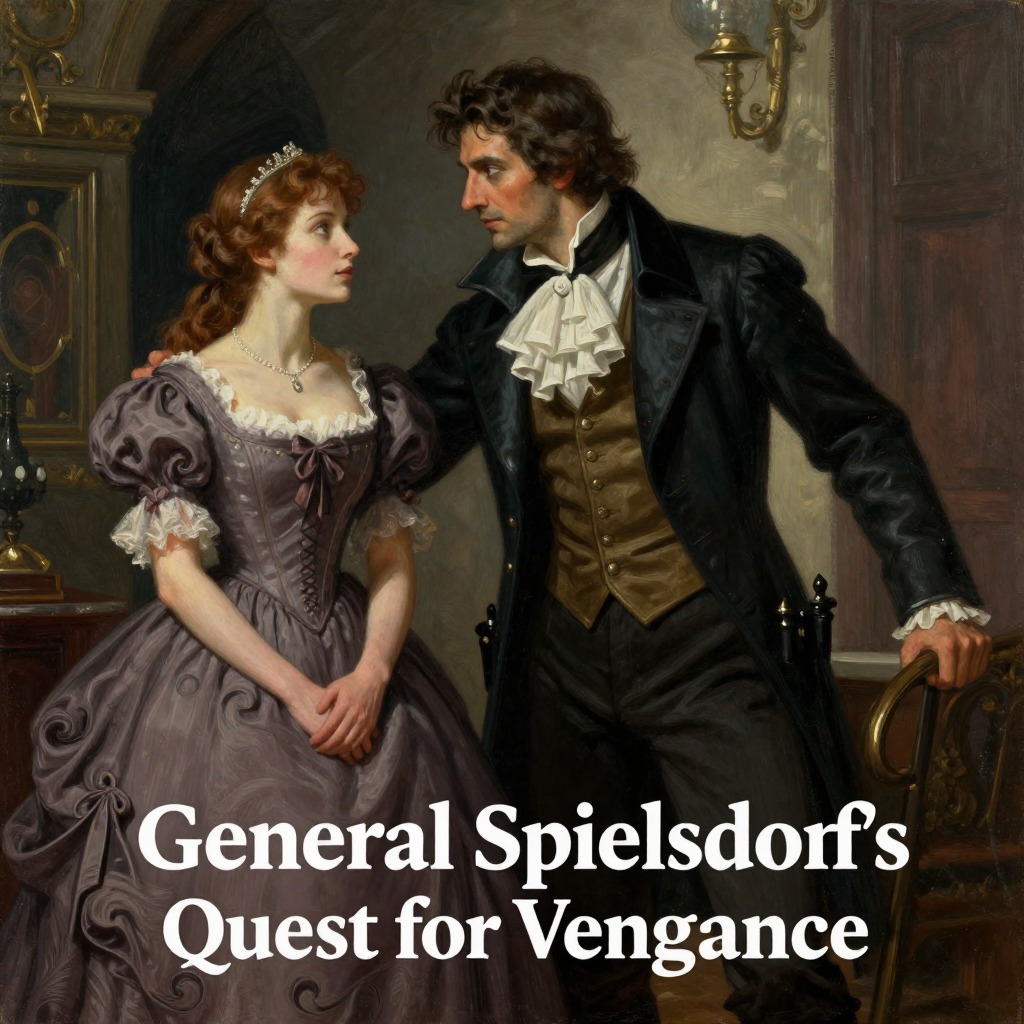
The Attack in the Chapel
The Attack in the Chapel is the story's decisive turning point, the moment when the supernatural threat that has been slowly draining Laura's life is openly confronted and identified, yet escapes physical destruction, setting the stage for the legal and ritual execution that follows. It is the scene in which General Spielsdorf, having just finished his harrowing account of his ward Bertha Rheinfeldt's death at the hands of a vampire, recognizes Carmilla as the same predator and attempts to destroy her on the spot, only to have her evade his blow, seize his wrist with a grip of inhuman strength, and vanish into the ruined chapel's shadows.
Setting and Context
The confrontation takes place inside the shadowy, ivy-clad Chapel of Karnstein, the ruined Gothic church of the extinct Karnstein family, whose moldering monuments surround the party. Laura, her father, and General Spielsdorf have just arrived at the ruins, and the General has spent the carriage ride and the walk through the chapel grounds relating the story of how a mysterious young woman calling herself Millarca insinuated herself into his household at a masked ball, and how his beloved Bertha subsequently sickened and died from what the physician from Gratz diagnosed as vampire attacks. The atmosphere is heavy with dread: Laura has recognized that every symptom the General describes—the languor, the dreams, the sensation of needles piercing the throat, the convulsive strangulation—matches her own experience with Carmilla. The chapel is dark, overhung by towering foliage, and the only sound is the distant axe of a woodman. Laura, seated on a squared block of wood that serves as a bench, is deeply shaken by the story's implications.
The Recognition and the Attack
As Laura sits in the haunted stillness, she sees with relief the beautiful face and figure of Carmilla enter the chapel through a narrow arched doorway surmounted by a demoniacal grotesque. Laura nods and smiles in answer to Carmilla's engaging smile. But at that instant, General Spielsdorf, who has been leaning against a shattered monument with his eyes fixed on the ground, catches up the woodman's hatchet and starts forward with a cry. The moment he sees Carmilla, a brutalized change comes over her features—an instantaneous and horrible transformation—and she makes a crouching step backward. Before Laura can even scream, the General strikes at Carmilla with all his force. She dives under his blow, unscathed, and catches him in her tiny grasp by the wrist. He struggles for a moment to free his arm, but his hand opens, the axe falls to the ground, and Carmilla is gone.
The Aftermath and Identification
The General staggers against the wall, his grey hair standing on end, a moisture shining over his face as if he were at the point of death. The entire frightful scene has passed in a moment. Madame Perrodon, who has just entered the chapel, impatiently repeats the question, "Where is Mademoiselle Carmilla?" Laura points to the door through which Madame entered, saying Carmilla went there only a minute or two since. But Madame insists she has been standing in that passage ever since Carmilla entered, and Carmilla did not return. They call her name through every door and passage and from the windows, but no answer comes. The General, still agitated, asks Laura, "She called herself Carmilla?" When Laura confirms it, he declares, "Aye, that is Millarca. That is the same person who long ago was called Mircalla, Countess Karnstein." He orders Laura to depart from the accursed ground immediately, to drive to the clergyman's house and stay there until they come, and warns her, "May you never behold Carmilla more; you will not find her here."
Significance and Consequences
The Attack in the Chapel transforms the story from a mystery of unexplained illness and ambiguous supernatural hints into an open confrontation with a named, identified vampire. It confirms that Carmilla, Millarca, and Mircalla, Countess Karnstein, are the same entity—a vampire who has been active for over a century, using anagrammatic variations of her name to infiltrate households. The attack also demonstrates the vampire's physical capabilities: her ability to transform her features in an instant, her preternatural speed and agility in evading a full-force blow, and the "power of the hand" that Baron Vordenburg later describes—the slender hand that closes like a vice of steel and leaves a numbness in the limb it seizes. Carmilla's disappearance from the chapel, despite Madame's having blocked the only exit, underscores her supernatural nature and her ability to move through spaces in ways that defy normal physical laws. This event directly precipitates the formal proceedings of the next day: the opening of the tomb of Mircalla, Countess Karnstein, the discovery of her perfectly preserved body floating in blood, and the ritual execution by stake, decapitation, and burning that finally ends the vampire's reign.