The priest
The priest appears only briefly in Laura's account, yet his presence marks a crucial intersection of the sacred and the supernatural in the story. He is introduced as a venerable old man in a black cassock, with a sweet and gentle face and white hair, who enters the nursery after Laura's terrifying childhood encounter with a spectral visitor. His role is to pray with the frightened child and the women attending her, and to teach her a simple prayer that she would repeat for years afterward. In this single scene, he embodies the institutional Church's response to the inexplicable—offering ritual, comfort, and a framework of divine protection against forces that secular medicine and domestic care cannot address. Later, though he does not appear directly in the action, his clerical authority is invoked during the formal investigation and destruction of the vampire, when the legal and ecclesiastical procedures require the presence of a clergyman to witness the opening of Doctor Spielsberg's letter diagnosing vampirism. The priest thus functions as a threshold figure between the rational world of the schloss and the ancient, terrifying realities that the narrative ultimately confirms.
Appearance and Role in Laura's Childhood
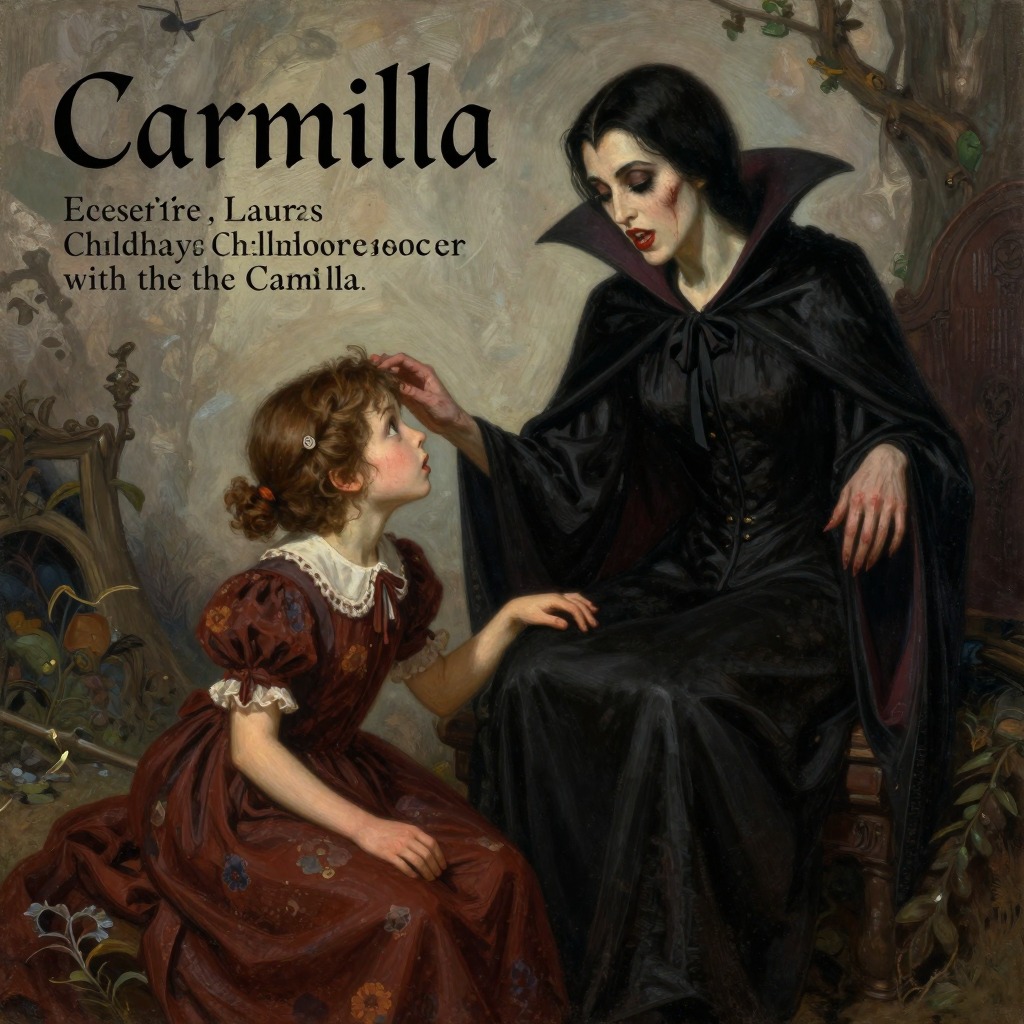
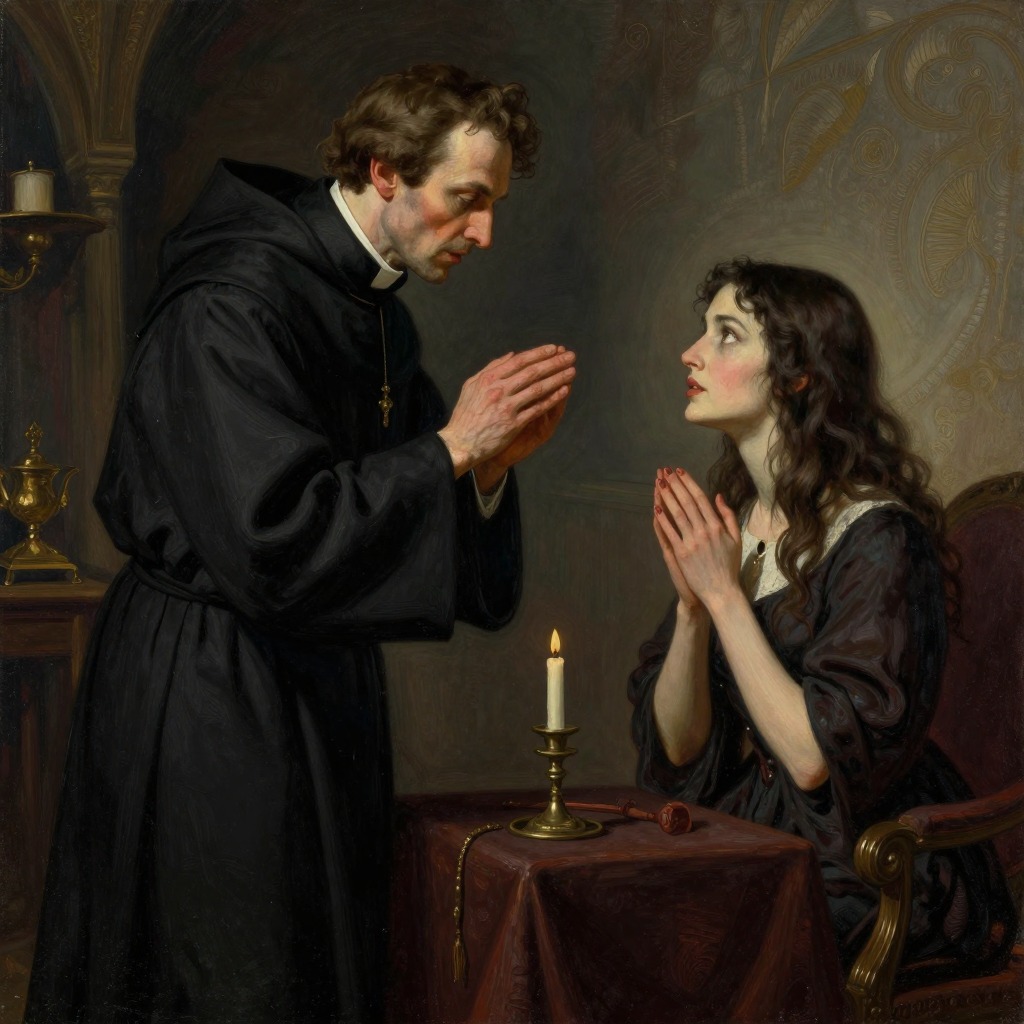
The priest is first seen in the aftermath of Laura's earliest remembered trauma, when she was about six years old and had been visited in her nursery by a strange woman who pricked her breast with needle-like sensations. The nurse and housekeeper had already examined the child and found no visible mark, and Laura's father had dismissed the event as a dream. Into this unsettled atmosphere comes the priest, described as a venerable old man in a black cassock, with a very sweet and gentle face. He talks kindly to Laura, then joins her hands together and teaches her to say, while the adults pray, "Lord hear all good prayers for us, for Jesus' sake." Laura remembers these exact words, and her nurse made her repeat them in her prayers for years afterward. The scene is rendered with unusual vividness: the priest kneels, the three women kneel with him, and he prays aloud with an earnest, quavering voice for what seemed to Laura a long time. The setting—the rude, lofty, brown room with clumsy furniture three hundred years old, the scanty light entering through a small lattice—is etched in her memory as one of the isolated pictures of a phantasmagoria surrounded by darkness. The priest's prayer does not erase the terror, but it provides a ritual container for it, and the prayer he teaches becomes a lasting talisman of words against the night.
Narrative and Thematic Significance
The priest's appearance is confined to a single childhood memory, yet his function reverberates through the rest of the story. He represents the only explicitly religious authority in Laura's world, and his intervention occurs at the precise moment when the natural explanations of father and nurse have failed to comfort her. The prayer he teaches—a petition that God hear all good prayers for Jesus' sake—is a formula of surrender and trust, and its repetition becomes a lifelong habit. The priest himself does not reappear in the main action, but the ecclesiastical framework he embodies is later invoked when Doctor Spielsberg insists that his letter diagnosing vampirism be opened only in the presence of the nearest clergyman, warning that otherwise the reader would despise it. The priest's absence at that critical moment—the clergyman is away, and General Spielsdorf reads the letter alone—underscores the isolation of the characters as they confront a horror that institutional religion has no ready vocabulary for, except the ancient rites of exorcism and execution that conclude the tale. The priest thus stands at the boundary between the domestic Christianity of Laura's childhood and the older, darker sacraments that the vampire's destruction requires.