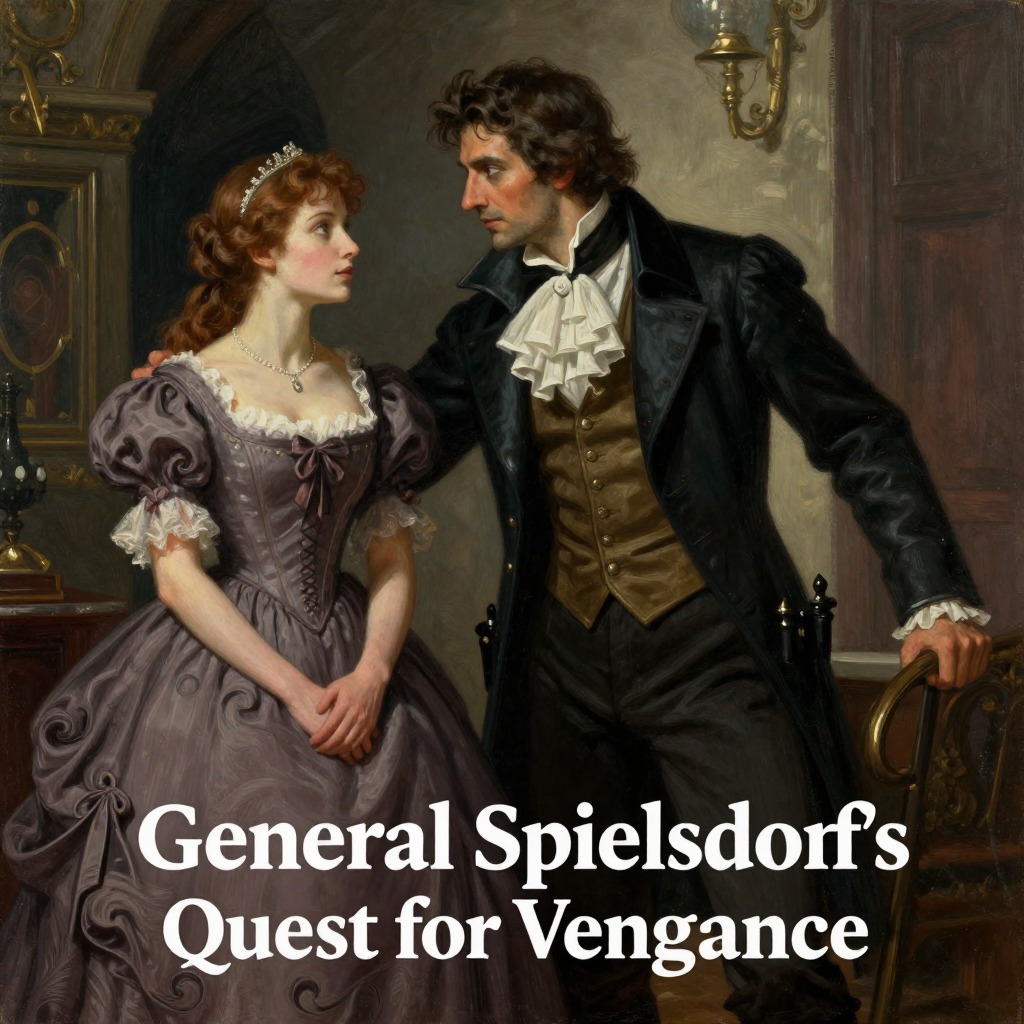
General Spielsdorf
General Spielsdorf is a retired Austrian military officer and a long-standing friend of Laura's father, living in a schloss nearly twenty miles from Laura's home in Styria. He is introduced as a neighbor whose visit Laura and her father eagerly anticipate, but his arrival is delayed by a personal catastrophe: the death of his beloved niece and ward, Bertha Rheinfeldt. His letter announcing the tragedy, written in a state of near distraction, is so vehement and self-contradictory that Laura reads it twice, suspecting grief has unsettled his mind. The letter reveals his fury at a "fiend who betrayed our infatuated hospitality" and his vow to devote his remaining days to "tracking and extinguishing a monster." This initial portrait establishes him as a man of deep affection, capable of profound grief and a consuming, righteous anger.
Life and Plot Trajectory
The General's story unfolds in two parallel arcs: his past ordeal with Carmilla and his present pursuit. Ten months after Bertha's death, he encounters Laura and her father while they are traveling to the ruins of Karnstein. His appearance has altered dramatically—he is thinner, with a gloom and anxiety replacing his former cordial serenity, and his dark blue eyes gleam with a sterner light. He insists on accompanying them to the ruined chapel, revealing that his purpose is to "unearth some of those fine people" and accomplish a "pious sacrilege" to rid the earth of monsters. He then narrates the full story of Bertha's destruction, beginning at a magnificent masked ball at Count Carlsfeld's schloss, where a mysterious lady and her daughter, Millarca, insinuated themselves into his company. The General, charmed and deceived, agreed to take charge of Millarca during the mother's sudden departure. At home, Millarca—revealed to be Carmilla—exhibited the same languor, sleepwalking, and predatory behavior that Laura later experiences. The General, initially skeptical, eventually witnessed the vampire in its true form: a large black object that crawled over Bertha's bed and swelled at her throat. He struck at the creature with his sword, but it vanished, and Bertha died before dawn. This narrative transforms him from a bereaved guardian into a man possessed by a mission.
Key Actions and Objectives
The General's primary objective is vengeance against the vampire who murdered his ward. He pursues this goal with military precision and ferocity. He seeks out the tomb of Mircalla, Countess Karnstein, the vampire's original identity, and enlists the aid of Baron Vordenburg, a scholar of vampirism, to locate the long-concealed grave. His actions culminate in a violent confrontation in the ruined Chapel of Karnstein. When Carmilla enters the chapel, the General seizes a woodman's hatchet and strikes at her with all his force. Though she dodges the blow and escapes, her grip on his wrist leaves him staggering against the wall, his grey hair standing on end, as if at the point of death. This attack, though unsuccessful in killing her, forces Carmilla to flee and sets the stage for her formal destruction. The General then oversees the legal proceedings: the exhumation of the Countess Mircalla's body, the driving of a sharp stake through her heart, the decapitation, and the burning of the remains. His role is that of the avenger who ensures the monster is not merely driven off but annihilated.
Relationships and Conflict
The General's central relationship is with his ward, Bertha, whom he loved as a daughter. Her death is the catalyst for his entire arc, transforming his affection into a burning need for retribution. His relationship with Carmilla is one of hunter and prey; he recognizes her immediately in the chapel, calling her by her true name, Mircalla, and denouncing her as the same person who was "long ago called Mircalla, Countess Karnstein." His conflict with Laura's father is more subtle: Laura's father initially suspects the General's sanity, glancing at him with "marked suspicion" during his story, but later becomes a collaborator in the hunt. The General's interaction with Laura is protective; after the chapel attack, he urges her to "depart from this accursed ground" and never behold Carmilla again. His relationship with Baron Vordenburg is one of grateful reliance, as the Baron's arcane knowledge provides the key to finding the vampire's tomb.
Change and Ending
The General undergoes a profound transformation from a sociable, cordial old soldier into a grim, obsessed avenger. The change is visible in his physical appearance and his speech, which is marked by intense bitterness and fury against "hellish arts." His skepticism about the supernatural is shattered by direct experience, and he is forced to credit "that which ran counter, diametrically, to all my theories." By the story's end, his mission is accomplished: the vampire is destroyed, and the territory is never again plagued by its visits. The General's final appearance is at the exhumation, where he recognizes Carmilla's face in the coffin, still tinted with the warmth of life. His role in the narrative concludes with the successful execution of the vampire, fulfilling his vow and providing a measure of closure to his grief.
Narrative Role and Evaluation
General Spielsdorf serves as a crucial secondary narrator and a catalyst for the story's resolution. His extended account of Bertha's death provides the reader with the essential backstory that explains Laura's own mysterious illness and identifies Carmilla as a vampire. He functions as a figure of righteous vengeance, embodying the active, masculine response to the supernatural threat that contrasts with Laura's passive suffering. His presence also introduces the theme of legal and procedural justice, as he insists on the formal Imperial Commission and the Inquisition to validate the vampire's destruction. The General's story is a tale within a tale, a narrative frame that deepens the novel's Gothic atmosphere and reinforces its central horror. His transformation from a trusting host to a hardened hunter underscores the novel's warning about the dangers of hospitality and the hidden evil that can lurk behind a beautiful face.