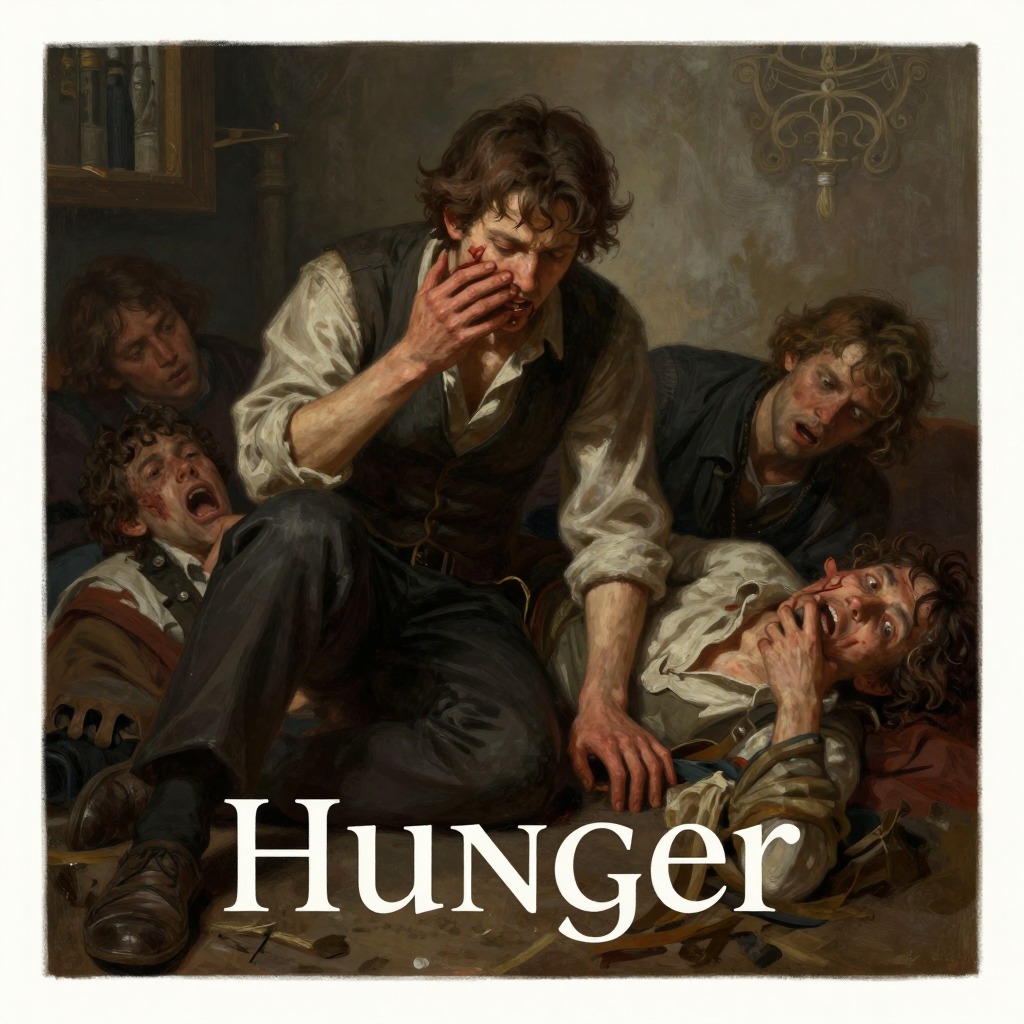
False Name at Police
The False Name at Police is a pivotal action in which the starving narrator, having been locked out of his lodging and directed to the guard-house as a homeless person, spontaneously invents the alias Andreas Tangen and the occupation of journalist for the Morgenbladet, a lie that secures him a bed in the reserved section and a polite dismissal the next morning, revealing both his desperate resourcefulness and the ease with which institutional systems can be deceived by a confident falsehood.
Background and Circumstances
After a night spent sleeping on a bench near the railway bridge, the narrator wakes soaked through from rain and is roused by a policeman. He wanders the streets in a state of bitter despondency, his hunger excruciating, and eventually finds himself locked out of his room in the tinker's workshop. Unable to open the door and with no money for an hotel, he follows a policeman's suggestion to report himself as homeless at the guard-house. The rain falls in torrents as he stands on the Town Hall steps, and the constable, after examining his personal appearance, tells him he must go to the guard-house and report himself as homeless. The narrator thanks the constable on the spot for the suggestion, and asks if he can simply go in and say he is homeless. The constable replies, "Just that."
The False Identity
When the guard asks for his name, the narrator, without any premeditation, answers "Tangen—Andreas Tangen!" He later reflects that he does not know why he lied; his thoughts fluttered about disconnectedly and inspired him with many singular whims. He hit upon this out-of-the-way name on the spur of the moment and blurted it out without any calculation, lying without any occasion for doing so. When asked for his occupation, he hesitates, thinking first of turning himself into a tinker but daring not, partly because he had given himself a name not common to every tinker and partly because he wore pince-nez. Then, suddenly, he decides to be foolhardy. He takes a step forward and says firmly, almost solemnly, "A journalist." The guard gives a start before writing it down, while the narrator stands as important as a homeless Cabinet Minister before the barrier. The guard then asks, "On what paper, Herr Tangen?" and the narrator replies, "Morgenbladet!" adding, "I have been out a little too late this evening, more's the shame!" The guard interrupts with a smile, "Oh, we won't mention that; when young people are out ... we understand!" and, turning to a policeman, says, "Show this gentleman up to the reserved section. Good-night!"
Consequences and Aftermath
The narrator feels ice run down his back at his own boldness and clenches his hands to steady himself. He worries about having dragged in the Morgenbladet, knowing that Friele could show his teeth when he liked, and is reminded of this by the grinding of the key turning in the lock. The policeman tells him the gas will burn for ten minutes, and when it goes out, he sits in the deepest darkness, unable to see his hand or the white walls. He lies awake, tormented by the darkness and by his own racing thoughts, which lead him to invent the word "Kuboa" and to experience a night of near-madness. The next morning, he is aroused by knocks on the door and reports himself downstairs to the officer on duty. In a large room with thirty or forty other homeless people, he is called up as "Andreas Tangen—journalist." He advances and bows. The officer says, "But, my dear fellow, how did you come here?" The narrator explains the whole state of the case, repeating the same story as the night before, lying without winking, lying with frankness—had been out rather late, worse luck ... café ... lost door-key. The officer smiles and says, "Yes; that's the way! Did you sleep well then?" The narrator answers, "Like a Cabinet Minister—like a Cabinet Minister!" The officer says he is glad to hear it, stands up, and says, "Good-morning." And the narrator goes. He receives no ticket for breakfast, though he has not eaten for more than three long days and nights, and he dares not demand one, fearing it would rouse suspicion and lead to his arrest for false pretences. So, with elevated head, the carriage of a millionaire, and hands thrust under his coat-tails, he strides out of the guard-house.
Narrative Role and Significance
The False Name at Police is a key episode that demonstrates the narrator's capacity for spontaneous, confident deception as a survival mechanism. It also exposes the arbitrary and easily manipulated nature of institutional authority: a well-told lie, delivered with the right bearing, can secure privileges—a bed in the reserved section, a polite dismissal—that the truth would never obtain. The alias Andreas Tangen and the false profession of journalist become a kind of protective mask, one that the narrator will later use again, as when he tells a policeman that he has only been out a little too late in a café, or when he introduces himself as Tangen to the shop-boy after stealing the five shillings. The episode also deepens the novel's exploration of identity and madness: the narrator is acutely aware that he is lying, yet he cannot fully explain why, and the lie itself becomes part of the delirious, improvisational logic that governs his actions under extreme hunger and exhaustion.