Mudrin 505
Mudrin 505 is the paleographer of Saro University, a frail, desiccated man in his late seventies who has been retained past retirement age in a non-teaching post so that he may continue his studies of ancient scripts. His mild gray-green eyes, watery from a lifetime of poring over faded manuscripts, peer out from behind thick spectacles, yet Siferra 89 knows that their watery appearance is deceptive: those are the sharpest eyes she has ever known, at least where ancient inscriptions are concerned.
Role in the Thombo Tablet Translation
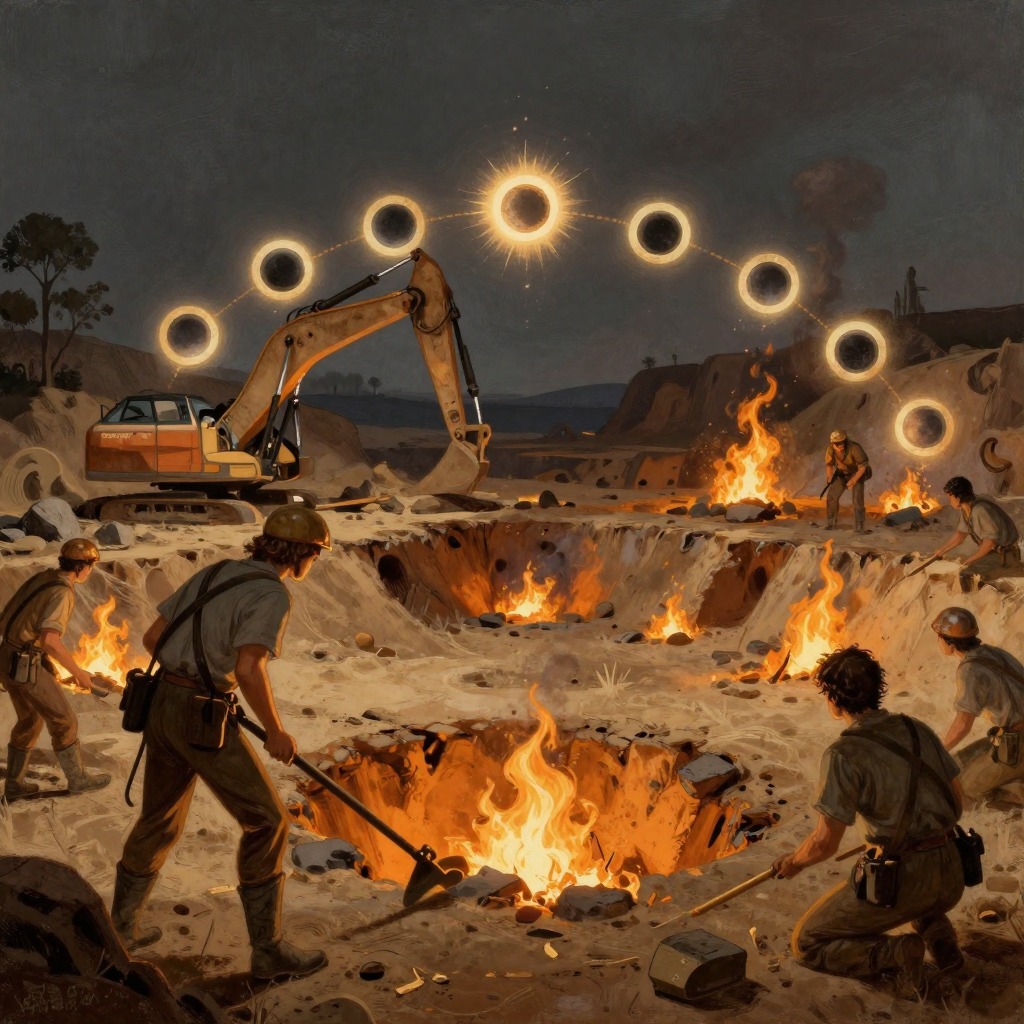
When Siferra returns from the Beklimot excavation carrying the six Thombo Tablets—three square ones from Level Three and three oblong ones from Level Five—she immediately summons Mudrin. He arrives at her office with a quavering voice, trembling with excitement at the prospect of examining the finds. Mudrin studies the tablets with intense concentration, first the square ones, then the oblong ones. He declares them "astonishing" and immediately identifies word-groups, though he cannot yet read them. On the square tablets, he recognizes a very primitive form of the Beklimot script, pointing out specific characters: a quhas here, a distorted tifjak there. The older, oblong tablets, however, are written in a completely unfamiliar script, very likely a syllabic one, and he cannot even begin to decipher them without a bilingual key. Mudrin insists on taking the tablets to his own laboratory, with his own lighting equipment, cameras, and scanning screens, to attempt a full transliteration. Siferra reluctantly parts with them, watching ruefully as the old man dodders from the room, the precious bundle clasped close against his hollow chest.
Translation and Its Consequences
Mudrin's work yields a preliminary translation that proves devastating. So far as he can tell, the Level Three tablets are an account of the destruction of a city by fire—the work of angry gods who periodically find it necessary to punish mankind for wickedness. This finding, when Siferra shares it with Beenay 25, directly echoes the teachings of the Apostles of Flame, who claim that the world is destroyed by fire every two thousand and forty-nine years. Siferra is horrified, realizing that her archaeological discovery could be used to provide "solid rational underpinning" for the Apostles' mythology. Mudrin's translation remains sketchy, hesitant, and sparse, because the Apostles, who possess a key to the ancient script, refuse to share their decoding material unless Siferra gives them the original tablets. She refuses, and Mudrin toils on without their help. Later, the tablets are stolen from the artifact safe, almost certainly by the Apostles, just before the eclipse. Mudrin's translations, however, are preserved in copies.
Death During Nightfall
During the chaos of Nightfall, when the Stars appear and the mob storms the Observatory, Siferra makes her way back to the Hall of Archaeology. On the stairs, she finds the body of an old man lying face upward at the first-floor landing. She recognizes him as Mudrin. His eyes are open, but there is no light in them. He is dead. Siferra, still in a state of mental dissociation, merely shrugs and continues upward, saying, "Well, you were very old anyway." Mudrin's death is one of the many casualties of the universal madness that sweeps Kalgash.
Posthumous Significance
After the catastrophe, Folimun 66 reveals to Theremon 762 that the Apostles have fully translated the Thombo Tablets, using their own ancient textual material. Folimun claims that the tablets provide an accurate and convincing version, uncorrupted by centuries of textual alteration, of the chronicles that have come down under the name of the Book of Revelations. He asserts that the tablets are straightforward historical accounts of two separate advents of the Stars thousands of years ago, and of the attempts made by the priesthoods of the time to warn the populace. Mudrin's initial, hesitant translation, though incomplete, was the first step in unlocking this knowledge, and his death during the chaos he had helped to document marks the end of the old world's scholarly endeavor and the beginning of a new, uncertain era.