Garden
The Garden is a central, multi-layered space in Siddhartha's journey, first encountered as the pleasure-grove of the courtesan Kamala, where he begins his worldly education in love and desire, and later reappearing as a site of memory, renunciation, and spiritual transformation, ultimately given by Kamala to the Buddhist community as a gift.
Identity and First Encounter
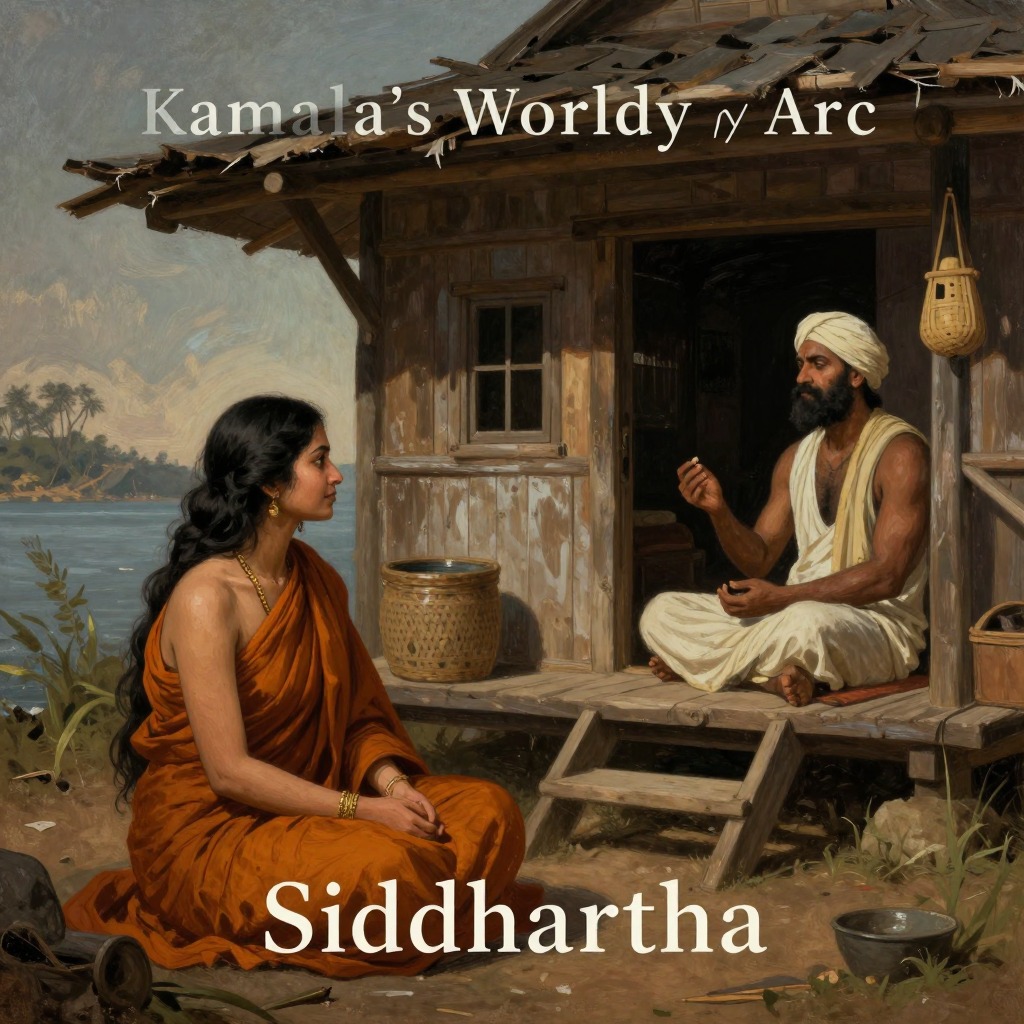
The Garden is introduced as a beautifully fenced grove before the large city, where Siddhartha first sees Kamala being carried in an ornamental sedan-chair by four servants, seated on red pillows under a colourful canopy. He observes her very fair, delicate, smart face, a brightly red mouth like a freshly cracked fig, well-tended eyebrows painted in a high arch, and smart, watchful dark eyes. The Garden is explicitly identified as Kamala's grove, and she is described as the famous courtesan who, aside from the grove, owns a house in the city. When Siddhartha later returns, freshly shaved and anointed with fine oil, he stands at the entrance, makes a bow, and receives the courtesan's greeting, then is conducted into a pavilion where Kamala lies on a couch. It is in this pavilion that Siddhartha recites his poem to Kamala, and she gives him his first kiss, a long, well-ordered, well-tested sequence of kisses that astonishes him like a child discovering a cornucopia of knowledge.
The Garden as a Site of Worldly Life and Love
Throughout Siddhartha's years as a merchant, the Garden remains the primary setting for his relationship with Kamala. He visits her daily at the hour appointed by her, wearing pretty clothes and fine shoes, soon bringing her gifts. Here, Kamala teaches him the art of love thoroughly, starting with the basics, instructing him that pleasure cannot be taken without giving pleasure, and that every gesture, every caress, every touch, every look, every spot of the body has its secret. The Garden is where Siddhartha tells Kamala that she is like him, different from most people, possessing a peace and refuge inside herself. It is also where Kamala, after a long conversation about Gotama, tells Siddhartha that he is the best lover she ever saw, stronger, more supple, more willing than others, but that he has remained a Samana and does not love her, does not love anybody. Siddhartha agrees, saying that people of their kind cannot love, that the childlike people can, and that is their secret.
The Garden as a Site of Disgust and Renunciation
In the later stages of his worldly life, the Garden becomes a place of profound disgust and the catalyst for Siddhartha's final renunciation. After an evening spent with Kamala in her beautiful pleasure-garden, sitting under the trees and talking, Siddhartha sees clearly for the first time how closely lust is akin to death. He reads a fearful inscription of small lines and slight grooves on Kamala's face, reminiscent of autumn and old age, and sees his own gray hairs. He then spends the night in his house with dancing girls and wine, but the next day, with a gloomy mind, he goes to the pleasure-garden he owns, locks the gate, sits down under a mango-tree, and feels death in his heart and horror in his chest. He senses how everything dies in him, withers in him, comes to an end in him. He thinks of his father, of Govinda, of Gotama, and realizes that the game is over. He rises, bids farewell to the mango-tree and the pleasure-garden, leaves the city, and never comes back.
The Garden's Transformation and Final Significance
After Siddhartha's disappearance, Kamala gives her pleasure-garden to the monks of Gotama as a gift and takes her refuge in the teachings. Years later, when Siddhartha, now an old ferryman, follows his runaway son to the city, he stops at the entrance of the beautiful pleasure-garden that used to belong to Kamala. He stands there for a long time, looking through the open gate, seeing monks in yellow robes walking among the beautiful trees. The past rises up in his soul: he sees himself standing there young, a bearded, naked Samana with hair full of dust; he sees young Kamala walking among the high trees; he sees himself being served food and drink, receiving his first kiss, beginning his worldly life. He lives through all of this once again, breathes Sansara, feels once again disgust and the wish to annihilate himself, and is once again healed by the holy Om. It is at this gate that he realizes his desire to cling to his son is foolish, that he cannot help him, and that the wound of love must become a blossom and shine. The Garden thus becomes the site where Siddhartha's entire life cycle—from youthful encounter to worldly immersion to final renunciation and healing—is compressed into a single, timeless vision.