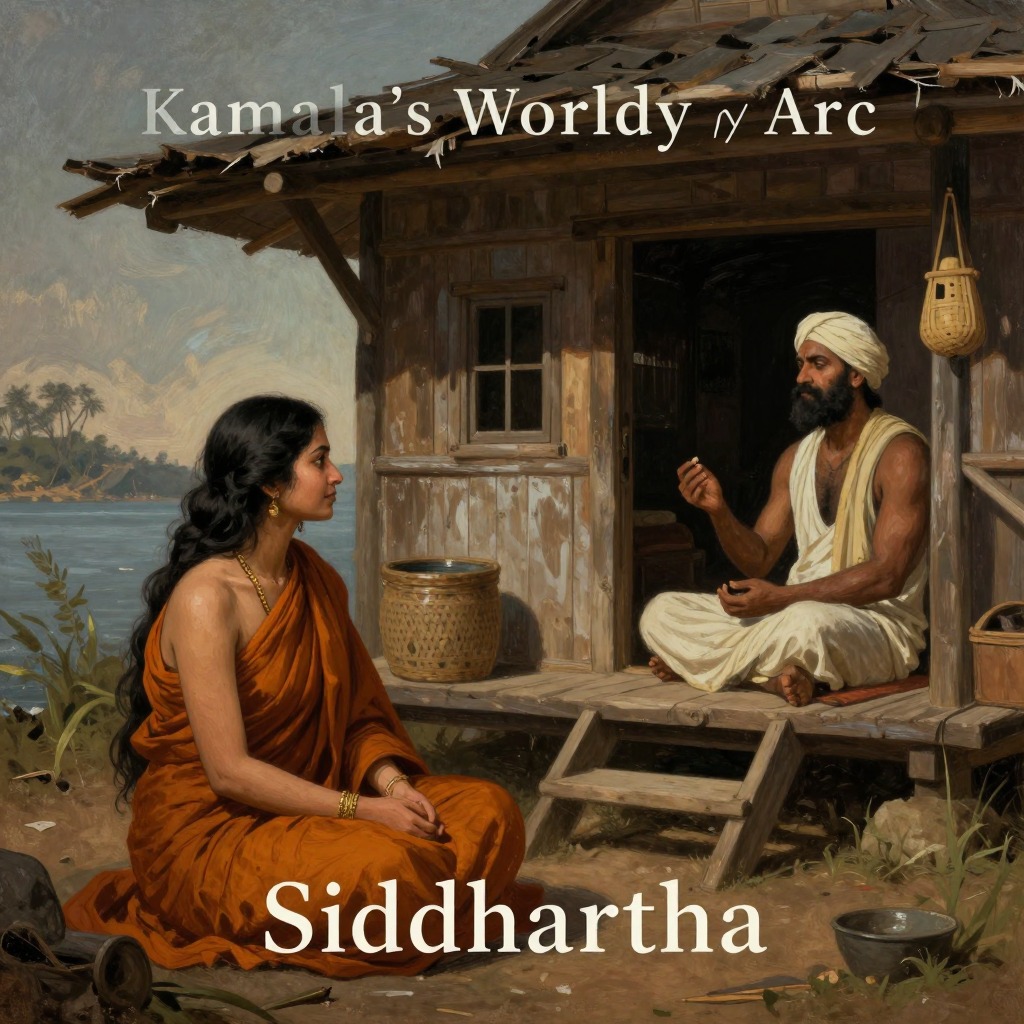
Meeting Kamala
Siddhartha's first meeting with Kamala is the pivotal event that draws him out of ascetic homelessness and into the sensual, commercial world of the city, where he will spend many years learning the arts of love, trade, and worldly desire before his eventual disillusionment. The encounter occurs just as Siddhartha, having left the Samanas and the Buddha Gotama, resolves to know himself through experience rather than teachings. Approaching the large city before evening, he comes across a beautifully fenced grove where a procession of servants, both male and female, carries baskets. In their midst, borne by four servants in an ornamental sedan-chair under a colourful canopy, sits a woman on red pillows. Siddhartha sees her clearly: under black hair piled high on her head, a very fair, delicate, smart face with a brightly red mouth like a freshly cracked fig, well-tended eyebrows painted in a high arch, smart and watchful dark eyes, and a clear, tall neck rising from a green and golden garment, her fair hands resting with wide golden bracelets over the wrists. He bows deeply as the sedan-chair approaches, and the beautiful woman nods with a smile for a moment before disappearing into the grove. Instantly drawn, Siddhartha feels a charming omen, but he also notices how the servants and maids look at him with despicable, distrustful, rejecting glances. He realizes he is still a Samana, an ascetic and beggar, and cannot enter the grove like this. He laughs. The next person he asks tells him this is the grove of Kamala, the famous courtesan, who also owns a house in the city. Then he enters the city. Now he has a goal.
Preparation and the First Approach
Pursuing his goal, Siddhartha allows the city to suck him in, drifting through the flow of the streets, standing still on squares, resting on stone stairs by the river. He makes friends with a barber's assistant, whom he finds working in the shade of an arch and later praying in a temple of Vishnu, and tells him stories of Vishnu and Lakshmi. He sleeps among the boats by the river. Early the next morning, before the first customers arrive, the barber's assistant shaves his beard, cuts his hair, combs it, and anoints it with fine oil. Then Siddhartha bathes in the river. When late in the afternoon Kamala approaches her grove in her sedan-chair, Siddhartha stands at the entrance, bows, and receives her greeting. He motions to the servant walking at the very end of her train and asks him to inform his mistress that a young Brahman wishes to talk to her. After a while, the servant returns and leads him, without a word, into a pavilion where Kamala is lying on a couch, and leaves him alone with her.
The Conversation in the Pavilion
Kamala recognizes him from the previous day and asks if he had not then worn a beard, long hair, and dust in his hair. Siddhartha confirms her observation and declares himself: he is Siddhartha, son of a Brahman, who left his home to become a Samana for three years, but has now left that path and come into this city. The first person he met, even before entering the city, was her. He tells her she is the first woman he addresses without turning his eyes to the ground, and he never wants to turn his eyes to the ground again when he meets a beautiful woman. Kamala smiles and plays with her fan of peacocks' feathers, asking if he came only to tell her this. Siddhartha replies that he came to thank her for being so beautiful and, if it does not displease her, to ask her to be his friend and teacher, for he knows nothing yet of that art which she has mastered in the highest degree. Kamala laughs aloud, saying never before has a Samana from the forest come to her wanting to learn from her, with long hair and an old, torn loin-cloth. Many young men come to her, including sons of Brahmans, but they come in beautiful clothes, fine shoes, with perfume in their hair and money in their pouches. Siddhartha responds that he has already started learning from her: he has taken off his beard, combed his hair, and put oil in it. What is still missing—fine clothes, fine shoes, money in his pouch—he considers trifles compared to the harder goals he has already reached. He asks if she is not satisfied with him as he is, with oil in his hair but without clothes, shoes, or money. Laughing, Kamala exclaims that he does not satisfy her yet; he must have pretty clothes, pretty shoes, lots of money in his pouch, and gifts for Kamala. Siddhartha declares that he has marked her words, and that his mouth, red and fresh, will be a suitable match for hers. He asks if she is not afraid of the Samana from the forest who has come to learn how to make love. Kamala replies that she is not afraid: love can be obtained by begging, buying, receiving it as a gift, or finding it in the street, but it cannot be stolen. She tells him it would be a pity if a pretty young man like him tackled it in such a wrong manner.
The Poem and the First Kiss
Siddhartha bows with a smile and agrees, settling that he will return once he has clothes, shoes, and money. He asks for advice on where to find these three things most quickly. Kamala tells him he must do what he has learned and ask for money, clothes, and shoes in return. When he says he can think, wait, and fast, and also write poetry, she offers to give him a kiss for a poem if she likes it. After a moment of thought, Siddhartha recites verses: "Into her shady grove stepped the pretty Kamala, / At the grove's entrance stood the brown Samana. / Deeply, seeing the lotus's blossom, / Bowed that man, and smiling Kamala thanked. / More lovely, thought the young man, than offerings for gods, / More lovely is offering to pretty Kamala." Kamala claps her hands loudly, making her golden bracelets clang, and declares the verses beautiful, saying she loses nothing by giving him a kiss for them. She beckons him with her eyes; he tilts his head so his face touches hers and places his mouth on that mouth like a freshly cracked fig. For a long time Kamala kisses him, and with deep astonishment Siddhartha feels how she teaches him, how wise she is, how she controls him, rejects him, lures him, and how after this first kiss there is to be a long, well-ordered, well-tested sequence of kisses, each different from the others, which he is still to receive. Breathing deeply, he stands astonished like a child at the cornucopia of knowledge and things worth learning revealed before his eyes.
Arranging the Path Forward
Kamala tells him that while his verses are beautiful, it will be difficult to earn enough money with verses alone; he needs a lot of money to be her friend. She asks what else he can do besides thinking, fasting, and making poetry. He mentions he knows sacrificial songs and magic spells, and can read and write. Kamala is impressed, noting that most people cannot read or write, and that this is very good. A maid then runs in and whispers a message. Kamala announces a visitor and tells Siddhartha to hurry away, that nobody may see him there. She orders the maid to give the pious Brahman white upper garments. Without fully understanding what is happening, Siddhartha is dragged away by the maid, brought into a garden-house avoiding the direct path, given the upper garments as a gift, led into the bushes, and urgently admonished to get out of the grove as soon as possible without being seen. He does so contently, managing to exit the grove and cross the hedge without a sound. Returning to the city with the rolled-up garments under his arm, he positions himself by the door of an inn where travellers stay, silently asks for food, and accepts a piece of rice-cake. But then pride flares up in him: he is no longer a Samana, and it is no longer becoming to beg. He gives the rice-cake to a dog and remains without food. He reflects that the life of people in this world is simple and presents no difficulties, unlike the difficult, toilsome, and hopeless life of a Samana. Now everything is easy, like the lessons in kissing Kamala is giving him. He needs only clothes and money—small, near goals that will not make a person lose any sleep. The next day he turns up at Kamala's house in the city, which he had already discovered. She tells him things are working out well: he is expected at Kamaswami's, the richest merchant in the city, and she had others tell him about Siddhartha. She instructs him to be polite but not too modest, and to become Kamaswami's equal, not his servant. Siddhartha thanks her and laughs. When she learns he has not eaten for two days, she sends for bread and fruits. As they part, she asks if he has a spell, since she is opening one door after another for him. Siddhartha replies that he told her he knew how to think, wait, and fast, and that these are useful for many things. He declares that soon he will be a merchant with money and all the things she insists upon. Kamala admits this, but asks where he would be without her. Siddhartha straightens to his full height and tells her that when he came to her grove, he took the first step; his resolution was to learn love from this most beautiful woman, and from that moment he knew he would carry it out, and that she would help him. He explains that when he has a goal, he does nothing, he waits, he thinks, he fasts, but he passes through the things of the world like a rock through water, without doing anything, without stirring—he is drawn, he lets himself fall. His goal attracts him because he does not let anything enter his soul that might oppose it. This, he says, is what fools call magic, but everyone can perform magic if they can think, wait, and fast. Kamala listens, loving his voice and the look from his eyes. She suggests quietly that perhaps it is also that Siddhartha is a handsome man whose glance pleases women, and that therefore good fortune comes towards him. With one kiss, Siddhartha bids farewell, wishing that his glance shall please her and that good fortune shall always come to him out of her direction.