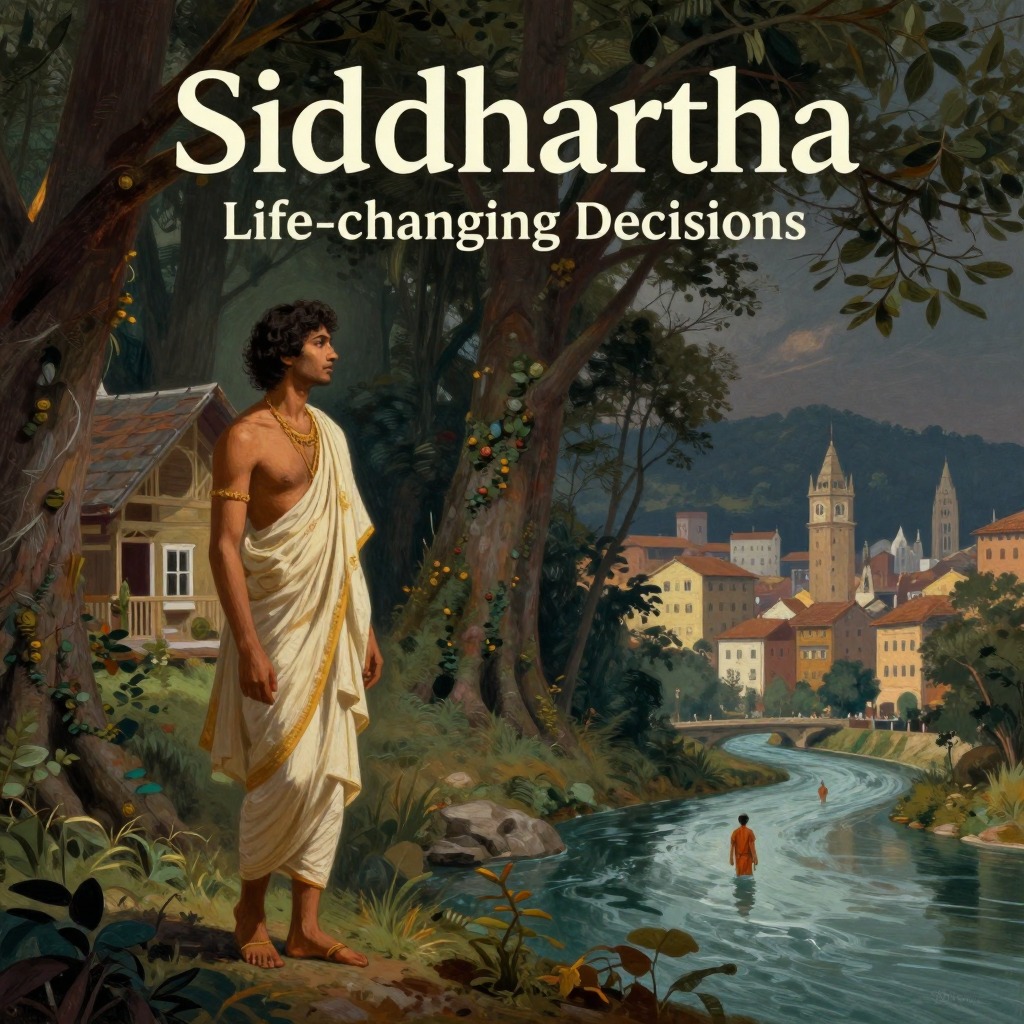
Siddhartha's Dream of the Dead Bird and Departure
Siddhartha's Dream of the Dead Bird and Departure marks the decisive rupture in his worldly existence, the moment when the accumulated disgust of years as a rich merchant and lover of Kamala finally erupts into a conscious, irreversible decision to leave everything behind. The event is triggered by a dream, but its roots lie deep in the slow decay of his soul during his time among the childlike people.
The Dream and Its Context
The dream arises from a night of profound self-disgust. Siddhartha had spent the evening with Kamala in her pleasure-garden, where she spoke with a hidden sadness and tiredness, asking him to tell her again about Gotama, the Buddha, and sighing that she might soon follow him. She then aroused him with a painful, biting fervor, as if trying to squeeze the last sweet drop from a fleeting pleasure, and for the first time Siddhartha saw clearly how closely lust was akin to death. Lying beside her, he read in the small lines and grooves of her face an inscription of autumn and old age, and felt his own gray hairs. He returned to his house, drank much wine with dancing girls, and went to bed long after midnight, his heart full of a misery he thought he could not bear. The disgust he felt penetrated his entire body: the lukewarm, repulsive taste of the wine, the too-sweet music, the too-soft smile of the dancing girls, the too-sweet scent of their hair and breasts—and above all, disgust with himself, with his perfumed hair, the smell of wine on his breath, the flabby tiredness of his skin. He wished to free himself of these pleasures and habits in an immense burst of vomiting. In the early morning, he fell into a half-conscious sleep, and in that sleep he dreamed.
In the dream, Kamala owned a small, rare singing bird in a golden cage. The bird, which always sang in the morning, had become mute. Siddhartha stepped before the cage and looked inside: the small bird was dead, lying stiff on the ground. He took it out, weighed it for a moment in his hand, and then threw it away into the street. In the same moment, he felt terribly shocked, his heart hurt as if he had thrown away from himself all value and everything good. The dream is a compressed symbol of his entire worldly life: the caged bird is the captive, singing spirit of his youth, now dead; the golden cage is the gilded prison of wealth, sensual pleasure, and the city; and his act of throwing it away is both a murder and a liberation, a recognition that what he has cherished is already lifeless.
The Immediate Aftermath and the Decision to Leave
Waking from the dream, Siddhartha was encompassed by a deep sadness. Worthless and pointless, he felt, was the way he had been going through life; nothing alive, nothing delicious or worth keeping remained in his hands. He stood alone and empty like a castaway on the shore. With a gloomy mind, he went to his own pleasure-garden, locked the gate, and sat down under a mango-tree, feeling death in his heart and horror in his chest. He sensed how everything died in him, withered, came to an end. He gathered his thoughts and traced the entire path of his life from his earliest days. He remembered the happiness he had felt as a boy, when he received praise from the Brahmans and felt a path opening before him; as a young man, when the goal of all thinking had ripped him upward; and the voice that had called him onward when he left home, when he left the Samanas, when he left Gotama. But for how long had he not heard that voice? For how long had he reached no height, how even and dull had his path become, without a high goal, without thirst, without elevation, content with small lustful pleasures yet never satisfied? He realized that for all these years he had tried to become like the childlike people, and in doing so his life had become much more miserable and poorer than theirs. The entire world of the Kamaswami-people had been only a game to him, a comedy. Only Kamala had been dear—but was she still? Did they not play a game without ending? The name of this game, he knew, was Sansara, a game for children, perhaps enjoyable once or twice, but not forever and ever again. Then Siddhartha knew that the game was over, that he could not play it any more. Shivers ran over his body; inside him, something had died.
He sat under the mango-tree the entire day, thinking of his father, of Govinda, of Gotama. Had he had to leave them to become a Kamaswami? When night fell, he looked up at the stars and thought: "Here I'm sitting under my mango-tree, in my pleasure-garden." He smiled a little—was it really necessary, was it right, was it not a foolish game, that he owned a mango-tree, that he owned a garden? He put an end to this thought as well; this also died in him. He rose, bid farewell to the mango-tree, bid farewell to the pleasure-garden. Though he had been without food all day and felt strong hunger, he thought of his house in the city, his chamber and bed, the table with meals—and smiled tiredly, shook himself, and bid farewell to these things as well. In the same hour of the night, Siddhartha left his garden, left the city, and never came back.
Kamala's Response and the Unborn Child
Kamaswami had people search for him, thinking he had fallen into the hands of robbers. Kamala, however, had no one look for him. When she was told of his disappearance, she was not astonished. Had she not always expected it? Was he not a Samana, a man at home nowhere, a pilgrim? Most of all, she had felt this during their last time together, and she was happy, despite the pain of loss, that she had pulled him so affectionately to her heart one last time, that she had felt so completely possessed and penetrated by him. When she received the first news of his disappearance, she went to the window where she held the rare singing bird captive in its golden cage. She opened the door of the cage, took the bird out, and let it fly. For a long time, she gazed after the flying bird. From that day on, she received no more visitors and kept her house locked. After some time, she became aware that she was pregnant from that last time with Siddhartha. The dream of the dead bird had been a prophecy; Kamala's act of freeing the living bird was her own quiet acknowledgment that the cage of their shared life had been opened, and that something new—a child—was already growing in its place.