Passadumkeag is a small town in Maine mentioned in Jud Crandall's account of the 1943 funeral train that carried the body of Timmy Baterman home from World War II, serving as one of several stops where flag-draped coffins were unloaded along the Bangor and Aroostook route.
Cincinnati is a major city in Ohio that serves as a connecting hub in Rachel Creed's desperate attempt to return to Ludlow after her son Gage's funeral. It is the city where Rachel and Ellie Creed, traveling with Rachel's parents Irwin and Dory Goldman, must change planes on their journey from Bangor to Chicago, and it is also the city where Rachel's missed connection forces her to rent a car and drive through the night, a decision that leads directly to her fatal encounter with the resurrected Gage.
LaGuardia Airport is the New York City transit hub where Rachel Creed's desperate cross-country journey to reach her husband Louis in Ludlow, Maine, is nearly derailed when she misses her connecting flight to Portland, a delay that forces her to drive the final leg by car and ultimately arrive too late to prevent the catastrophe at the Crandall house.
Bangor is the largest city near Ludlow and the primary urban center in the novel, serving as the location of the Eastern Maine Medical Center, the Brookings-Smith Mortuary, Mount Hope Cemetery, the Bangor International Airport, and the Howard Johnson's Motor Lodge where Louis Creed stays before exhuming his son's body. It is the site of Gage Creed's funeral and burial, and the city from which Rachel and Ellie fly to Chicago and to which Rachel returns in her desperate drive home.
Logan Airport is the Boston airport where Rachel Creed, racing to return to Ludlow after her son Gage's funeral, misses her connecting flight to Portland, Maine, forcing her to rent a car and drive the rest of the way through the night.
Hampden is a town visible from Prospect Hill, the viewpoint behind the Creed house in Ludlow, Maine, and is one of the communities Louis Creed can see across the Penobscot River valley on his first walk to the Pet Sematary.
Alabama is a state in the southern United States that appears in Stephen King's *Pet Sematary* as the origin of a drunken army officer from Graves and Registration who accompanies a shipment of coffins on a train journey through Maine during World War II.
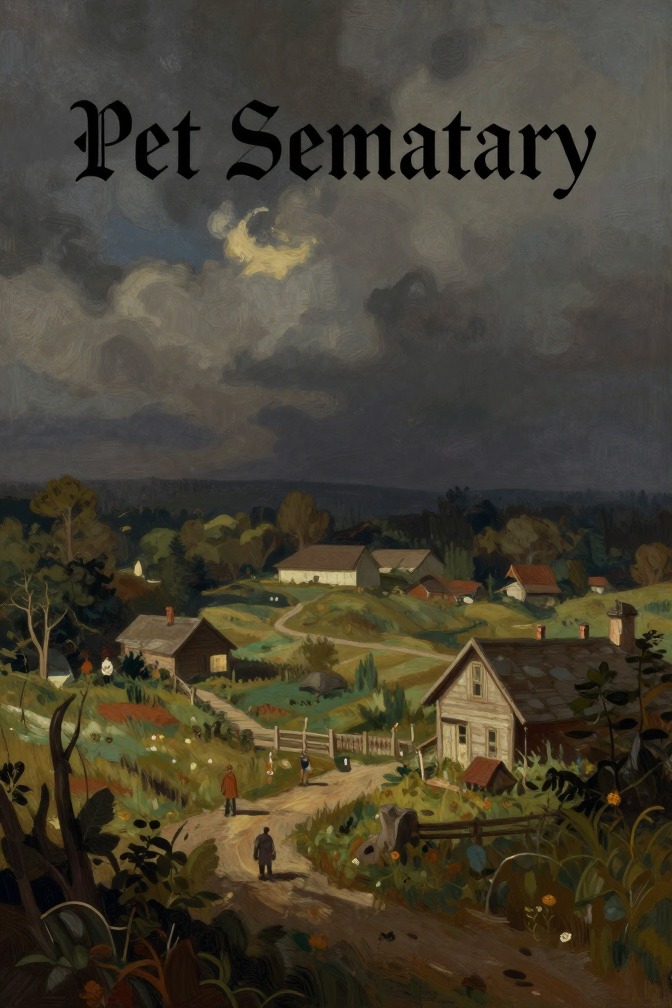
Prospect Hill is a low hill behind the Creed house in Ludlow, Maine, which offers a sweeping panoramic view of the Penobscot River valley and surrounding towns. It is the first place where the Creed family, together with their neighbor Jud Crandall, pause to take in the beauty of their new home's landscape, and it marks the beginning of the path that leads to the Pet Sematary and, beyond it, to the Micmac burying ground. The hill's deceptive modesty—it is not high, yet it reveals 'everything'—establishes a key thematic contrast between the ordinary surface of rural Maine life and the vast, hidden wilderness that lies just beyond, a wilderness that will eventually draw Louis Creed into its dark power.
Portland, Maine, serves as a critical waypoint in Rachel Creed's desperate journey back to Ludlow after her son Gage's funeral, a location where her flight connection fails and where she receives Jud Crandall's advice to stop for the night, a warning she ultimately ignores.
Hell in Pet Sematary is not a conventional theological afterlife but a narrative device that represents the ultimate consequence of defying death's finality. It is invoked as a curse, a destination for the damned, and a realm of torment that mirrors the novel's central themes of grief, guilt, and the monstrous cost of resurrection. The concept is woven through the characters' fears, their accusations, and the very nature of the Wendigo-touched burial ground, serving as a stark counterpoint to any hope of a peaceful afterlife.
Miami appears in Pet Sematary as a distant, almost mythical destination of escape and fantasy, a place where Louis Creed imagines fleeing his grief and his family's doom, and as a real location in a macabre anecdote about a corpse misrouted by an airline.
Storyville, Ohio, is the manufacturing origin of Gage Creed's coffin, a detail that underscores the impersonal, industrial nature of death and the commodification of grief, contrasting sharply with the handmade, organic markers of the Pet Sematary.
Jerusalem's Lot is a fictional town in Maine that appears in Stephen King's Pet Sematary, briefly mentioned by Rachel Creed as she drives north on the Maine Turnpike, its name evoking an unsettling, biblical resonance that deepens the novel's atmosphere of dread and supernatural menace.
Howard Johnson's Motor Lodge is the motel on Odlin Road in Bangor where Louis Creed stays the night before he exhumes his son Gage's body from Pleasantview Cemetery, a location that serves as the strategic and psychological staging ground for his descent into grave robbing and madness.
The Bear's Den is the student cafeteria at the University of Maine at Orono, where Louis Creed buys a tuna fish sandwich and a Coke for lunch on his second day of work, shortly after the traumatic death of Victor Pascow.
Orrington is a town in Maine, located near Ludlow, that serves as the site of the Orinco chemical fertilizer plant, whose heavy trucks repeatedly traverse Route 15 and are a constant, ominous presence in the novel, directly linked to the deaths of both Church and Gage Creed.
Purgatory, in the theological framework of Pet Sematary, is a concept that Louis Creed invokes during a conversation with his daughter Ellie about the afterlife, but the novel itself presents a world where the Catholic doctrine of purgatory is overshadowed by a far more immediate and sinister geography: the Micmac burying ground beyond the Pet Sematary, a place that functions as a literal, pagan purgatory—a liminal space where the dead can be returned to a corrupted form of life, but never to true peace.
Limestone is a town in Aroostook County, Maine, that serves as the entry point for the bodies of American soldiers killed in World War II, including that of Timmy Baterman, whose corpse was flown there before being transported south on a "mystery train." The town's function as a logistical node in the machinery of wartime death underscores the novel's preoccupation with the impersonal, bureaucratic handling of mortality and the long distances—both geographical and emotional—that separate the battlefield from the home front.
Mrs. Vinton's field is the large, open meadow adjacent to the Creed property in Ludlow, Maine, serving as the immediate threshold between the domestic safety of the Creed home and the wild, increasingly ominous woods that lead to the Pet Sematary and the Micmac burying ground. It is the site of the last genuinely happy day of Louis Creed's life—March 24, 1984—when he and his son Gage flew a Vulture kite there, a moment of pure, unshadowed joy that stands in stark contrast to the horrors that follow. The field functions as a liminal space, a pastoral buffer zone that is both a place of innocent play and the last point of civilization before the characters step into the supernatural wilderness.
The Creed kitchen is the domestic heart of the Creed household in Ludlow, Maine, where the family's most intimate and volatile moments unfold. It is the site of Louis and Rachel's bitter argument about death and the Pet Sematary, the place where Louis confronts the resurrected Church's unsettling presence, and the room where Ellie matter-of-factly declares that Norma Crandall will die anyway. More than a functional space for meals, the kitchen becomes a stage for the family's fractured grief, their unspoken secrets, and the creeping horror that originates in the woods beyond their home.
Brewer is a small city in Maine, located across the Penobscot River from Bangor, that serves as a site of mundane errands and practical preparations in the novel, including Louis Creed's purchase of grave-robbing tools at a hardware store.
Boston is a major city in New England that serves as a critical transit hub in the novel, where Rachel Creed's attempt to return home to Ludlow is thwarted when she misses her connecting flight, forcing her to drive through the night and setting the stage for the final tragedy.
Heaven is a contested and ambiguous concept in Pet Sematary, serving as a site of theological debate, personal faith, and ironic contrast to the novel's central horror of unnatural resurrection. The narrative repeatedly invokes heaven—through scripture, characters' beliefs, and the absence of any divine intervention—to underscore the story's bleak materialism: the only afterlife the book depicts is a monstrous return to the same flawed world.
Orono is the Maine college town where Louis Creed takes up his post as director of University Medical Services, and where the first catastrophic event of the novel—the death of student Victor Pascow—occurs on his very first day of work, setting in motion the supernatural chain that will eventually destroy his family.
The Creed living room is the central domestic space of the Creed family home in Ludlow, Maine, where the family gathers for meals, conversation, and quiet evenings. It is the site of key emotional confrontations, including Louis and Rachel's argument about death and the Pet Sematary, and later becomes a space of eerie stillness and dread after Gage's death, where Louis sits alone playing solitaire, awaiting the return of his resurrected wife.
Providence, Rhode Island, is the city where Louis Creed travels in October 1984 to present a paper at the New England Conference on College and University Medicine, a professional milestone that marks his growing confidence in his new role as director of the University of Maine infirmary and his psychological distance from the traumatic death of Victor Pascow.
Fargo is a city in North Dakota mentioned in the novel as a destination in a macabre anecdote about a corpse misrouted during air transport, illustrating the absurd and grotesque failures that can occur in the handling of the dead.
The Mayan civilization is referenced in Pet Sematary as a parallel to the Micmac Indian tribe, both of whose ancient, powerful practices and monumental constructions are now forgotten or mysterious. The comparison serves to underscore the profound, unknowable nature of the Micmac burying ground and its power over death, framing it as a site of lost, primal knowledge rather than a simple haunted location.
Des Moines is a city in Iowa that appears in the novel as a destination in a macabre anecdote told by a pathology clerk, illustrating the absurd and grotesque failures that can occur in the transportation of human remains.
The ambulance at the University of Maine's Student Medical Center is a critical piece of infrastructure that fails at a crucial moment, symbolizing the inadequacy of institutional systems in the face of sudden, catastrophic death and foreshadowing the novel's central theme of helplessness against mortality.