The Resource Center is the euphemistic name for the television room at Georgia Pines, the nursing home where Paul Edgecombe spends his final years. It serves as a central gathering place for residents, but its programming and atmosphere contribute to the erosion of memory and the will to live, embodying the institution's subtle but pervasive danger.
Trapingus County is the rural southern jurisdiction where the Detterick twins were raped and murdered, and where John Coffey was arrested, tried, and convicted for the crime. It is the site of the crime scene on the Trapingus River, the county seat of Tefton, and the domain of the incompetent Sheriff Homer Cribus. The county's legal and social machinery—its all-white jury, its prosecutor, and its press—functioned to condemn Coffey swiftly, and the evidence that might have exonerated him was never allowed to surface.
The sausages are a small but crucial piece of physical evidence in the case against John Coffey. Found as a scrap of cooked link sausage beside the Dettericks' dead dog, Bowser, they were used by the real killer to charm the animal before breaking its neck. The absence of sausages in Coffey's own lunch, which he could not have re-tied, becomes a key clue pointing to his innocence.
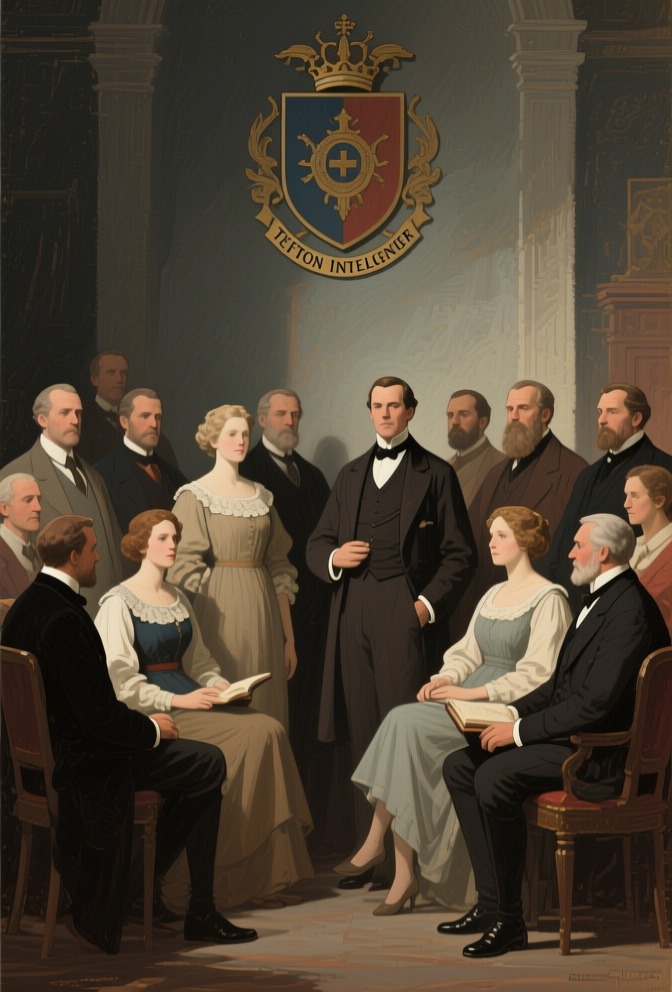
The Tefton Intelligencer is the local newspaper of Trapingus County, whose reporter Burt Hammersmith covered the John Coffey trial and provided Paul Edgecombe with the gruesome details of the Detterick twins' murder that the paper deemed too graphic to print.
John Coffey and Mr. Jingles share a relationship defined by a single, miraculous act of healing that transforms the mouse from a broken, dying creature into a living symbol of Coffey's power and the moral weight of the story. When Percy Wetmore deliberately crushes Mr. Jingles under his boot, snapping the mouse's back, Coffey takes the animal into his hands and, through a process of inhalation and exhalation, restores it to life. This event not only cements the bond between the giant condemned man and the tiny pet but also reveals the nature of Coffey's gift—a power to absorb suffering and expel it—and sets the stage for the novel's central moral crisis.
Paul Edgecombe, the E Block superintendent at Cold Mountain Penitentiary, develops a profound and complex relationship with John Coffey, the giant, childlike man condemned for the rape-murder of the Detterick twins. From their first meeting, Edgecombe is struck by Coffey's gentleness and strange, weeping eyes, and he soon discovers that Coffey possesses a miraculous healing power. This knowledge forces Edgecombe to confront his own beliefs about justice, innocence, and the nature of good and evil, ultimately leading him to risk his career and freedom in a desperate attempt to save Coffey from the electric chair.
The relationship between William Wharton and Dean Stanton is defined by a single, violent encounter: Wharton's surprise attack on Stanton during his arrival at E Block, an assault that nearly killed the guard and exposed the lethal consequences of underestimating a condemned prisoner's cunning.
The rule of never refusing the condemned is an unwritten ethical principle that Paul Edgecombe and the E Block guards follow, rooted in the recognition that condemned prisoners have no real power and that denying their last requests serves no purpose other than cruelty. This rule is tested and ultimately broken during the botched execution of Eduard Delacroix, when Percy Wetmore deliberately uses a dry sponge, causing a horrific death, and later when Paul and his colleagues must decide whether to honor John Coffey's final wish to die without the mask.
The rule "You can only fry a man once" is the grim, pragmatic axiom that governs behavior on E Block at Cold Mountain Penitentiary. It expresses the condemned prisoner's ultimate freedom: because the state can execute him only a single time, he has nothing left to lose, and this knowledge gives him a terrifying power over the guards who must control him. The rule shapes every encounter between the keepers and the kept, turning the Green Mile into a theater where the threat of violence is always balanced by the prisoner's indifference to punishment.
October 27, 1995, is the date of Stephen King's foreword letter to *The Green Mile*, written as the serial publication was underway and the outcome remained uncertain. The letter establishes the book's epistolary frame, explains the serial-novel experiment, and introduces the narrator Paul Edgecombe as an old man writing from a Georgia nursing home, a perspective that governs the entire narrative.
The winter of 1932 is the season following the execution of John Coffey, during which Paul Edgecombe and Brutus Howell discover the remnants of Mr. Jingles's colored spool in a beam of the restraint room, prompting their mutual decision to leave death row work forever.
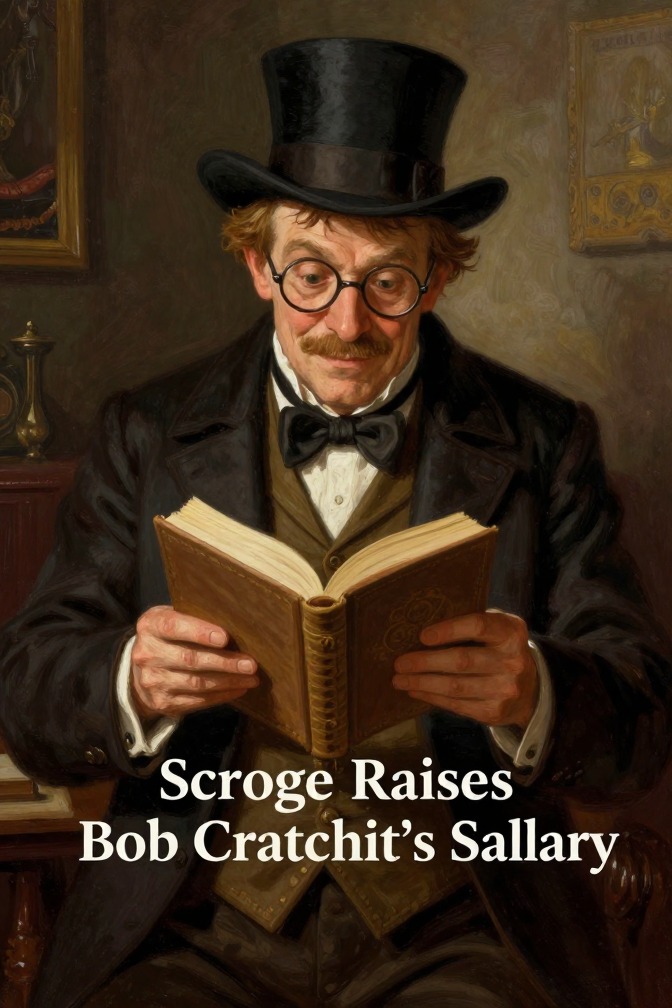
Scrooge Raises Bob Cratchit's Salary is the climactic act of Ebenezer Scrooge's moral transformation on Christmas morning, in which he not only reverses his lifelong miserliness but also becomes a benefactor to his clerk, Bob Cratchit, and his family. This action, performed with theatrical playfulness and genuine earnestness, marks the definitive break from Scrooge's former identity as a cold, grasping man and establishes his new role as a generous master and a second father to Tiny Tim.
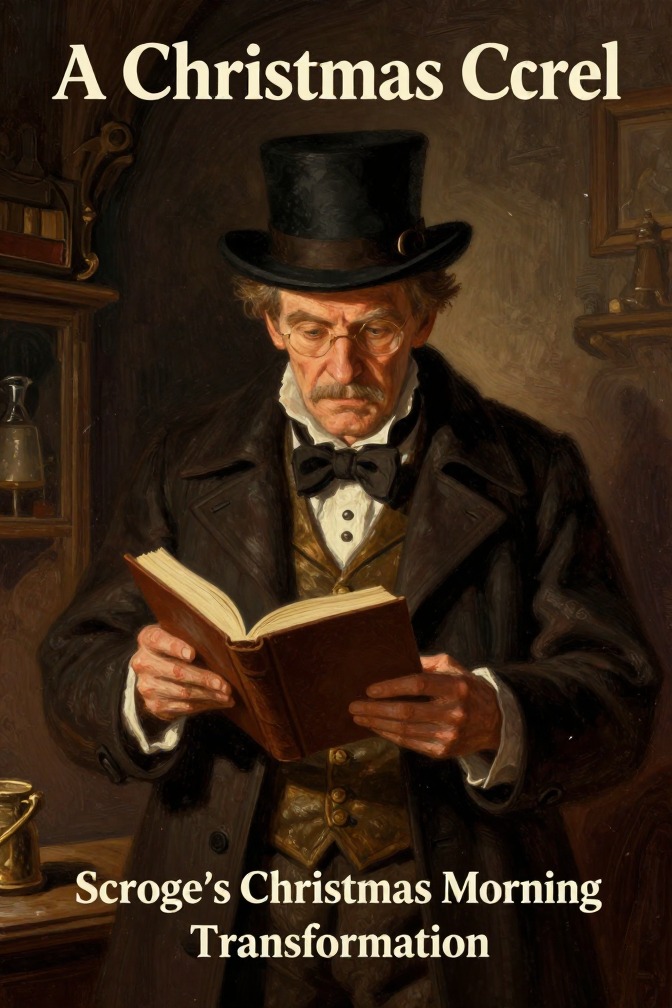
Scrooge's Christmas Morning Transformation is the climactic action of A Christmas Carol, in which Ebenezer Scrooge awakens on Christmas Day a radically changed man, embracing joy, generosity, and human connection after his harrowing night with the three Spirits.
The Ghost of Christmas Present visits Scrooge, revealing the joy, generosity, and human connection of the present Christmas, and confronting him with the dire consequences of his own miserly philosophy.
The Ghost of Christmas Yet to Come visits Scrooge, showing him a future of death, indifference, and isolation, which finally breaks his resistance and leads to his redemption.
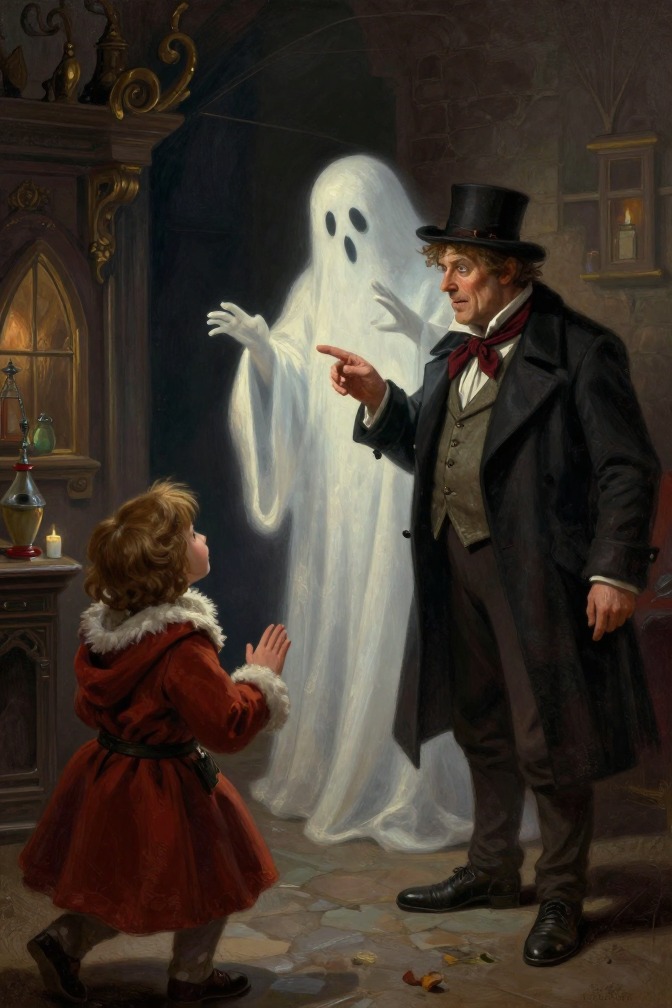
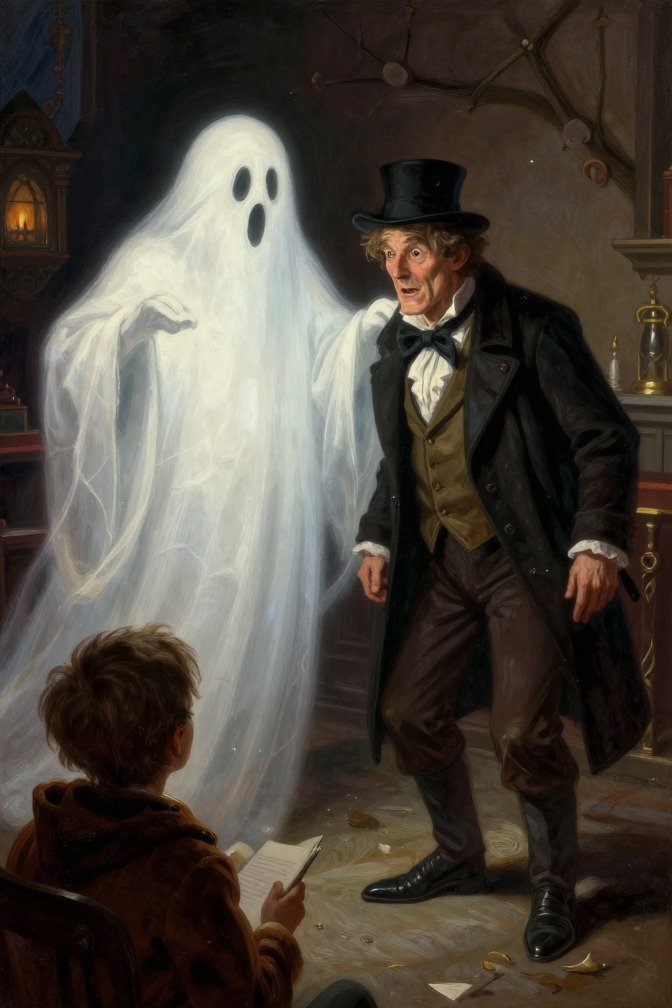
Marley's Ghost visits Scrooge is the pivotal supernatural event that initiates Ebenezer Scrooge's moral transformation, as the seven-years-dead partner appears in Scrooge's chambers on Christmas Eve to warn him of his impending doom and announce the coming of three Spirits.
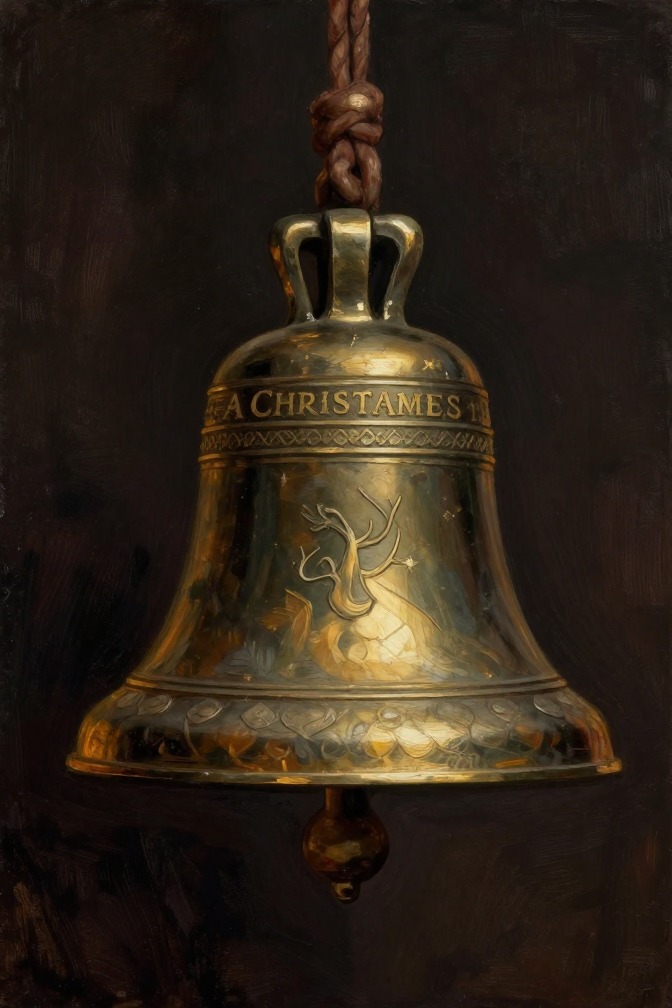
The bell is a disused, forgotten object in Scrooge's chambers that becomes the first supernatural signal of Marley's Ghost's approach, marking the threshold between Scrooge's ordinary world and the spiritual intervention that will transform him.
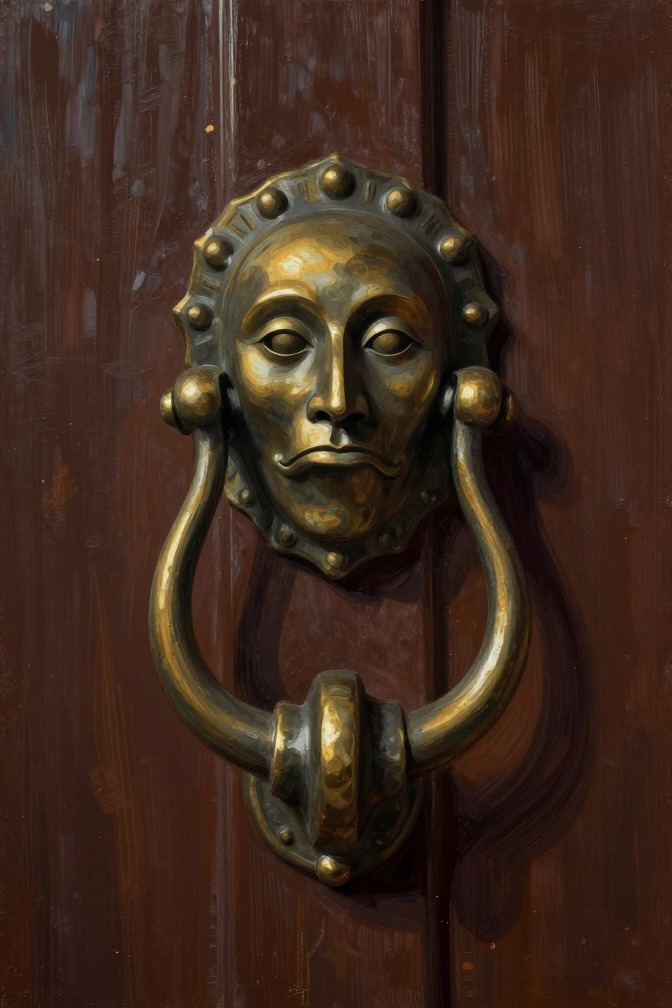
The door knocker on Scrooge's chambers is a seemingly ordinary object that becomes the site of a supernatural vision, transforming into the face of his dead partner Jacob Marley and later serving as a symbol of Scrooge's redemption.
The prize turkey is the enormous bird Scrooge impulsively purchases on Christmas morning and anonymously sends to the Cratchit household, serving as the first concrete act of his transformed character and the story's most vivid symbol of reckless, joyful generosity.
The pudding is the centerpiece of the Cratchit family's Christmas dinner, a humble yet magnificent creation that embodies their joy, resilience, and unity in the face of poverty, and becomes a key symbol of the domestic warmth and communal spirit that Scrooge learns to value.
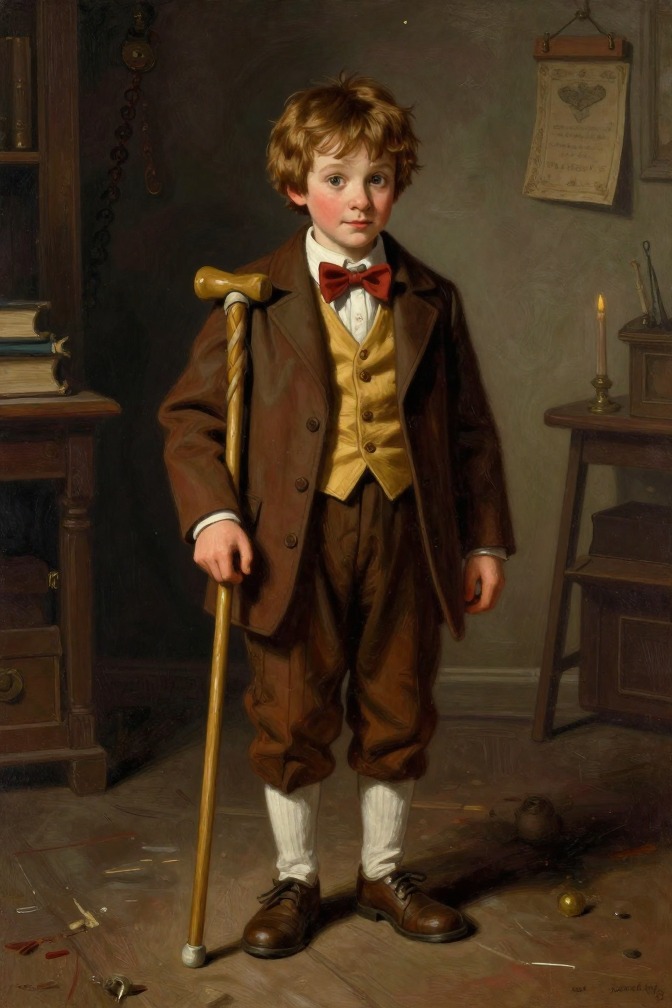
Tiny Tim's crutch is a powerful symbol of the Cratchit family's poverty and the fragility of the child's life, serving as the central object through which Scrooge's moral transformation is measured and ultimately completed.
Every man's business is his own is the governing principle of Ebenezer Scrooge's life before his transformation, a maxim he deploys to reject human sympathy, charity, and moral responsibility. The story systematically dismantles this rule, exposing it as a philosophy of isolation and spiritual death, and replaces it with an ethic of active, generous engagement with others.
New Year's Day appears in A Christmas Carol as a companion greeting to Christmas, a marker of the festive season's hopeful conclusion, and a symbol of the new life Scrooge embraces after his transformation. It is invoked in greetings, toasts, and the final celebration of Scrooge's redemption, reinforcing the story's movement from isolation to community and from spiritual death to renewal.
Twelfth Night, the final festivity of the Christmas season, appears in A Christmas Carol as the setting for a children's party that Scrooge and the Ghost of Christmas Present visit, marking the moment when Scrooge first notices the Spirit's aging and learns that its life is nearly over.
Anne stays at Uppercross is the period from September to late November 1814 during which Anne Elliot, instead of accompanying her father and sister to Bath, resides at Uppercross Cottage with her sister Mary Musgrove and later divides her time between the Cottage and the Great House. This stay, prompted by Mary's claim of illness and Elizabeth's dismissive remark that 'nobody will want her in Bath,' becomes the decisive setting for Anne's reunion with Captain Frederick Wentworth after eight years of separation, the gradual rekindling of his feelings, and the series of events—including the walk to Winthrop, the expedition to Lyme, and Louisa Musgrove's fall from the Cobb—that ultimately lead to their reconciliation. The Uppercross months constitute the emotional and narrative core of Persuasion, transforming Anne from a faded, overlooked daughter into a woman whose constancy, usefulness, and depth of character are finally recognized by the man she never ceased to love.
Anne Elliot volunteers to stay behind in Lyme to nurse the injured Louisa Musgrove, a decision that reveals her competence, selflessness, and the shifting dynamics of her relationship with Captain Wentworth.
Captain Benwick proposes to Louisa Musgrove, an event that astonishes Anne Elliot and the entire Uppercross circle, as it resolves the romantic uncertainty surrounding Louisa and frees Captain Wentworth from a perceived obligation, thereby reshaping the novel's romantic landscape.
Elliot pride is the overweening family vanity that defines Sir Walter Elliot and his eldest daughter Elizabeth, shaping their social judgments, financial decisions, and personal relationships throughout Persuasion. It manifests as an obsessive concern with rank, appearance, and lineage, a contempt for those deemed inferior, and a blindness to genuine worth—traits that Anne Elliot must overcome and that the novel ultimately critiques through the contrasting values of the navy and of personal merit.
Lady Russell's influence is the central shaping force of Anne Elliot's life, most decisively exercised when she persuades the nineteen-year-old Anne to break her engagement to Captain Frederick Wentworth, an act that produces eight years of regret and sets the novel's emotional and moral trajectory.
Persuasion is the central concept and title of Jane Austen's novel, representing the act of being influenced by others' advice against one's own feelings, a force that shapes the lives of the protagonist Anne Elliot and those around her, and whose consequences the novel explores and ultimately redeems.