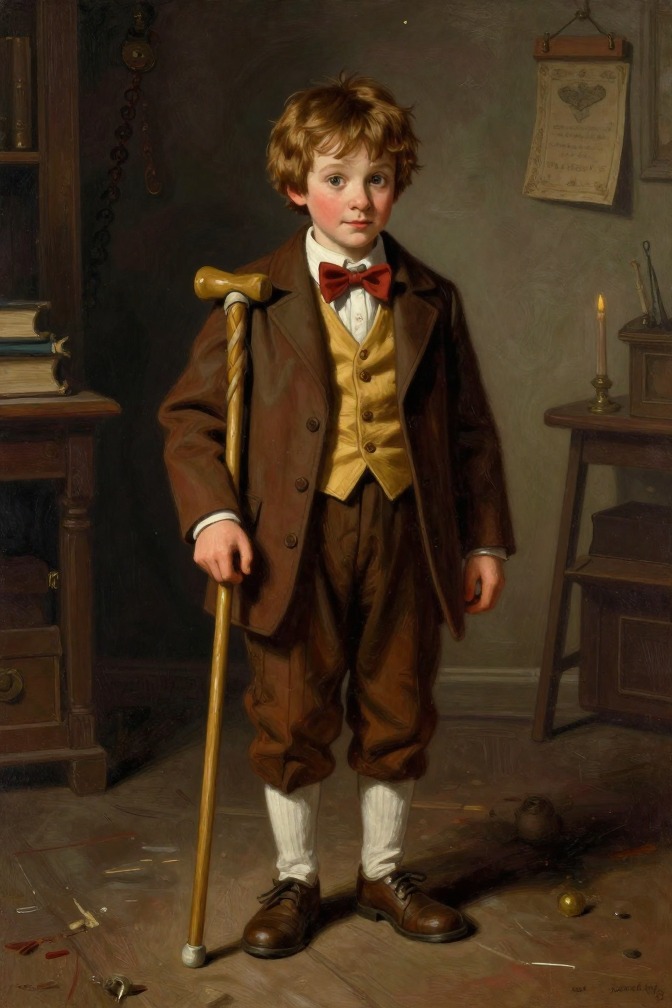
Tiny Tim's crutch is a powerful symbol of the Cratchit family's poverty and the fragility of the child's life, serving as the central object through which Scrooge's moral transformation is measured and ultimately completed.
Every man's business is his own is the governing principle of Ebenezer Scrooge's life before his transformation, a maxim he deploys to reject human sympathy, charity, and moral responsibility. The story systematically dismantles this rule, exposing it as a philosophy of isolation and spiritual death, and replaces it with an ethic of active, generous engagement with others.
New Year's Day appears in A Christmas Carol as a companion greeting to Christmas, a marker of the festive season's hopeful conclusion, and a symbol of the new life Scrooge embraces after his transformation. It is invoked in greetings, toasts, and the final celebration of Scrooge's redemption, reinforcing the story's movement from isolation to community and from spiritual death to renewal.
Twelfth Night, the final festivity of the Christmas season, appears in A Christmas Carol as the setting for a children's party that Scrooge and the Ghost of Christmas Present visit, marking the moment when Scrooge first notices the Spirit's aging and learns that its life is nearly over.
Anne stays at Uppercross is the period from September to late November 1814 during which Anne Elliot, instead of accompanying her father and sister to Bath, resides at Uppercross Cottage with her sister Mary Musgrove and later divides her time between the Cottage and the Great House. This stay, prompted by Mary's claim of illness and Elizabeth's dismissive remark that 'nobody will want her in Bath,' becomes the decisive setting for Anne's reunion with Captain Frederick Wentworth after eight years of separation, the gradual rekindling of his feelings, and the series of events—including the walk to Winthrop, the expedition to Lyme, and Louisa Musgrove's fall from the Cobb—that ultimately lead to their reconciliation. The Uppercross months constitute the emotional and narrative core of Persuasion, transforming Anne from a faded, overlooked daughter into a woman whose constancy, usefulness, and depth of character are finally recognized by the man she never ceased to love.
Anne Elliot volunteers to stay behind in Lyme to nurse the injured Louisa Musgrove, a decision that reveals her competence, selflessness, and the shifting dynamics of her relationship with Captain Wentworth.
Captain Benwick proposes to Louisa Musgrove, an event that astonishes Anne Elliot and the entire Uppercross circle, as it resolves the romantic uncertainty surrounding Louisa and frees Captain Wentworth from a perceived obligation, thereby reshaping the novel's romantic landscape.
Elliot pride is the overweening family vanity that defines Sir Walter Elliot and his eldest daughter Elizabeth, shaping their social judgments, financial decisions, and personal relationships throughout Persuasion. It manifests as an obsessive concern with rank, appearance, and lineage, a contempt for those deemed inferior, and a blindness to genuine worth—traits that Anne Elliot must overcome and that the novel ultimately critiques through the contrasting values of the navy and of personal merit.
Lady Russell's influence is the central shaping force of Anne Elliot's life, most decisively exercised when she persuades the nineteen-year-old Anne to break her engagement to Captain Frederick Wentworth, an act that produces eight years of regret and sets the novel's emotional and moral trajectory.
Persuasion is the central concept and title of Jane Austen's novel, representing the act of being influenced by others' advice against one's own feelings, a force that shapes the lives of the protagonist Anne Elliot and those around her, and whose consequences the novel explores and ultimately redeems.
Admiral and Mrs Croft become tenants of Kellynch Hall, a pivotal event that resolves Sir Walter Elliot's financial crisis by letting his ancestral home to a naval officer and his wife, setting in motion the novel's central reunions and conflicts.
Louisa Musgrove's engagement to Captain Benwick is a surprising turn in Persuasion, resolving the romantic tension around Captain Wentworth and freeing him to pursue Anne Elliot. The news, revealed in a letter from Mary Musgrove, astonishes Anne and the reader, as it pairs the lively Louisa with the melancholy, bookish Captain Benwick, a match that seems improbable but is explained by their shared weeks of intimacy during Louisa's convalescence at Lyme.
Mr Elliot and Mrs Clay leave Bath, an event that concludes the novel's secondary plot, revealing Mr Elliot's true character as a cold, calculating man who abandons his scheme to marry Anne Elliot and instead elopes with Mrs Clay, thereby freeing Sir Walter from her influence and clearing the way for Anne's happiness with Captain Wentworth.
The revelation of Mr Elliot's true character occurs when Mrs Smith, Anne's former schoolfellow, discloses his past duplicity, selfishness, and cruelty, exposing him as a man without heart or conscience who had long schemed for his own advantage.
At the concert in Bath, Captain Frederick Wentworth, unable to bear the sight of Anne Elliot with Mr Elliot, writes her a passionate letter declaring his undying love and offering himself to her again, which becomes the decisive turning point that leads to their reconciliation.
Captain Frederick Wentworth's description of his ideal woman—"a strong mind, with sweetness of manner"—serves as a concise expression of the qualities he most values and, ironically, as an exact portrait of Anne Elliot, the woman he believes he has lost. The phrase encapsulates the central tension of Persuasion between firmness of character and gentleness of disposition, and it becomes a touchstone for the novel's exploration of constancy, persuasion, and the nature of true attachment.
The art of knowing our own nothingness is a phrase that captures Anne Elliot's reflective realization, after moving from Kellynch to Uppercross, that one's own concerns and importance are often invisible or irrelevant outside one's immediate circle. It encapsulates a central theme of the novel: the humbling recognition of personal insignificance in the broader social world, and the quiet wisdom that comes from such awareness.
The phrase "the choicest gift of Heaven" appears in Persuasion as Anne Elliot's reflection on her friend Mrs. Smith's remarkable resilience, a quality that Anne identifies as a divine endowment enabling Mrs. Smith to counterbalance almost every other want through an elastic mind and a disposition to be comforted.
The comfort of cool air is a recurring motif in Persuasion, associated with Anne Elliot's moments of emotional release, physical relief, and solitary reflection, often in natural settings that contrast with the oppressive social environments she must navigate.
The darings of heedlessness and the resolution of a collected mind is a key thematic contrast in Persuasion, articulated by Captain Frederick Wentworth during his walk to Winthrop, where he distinguishes between Louisa Musgrove's reckless impulsiveness and the composed, principled firmness he later comes to recognize in Anne Elliot. This phrase encapsulates the novel's moral argument about the nature of true strength of character, marking Wentworth's own education in distinguishing between superficial boldness and genuine fortitude.
The dread of a future war is the final, quiet note of anxiety that shadows Anne Elliot's happiness as a sailor's wife, representing the personal cost of a profession that brings both glory and constant peril.
The phrase 'the glory of being a sailor's wife' appears in the final chapter of Persuasion, where Anne Elliot reflects on her marriage to Captain Frederick Wentworth. It encapsulates the novel's central theme of finding honor and happiness in a life shaped by the naval profession, a life that demands constant vigilance and the acceptance of risk, but which Anne embraces with full-hearted commitment.
The joy of the escape is a phrase that captures Anne Elliot's profound relief and gratitude when she realizes she will not have to face Captain Frederick Wentworth at a dinner party at Uppercross Great House, following the alarming injury of her nephew, Little Charles Musgrove.
The phrase 'the most perfect good understanding' appears in Persuasion as Anne Elliot's description of the harmonious mutual affection between Henrietta and Louisa Musgrove, a quality she envies because she has known so little of it with her own sisters. The expression encapsulates a central theme of the novel: the contrast between genuine, supportive family bonds and the cold, self-interested relationships that dominate Anne's life at home.
The phrase 'the pen has been in their hands' is a key argument in Anne Elliot's debate with Captain Harville about gender and constancy, asserting that men have historically controlled written narratives and therefore biased the record against women.
The phrase 'the tax of quick alarm' appears in the final chapter of Persuasion, encapsulating the emotional cost Anne Elliot must pay for marrying a naval officer. It represents the perpetual anxiety and fear for a husband's safety that accompanies the glory of being a sailor's wife, a theme that resonates throughout the novel's exploration of love, duty, and the precariousness of life at sea.
The phrase 'the warmth of her heart' appears in the final chapter of Persuasion as the defining quality of Anne Elliot's character, contrasted with Mrs. Smith's 'glow of her spirits' to encapsulate the novel's moral and emotional architecture.
The white glare of Bath is a recurring sensory image in Jane Austen's Persuasion that captures Anne Elliot's visceral aversion to the city, contrasting the harsh, artificial brightness of Bath with the natural, emotional landscapes of Kellynch and Uppercross, and symbolizing the broader themes of displacement, vanity, and the loss of authentic feeling.
The phrase 'the work of an instant' appears in Persuasion at the climactic moment when Captain Wentworth, having just written a letter declaring his enduring love for Anne Elliot, places it before her and leaves the room in a single, swift motion that transforms their entire relationship.
Camden Place is the Bath residence of Sir Walter Elliot and his family after they let Kellynch Hall, a house that embodies their social pretensions, financial decline, and the superficial values of Bath society, while serving as the central setting for Anne Elliot's renewed acquaintance with Captain Wentworth and the revelation of Mr Elliot's true character.