The Confess to Shopkeeper is a pivotal action in Part III of Knut Hamsun's *Hunger*, in which the starving narrator, after stealing five shillings from a provision shop, returns to the shop to confess his crime, only to find the shopkeeper's boy too fearful to act, leading to a bizarre and morally ambiguous confrontation that deepens the narrator's self-loathing.
The narrator's first encounter with Ylajali occurs on a morning in Christiania when, after leaving the park to retrieve his pencil from a pawnbroker, he overtakes two ladies on the street and, in a state of disordered excitement, begins to follow them, inventing the name Ylajali and repeatedly addressing one of them with the cryptic phrase 'You are losing your book, madam,' an episode that establishes the obsessive, hallucinatory quality of his desire and the intersection of hunger, shame, and erotic fixation that will define their relationship.
The protagonist impulsively gives away the five shillings he stole from a shopkeeper to an old cake vendor, an act that briefly restores his sense of honor but leaves him penniless and hungry again.
Write Story is the central creative act through which the unnamed narrator of Knut Hamsun's Hunger attempts to survive, maintain his identity, and resist the collapse of his mind and body. It is not merely a profession but a desperate, recurring ritual of self-creation and self-destruction, a process that oscillates between ecstatic inspiration and crushing failure, and that ultimately defines his relationship to the world, to God, and to his own sanity.
Freedom of Will is a recurring intellectual preoccupation of the unnamed narrator in Knut Hamsun's *Hunger*, a concept he invokes as a potential subject for a lucrative newspaper article but which he ultimately proves unable to write, thereby dramatizing the collapse of his autonomous agency under the pressure of extreme poverty and starvation.
The First Encounter with Ylajali is the pivotal event in Part I of Hunger where the starving narrator, driven by a volatile mix of hunger, nervous excitement, and a sudden, inexplicable impulse, accosts a strange woman on the street, invents the name 'Ylajali' for her, and follows her to her home, establishing a haunting, obsessive connection that will recur throughout the novel.
The Night in the Guard-House is a pivotal event in which the starving narrator, locked out of his lodgings and homeless, reports himself to the police under a false name and spends a night in a cell, where he experiences a hallucinatory crisis of darkness, invents the word "Kuboa," and nearly succumbs to madness before the dawn restores him.
Philosophical Cognition is a three-volume dissertation that the protagonist of Hunger conceives during a moment of grand ambition, only to have its creation thwarted by the loss of his pencil, symbolizing the gap between his intellectual aspirations and the brutal reality of starvation.
The green blanket, borrowed from Hans Pauli Pettersen, is a recurring object in Knut Hamsun's *Hunger* that embodies the protagonist's desperate poverty, his wavering moral integrity, and the constant temptation to commit theft for survival. It serves as a tangible symbol of his borrowed existence and the thin line between honor and degradation.
Dampkökken is a steam cooking kitchen and famous cheap eating-house in Christiania that appears in Knut Hamsun's novel Hunger as a recurring symbol of the nourishing, ordinary life from which the starving narrator is excluded.
The Grand Hotel in Christiania serves as a central landmark in Knut Hamsun's *Hunger*, a symbol of the social and economic divide that the starving narrator both observes and is excluded from. It is a place of warmth, light, and conviviality, a constant reminder of the life he cannot afford, and a site where his desperation and alienation are thrown into sharp relief.
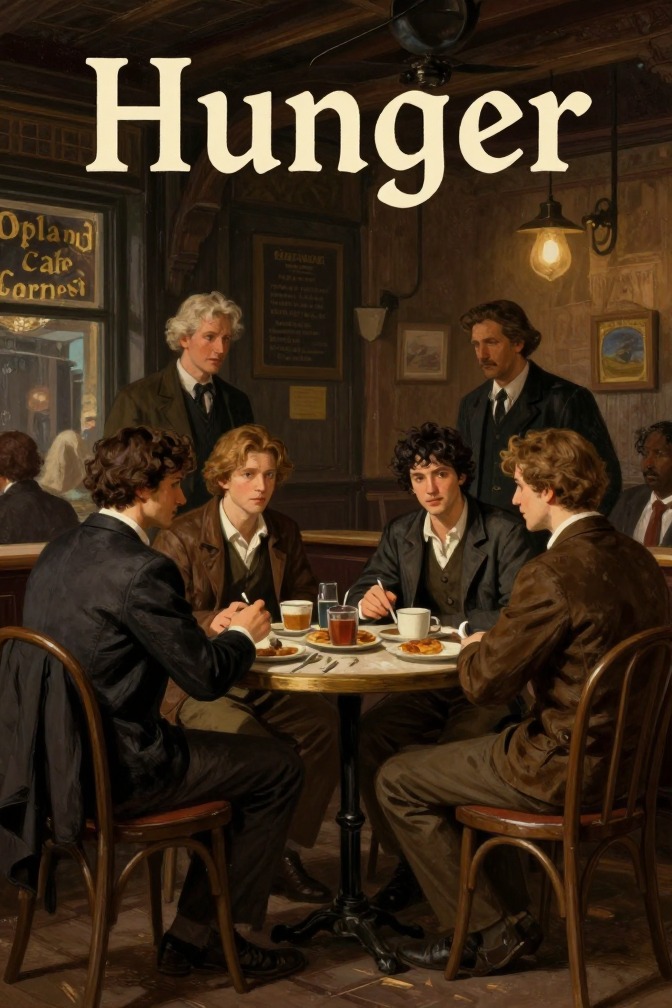
The Opland Café is a recurring location in Knut Hamsun's *Hunger*, serving as a site where the protagonist seeks out an acquaintance for financial help and, later, a place to buy a candle. It represents a fleeting hope for relief from his relentless poverty and hunger, but ultimately becomes another setting where his desperate circumstances are met with failure.
Kathe Detterick, one of the nine-year-old twin daughters of Klaus and Marjorie Detterick, was abducted, raped, and murdered in June 1932, a crime for which John Coffey was wrongfully convicted and executed. Her death, along with that of her sister Cora, forms the central injustice of the novel, and the circumstances of the crime—the killer's manipulation of the girls' love for each other to silence them—become a key revelation about the true nature of evil.
The black insects are a physical manifestation of the sickness, pain, and death that John Coffey draws out of those he heals. They appear as a swirling cloud expelled from his mouth and nose after he has absorbed an affliction, first turning white and then vanishing into the air. The insects represent the tangible transfer of suffering from the healed to the healer, and their presence marks every instance of Coffey's miraculous power.
The mouse that appears on E Block at Cold Mountain Penitentiary in the summer of 1932, first called Steamboat Willy by Brutus Howell and later named Mr. Jingles by Eduard Delacroix, is a creature of extraordinary intelligence and emotional significance. It becomes Delacroix's devoted companion, learns to fetch a colored spool, and is nearly killed by Percy Wetmore before being miraculously healed by John Coffey. The mouse survives for decades after Coffey's execution, living into the 1990s with Paul Edgecombe at Georgia Pines, and its death marks the end of the last living connection to the miracles of the Green Mile.
The prison auto shop at Cold Mountain Penitentiary was a planned but never-built facility, emblematic of the Depression-era pork-barrel politics and institutional inertia that characterized the prison's administration. Its intended site, the old library building, became a symbol of abandoned ambition and the pervasive smell of decay that marked the prison's physical plant.
Trapingus County is the rural southern jurisdiction where the Detterick twins were raped and murdered, and where John Coffey was arrested, tried, and convicted for the crime. It is the site of the crime scene on the Trapingus River, the county seat of Tefton, and the domain of the incompetent Sheriff Homer Cribus. The county's legal and social machinery—its all-white jury, its prosecutor, and its press—functioned to condemn Coffey swiftly, and the evidence that might have exonerated him was never allowed to surface.
John Coffey and Melinda Moores are connected by a single, transformative act of healing that redefines both characters: Coffey, a condemned man with miraculous powers, draws a fatal brain tumor out of the warden's wife, restoring her to health while absorbing her suffering into himself, an event that deepens Paul Edgecombe's moral crisis and sets in motion the final tragedy of Coffey's execution.
The 1930s, the decade of the Great Depression, forms the historical backdrop for Stephen King's *The Green Mile*, shaping the economic desperation, social attitudes, and penal practices that drive the novel's plot and character motivations.
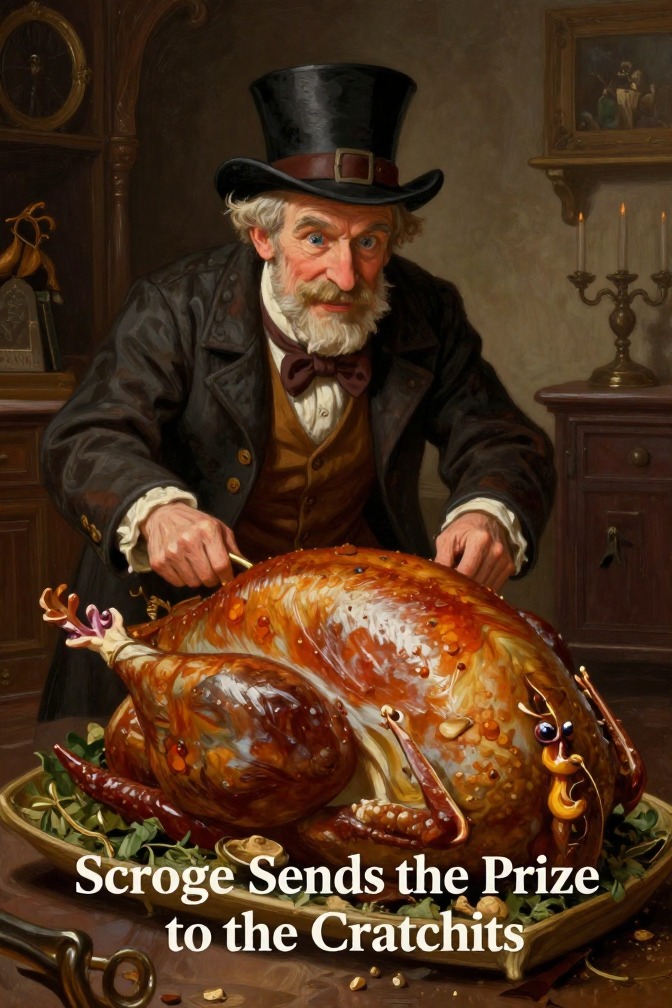
Scrooge Sends the Prize Turkey to the Cratchits is the first concrete act of Ebenezer Scrooge's redemption on Christmas morning, a secret, anonymous gift of an enormous turkey to the family of his clerk, Bob Cratchit, that marks his decisive break from a lifetime of miserliness and his embrace of the Christmas spirit of generosity.
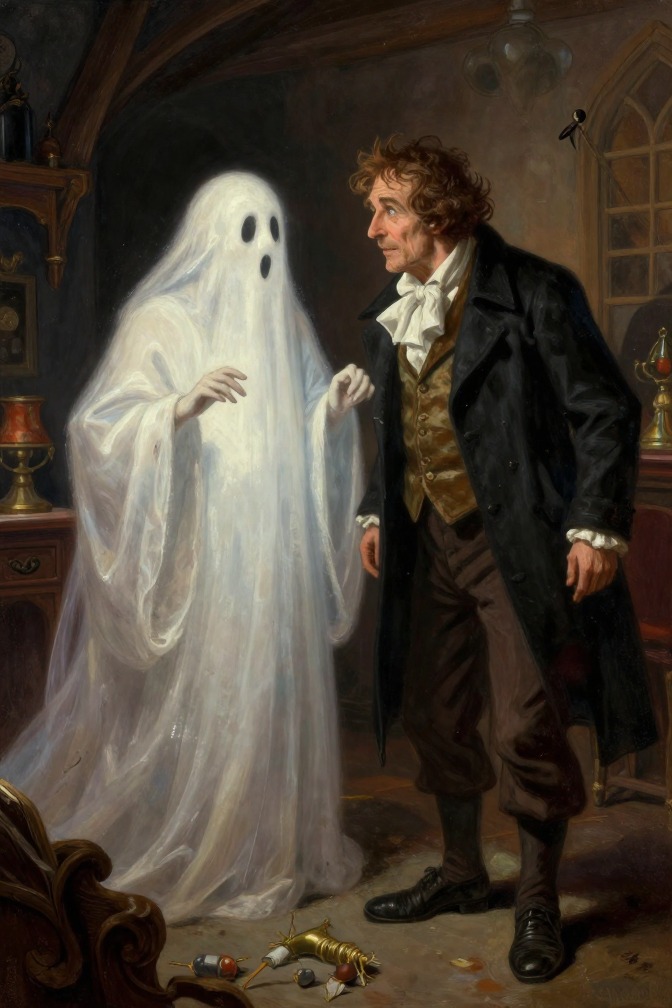
The Ghost of Christmas Past visits Ebenezer Scrooge, initiating his moral reclamation by forcing him to confront the painful and joyful memories of his own history, from his lonely childhood and beloved sister to his apprenticeship and the broken engagement that set him on the path to miserliness.
Negus is a warm, spiced wine drink that appears in A Christmas Carol as a symbol of festive generosity, domestic comfort, and communal joy, most notably served at the Fezziwig Christmas party and later referenced in Scrooge's final transformation.
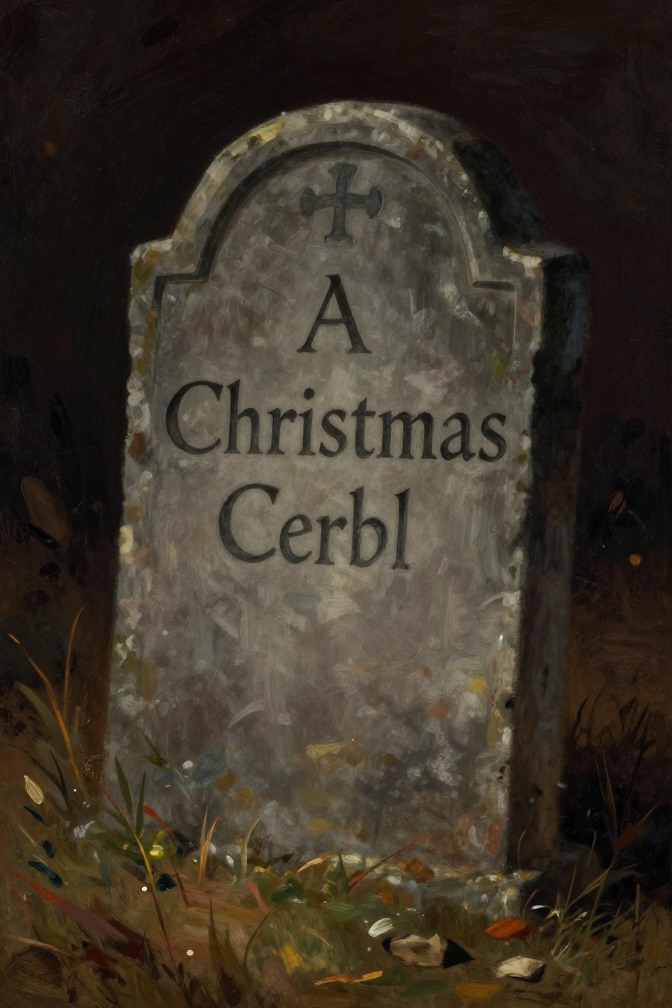
The grave stone is the neglected, weed-choked marker in a churchyard that bears the name Ebenezer Scrooge, which the Ghost of Christmas Yet to Come shows Scrooge as the culminating vision of his possible future. It is the single object that forces Scrooge to confront the literal end of his isolated, avaricious life and becomes the catalyst for his desperate plea to change his course.
Scrooge and Marley is the counting-house and partnership firm founded by Ebenezer Scrooge and Jacob Marley in London's financial district, whose name endures above the warehouse door years after Marley's death and whose identity as a business entity becomes the symbolic anchor of Scrooge's miserly worldview before his transformation.
Firmness of character is a central concept in Persuasion, explored through the contrasting behaviors of Anne Elliot, Captain Wentworth, and Louisa Musgrove. The novel ultimately critiques rigid, unyielding firmness, advocating instead for a balanced resolution that incorporates principle, flexibility, and genuine feeling.
Louisa Musgrove's engagement to Captain Benwick is a surprising turn in Persuasion, resolving the romantic tension around Captain Wentworth and freeing him to pursue Anne Elliot. The news, revealed in a letter from Mary Musgrove, astonishes Anne and the reader, as it pairs the lively Louisa with the melancholy, bookish Captain Benwick, a match that seems improbable but is explained by their shared weeks of intimacy during Louisa's convalescence at Lyme.
Mr Elliot and Mrs Clay leave Bath, an event that concludes the novel's secondary plot, revealing Mr Elliot's true character as a cold, calculating man who abandons his scheme to marry Anne Elliot and instead elopes with Mrs Clay, thereby freeing Sir Walter from her influence and clearing the way for Anne's happiness with Captain Wentworth.
The revelation of Mr Elliot's true character occurs when Mrs Smith, Anne's former schoolfellow, discloses his past duplicity, selfishness, and cruelty, exposing him as a man without heart or conscience who had long schemed for his own advantage.
The glow of his soul is a phrase from Captain Harville's impassioned speech to Anne Elliot in Chapter 23 of Persuasion, describing the profound emotional experience of a sailor who, after a long and perilous separation, is reunited with his wife and children. It encapsulates the novel's central theme of enduring love and constancy, particularly within the context of the naval profession, and serves as a key moment that prompts Captain Wentworth to reveal his own undiminished feelings for Anne.
The sweet scenes of autumn is a recurring motif in Persuasion, representing Anne Elliot's emotional landscape, her nostalgia, and the bittersweet passage of time. The phrase appears during a key walk at Uppercross, where Anne, surrounded by the fading beauty of the season, reflects on lost love and the decline of her own happiness.