Stromboli
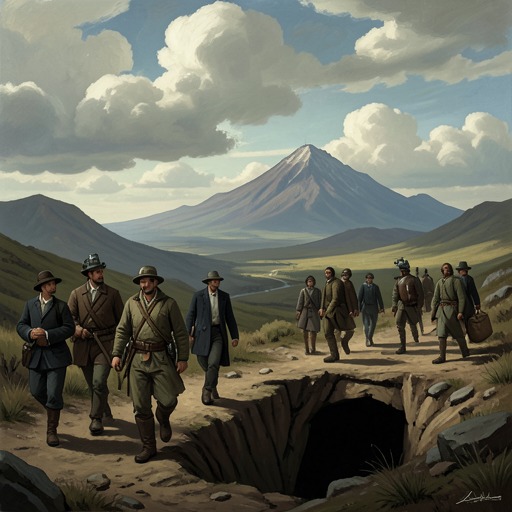
A Journey to the Centre of the EarthStromboli is the Mediterranean island where Henry Lawson and Professor Hardwigg emerge from the earth after entering it through Sneffels in Iceland. Its identification turns an apparently impossible escape into a concrete geographic arrival: the explorers have crossed from a landscape of eternal snow to Sicily’s green country and blue sky, and the island becomes the threshold between the subterranean expedition and their return to Europe.
Identification and Setting
A little shepherd supplies the name when asked what the island is called. His reply is brief, but it changes the explorers’ understanding of where they are. They recognize Stromboli as the ancient Strongylos, associated in myth with Aeolus keeping the winds and tempests chained, and identify the blue mountains toward the rising sun as Calabria. Etna, described as the mighty volcano on the southern horizon, completes the newly legible Mediterranean landscape.
The name itself prompts an outburst of recognition. Henry repeats it, while Professor Hardwigg joins his gestures and words in what Henry likens to an ancient chorus. The scene sets the island’s immediate, physical identity against its mythic associations: this is at once a real place they can locate by its neighboring mountains and a landscape charged with classical memory.
The Expedition’s Emergence
Stromboli marks the expedition’s extraordinary reversal of direction. The travelers had entered the earth through one volcano and emerged through another, more than twelve hundred leagues from Sneffels. The distance links the Icelandic starting point to the Mediterranean destination while emphasizing how completely the underground journey has displaced them from their point of entry.
The change is registered through contrasting climates and colors. The expedition leaves behind Iceland’s eternal snows and gray fog and arrives in a land of verdure beneath an azure Sicilian sky. Stromboli therefore gives geographical form to the ending’s transformation: what began as a descent into darkness concludes in an open, sunlit region. The volcano is not simply an exit but the counterpart to Sneffels, completing the journey through the earth by returning the explorers to the surface at a distant point.
Arrival and the Return to Safety
After reaching the island, the travelers eat fruit and drink fresh water, then continue toward the port of Stromboli. They decide not to explain how they arrived. They fear that local Italian superstition might lead people to regard them as demons vomited from the infernal regions, so they present themselves instead as humble, unfortunate shipwrecked travelers. That safer account conceals the extraordinary route while making practical contact with the island’s inhabitants possible.
The Strombolite fishermen receive them as shipwrecked travelers and provide clothes and food. After forty-eight hours, on September 30, a small vessel carries them to Messina, where several days of rest restore them. Stromboli thus supplies not only the point of emergence but the first human welcome after the underground ordeal. Its people help turn an escape from a volcanic outlet into a survivable return to settled life.
Narrative Significance
The island’s role in the conclusion depends on the contrast between the scale of the expedition and the ordinary means by which it ends. A shepherd’s place-name identifies the explorers’ position; fishermen’s hospitality and a small vessel carry them onward. The extraordinary achievement has to be translated into a comprehensible public story, and the travelers choose the familiar fiction of shipwreck rather than disclose a journey through the earth.
The final route continues beyond Stromboli: the explorers sail from Messina aboard the Volturne, land at Marseilles three days later, and reach Hamburg on October 9. Yet the island remains the decisive point at which their underground passage becomes a return journey. The account closes by insisting that the whole narrative may be disbelieved, even as its narrator claims to be armed against incredulity. Stromboli’s concrete geography—its shepherd, neighboring mountains, fishermen, food, and port—anchors that improbable ending in the details of an actual arrival.