Jaws of Life
AccidentThe Jaws of Life is the powerful vehicle-extrication tool deployed after the Golden Gate Bridge collision to open the wrecked car and free Allyson Clarke. Its decisive role lies not in acting alone but in enabling a carefully coordinated rescue: rescuers use it alongside cutters, saws, chains, and medical equipment while working against the possibility that Allyson will not survive long enough to reach the hospital.
Arrival and Rescue Priorities
A five-person crew arrives with the Jaws of Life and quickly assesses the wreck with the people already at the scene. The rescuers prioritize Allyson, whose condition is critical, while Chloe Thorensen receives oxygen through an open window and waits; she is in serious distress, but Allyson is in greater immediate danger, and the front seat must be removed before Chloe can be moved. Jamie Applegate is also inside the car. The crew’s first actions make the vehicle safer to work on: one rescuer stabilizes it with wedges and chocks, another deflates the tires, and others clear broken glass. Tarps cover the young people so falling glass will not injure them as the work continues.
How the Tool Is Used
The extraction proceeds in stages rather than through one forceful movement. Rescuers remove the windows, including the windshield, which two men work around with a flathead ax before folding it away. With Allyson still covered by a tarp, one rescuer enters the car, removes the keys, and cuts the seat belts. The crew then opens the roof using a hydraulic cutter and hand hacksaws. The Jaws of Life is inserted into a drilled opening in the door to force it open. The machine weighs close to one hundred pounds and requires two men to hold it; its loud operation is compared in the scene to a jackhammer.
Once the door has been removed, the rescuers pull away the dashboard and steering assembly with nine-foot chains and a giant hook. They do not move Allyson as soon as the car is opened: paramedics first slip a backboard beneath her to further immobilize her. The tool’s forceful work is therefore paired with deliberate restraint. The car is progressively opened, but the people inside still have to be moved with care to avoid causing further harm.
Extraction and Immediate Outcome
A paramedic lies beside Allyson during the operation, monitoring her breathing, IV, and air tube. After the front of the car, roof, and doors have been removed, the paramedics can lift her out. The team carries her gently to a gurney and runs as smoothly as possible to the waiting ambulance, balancing urgency against the need to protect her neck and spine. The sequence takes place under acute pressure: the rescue crew has been at work only moments, and the doctor watching them believes that Allyson’s chance of surviving depends on their speed and practiced coordination.
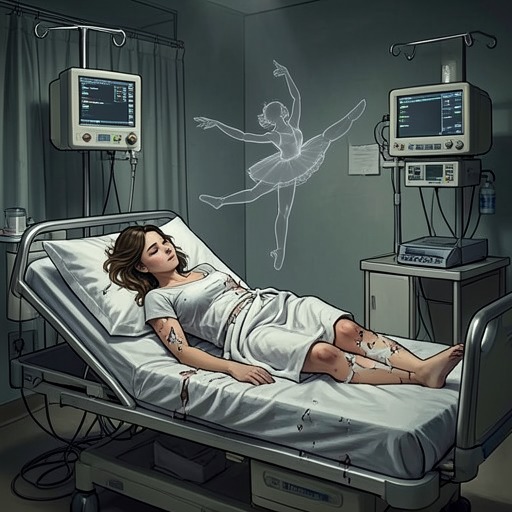
At exactly midnight, an ambulance leaves the bridge carrying Allyson, Phillip Chapman’s body, and the young doctor, who wants to accompany her although he knows she needs a neurosurgeon. Two additional ambulances arrive, and their paramedics turn to Chloe and Jamie. Allyson is taken to the intensive care unit; later, as she begins to improve, she is weaned off the respirator but remains there for observation. The narrative does not make the tool a guarantee of recovery: it makes extraction and urgent medical treatment possible while the outcome remains uncertain.
Narrative Significance
The Jaws of Life gives physical form to the rescue’s central conflict between speed and delicacy. The crew must dismantle the car rapidly, yet each step is controlled and sequenced around the occupants’ needs. The machine’s weight and noise make its material force unmistakable, while the backboard, air tube, and paramedics’ close monitoring show how that force is subordinated to careful human coordination. The tool is crucial to getting Allyson out, but the scene presents survival as dependent on an entire chain of actions, from stabilizing the vehicle to carrying her to the ambulance.