Marin General Hospital
AccidentMarin General Hospital becomes the central medical setting in the immediate aftermath of the crash: the place where news of survival first arrives, danger is assessed, and the family’s hopes are repeatedly tested against clinical uncertainty.
Emergency arrival and first assessments
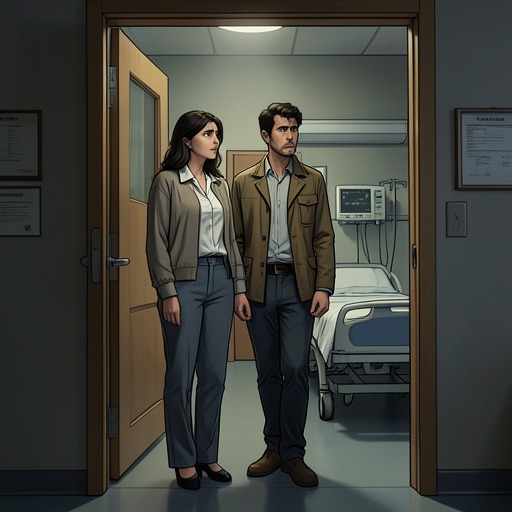
Page Clarke learns by telephone that Allyson Clarke has been taken to Marin General Hospital, is still alive, and remains in critical condition; the staff cannot yet provide more because the doctors are occupied with her. Page reaches the hospital about eight minutes later and runs into a crowded emergency unit, where she sees reporters taking notes from a highway patrolman. A staff member confirms that Allyson is alive but very badly hurt, with a severe head injury, and that the neurosurgical team is attending to her. The first account of her condition turns the hospital from a destination into a place of suspended uncertainty: Page must wait for specialists to explain what can be known and what remains undecided. The neurosurgeons warn that swelling and the extent of the damage could leave Allyson in a permanent coma or with major brain impairments, and recommend immediate surgery. Page asks whether Allyson could ever be well again, and whether waiting would change the decision; the urgency is inseparable from the fact that Brad Clarke is Allyson’s father too. When Page is eventually allowed into the intensive-care room, monitors and medical equipment surround her daughter, making visible the scale of the intervention while offering no assurance yet about its outcome.
Operations and intensive care
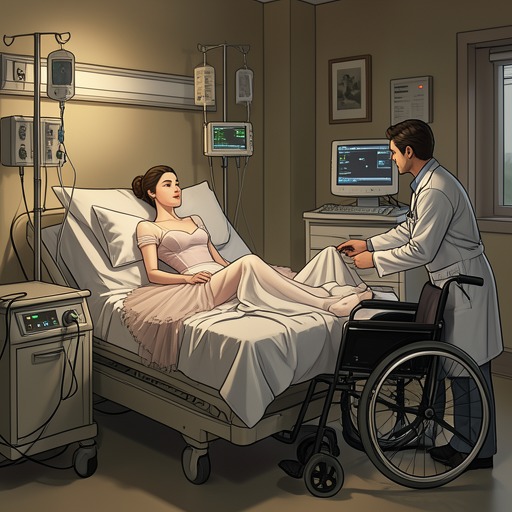
Chloe Thorensen’s surgery gives the hospital’s first guardedly encouraging report. Her pelvis has been repaired, her hip replaced, and rods and pins placed in both legs; the surgeon expects the hardware to be removed in a year or two. Although her ballet ambitions are over, the doctors are optimistic that she may walk and perhaps dance again, depending on her recovery in the coming weeks. Trygve Thorensen cries as he hears the assessment, which offers hope for Chloe even as Allyson’s condition remains uncertain.
At Marin General Hospital, Page Clarke learns that Allyson has weathered her first operation as well as could be expected and will need further transfusions. Because Page has the same blood type, she gives a pint of blood. She spends the night in the waiting room, scarcely sleeping, and is finally allowed to see her daughter early the next morning. The hospital’s timetable—updates, waiting, brief visits—becomes the measure of a vigil in which even a stable condition is only provisional.
The feared swelling develops, putting pressure on Allyson’s wound and skull and raising concern about blood clots. When the pressure becomes dangerous and there is no improvement, the doctors call for another operation, only four days after the first. Page signs the consent papers and sits with Allyson in the otherwise quiet intensive-care unit, holding her hand, speaking to her, touching her cheek, and kissing her before the staff take her to surgery. The decision is urgent: the doctors tell Page that without the operation Allyson would not survive.
Afterward, the surgeon reports that Allyson survived and that her vital signs are good. The team has relieved as much pressure as possible, though the problem was worse than expected; medication is keeping her subdued to give her brain time to repair. The possibility of a full or near-full recovery remains open, but so does the danger of death, and the doctors cannot yet say how long she will remain comatose. At Marin General, reassurance never quite becomes certainty: each favorable report is paired with another period of waiting.
Recurrent emergencies and the long aftermath
Marin General Hospital soon becomes familiar for reasons beyond Allyson Clarke’s crisis. When Andy Clarke is injured at school, Trygve Thorensen is told that the boy may have a broken shoulder and drives to the emergency room. Andy arrives conscious and frightened; examination shows a broken arm and dislocated shoulder, and the staff check him for a possible head injury. Trygve stays beside him while the shoulder is put back in place and the arm is set. Andy leaves with his arm in a sling, pain medication, and instructions to rest in bed for a day; the cast is to remain for six weeks. For Page Clarke, already worn down by waiting for Allyson, the news brings a fresh shock. Trygve puts an arm around her as she shakes and cries, then drives her and Andy home. The hospital’s emergency department, by now familiar to the family, gathers separate injuries and separate fears into one continuing ordeal.
The intensive-care setting also receives visitors whose presence contrasts with the uncertainty surrounding Allyson’s condition. Alexis Addison arrives with her mother, dressed for an elegant New York lunch rather than a hospital visit; their conspicuous finery marks the distance between ordinary social life and the crisis unfolding at Marin General. But the decisive measure of Allyson’s progress is neither appearance nor reassurance. In the later work with a therapist, Page helps stretch her daughter’s muscles, which remain rigid and difficult to move. The exercises are exhausting, and Allyson’s body and mind seem not to respond, turning care into a slow test of endurance rather than a quick recovery.
When Allyson eventually shows signs of waking, the hospital again becomes the place where hope meets an uncertain prognosis. Page sits beside her for a long time, crying and looking at her, before Frances arrives in disbelief. A doctor asks Allyson to squeeze his hand and look at him; she manages both requests, but does not speak, instead looking toward her mother and shaking her head. The doctor explains that she has probably lost most of her language and much of her large-motor ability, while the extent of the brain damage remains unclear. The change from coma to responsiveness is profound, but Marin General’s role in the family’s story does not end with that change: the hospital’s assessments make clear that survival and recovery are not the same, and that the next stage will be measured in uncertain capacities and sustained care.
What the hospital can and cannot promise
Marin General Hospital’s importance lies not in offering a single authoritative answer but in showing how the meaning of survival changes as knowledge accumulates. Early clinical judgments frame Allyson Clarke’s condition through immediate threats and probabilities; later, responsiveness marks a change without resolving what she can recover. The hospital thus distinguishes being alive from being well, and waking from regaining language, movement, or independence. Its medical assessments guide urgent decisions, but their limits remain visible: each new sign alters what the family can hope for without settling the future.