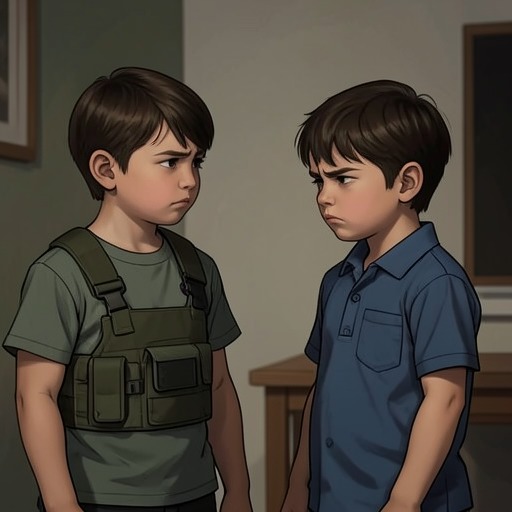
Page and Brad separate and decide to divorce
AccidentPage and Brad separate and decide to divorce after the concealment and conflict in their marriage become impossible to contain within the same home. Their separation unfolds alongside Allyson’s prolonged medical crisis, but Page recognizes that the accident may have exposed rather than caused the marriage’s underlying fractures. Brad moves out, Andy experiences the break as a loss of family, and the eventual decision to contact lawyers gives the separation a legal direction without making it emotionally simple.
Causes and the decision to separate
The decision comes during a private conversation in the garden, away from the rest of the household. Brad describes a life divided among competing pressures: he is rarely at home, Page is angry, Andy watches him, and he struggles to make himself visit Allyson. Stephanie is pressing him to move in with her, but he is uncertain whether he is ready. He considers staying elsewhere for a while, yet recognizes that the existing arrangement is not working for anyone. His account makes clear that the affair with Stephanie is not an abstract secret in the background; it is shaping where Brad wants to live and what he can offer his family.
Page does not ask him to remain simply because the marriage once seemed secure. She tells him to move out, then explains that they have been pretending for weeks and that the marriage may have been over before she learned about his other life. Brad had not told her what he was doing until he was ready to let go of their shared life, she believes. He regrets having said it, but cannot undo the disclosure and does not truly want to take it back. Their conversation is subdued, yet its central change is decisive: the question shifts from how to preserve the household to how to end living together.
Both wonder whether the accident brought them to this point or merely acted as a catalyst. Page cannot reconcile the separation with her former belief that they had a perfect life, and she cannot identify a single mistake that explains its collapse. The uncertainty does not reverse her decision. She concludes that the situation has become nightmarish and that the family cannot continue as it is. The scene presents the marriage’s end not as a sudden verdict on one argument, but as the recognition of a breakdown neither spouse can now plausibly deny.
Moving out and telling Andy
Brad agrees to organize his departure. He plans to travel to New York, return on Thursday, and work out what to do by the following weekend. Page, meanwhile, decides that her mother should leave the house the next morning. She understands that her mother, Alexis, and Brad have each been using or hurting her in different ways, and resolves to stop sustaining those arrangements. The separation thus coincides with a broader effort to reclaim the household and set limits on relationships that have become painful.
When Brad returns from New York, Page does not see him at first. He visits Allyson at the hospital while Page is away, then later arrives home to pack. Andy enters the bedroom and finds suitcases on the floor, another on the bed, and clothes scattered around. The practical signs of departure tell him what the adults had not yet explained. Brad tells him he is moving to the city, while Andy will stay with Page. Andy asks whether his parents are getting divorced. Brad says that they may be, and explains that moving out seemed sensible because he and Page have been fighting so much. Andy also wonders whether his own earlier act of running away is the reason his father is leaving; the question shows how readily a child can interpret an adult decision as his responsibility.
Brad stays overnight and works through papers, but the next morning does not restore the family’s ordinary rhythms. Page makes pancakes and sausages, food the family usually likes, yet no one can eat. Andy, whose broken arm prevents him from playing in his scheduled baseball game, wants Brad to stay and play with him. Brad nevertheless says he needs to return to the city, where Stephanie is waiting. The domestic details make the departure concrete: the family’s familiar meal and the child’s missed game cannot hold Brad in the home.
As Brad loads bags and boxes into his car, Andy asks when he will see him. Brad promises the next Saturday and says Andy can call him daily at the office, asking him to imagine that he is away on a trip. But the promises do not quiet Andy, who cries as Brad leaves; Page cries too. She and Andy remain together after the car has gone. For Page, the departure feels like losing two people they love, a grief intensified by Allyson’s accident and continuing absence from home.
From separation to divorce
The move does not immediately settle the legal future of the marriage. Later, when Brad and Page meet at the hospital, he says it is time to call their lawyers. He argues that continuing to hang on is painful and may give Andy false hope; knowing that the separation is final, he thinks, might help all of them adjust. Page agrees, though she experiences the step as the final death knell for the marriage. She knows she has a right to a family and a husband, but recognizes that wanting those things does not guarantee their return.
Brad says they will probably be divorced by the end of the year, perhaps before Christmas, because Stephanie hopes to marry him on Christmas Eve if the divorce comes through in time. The prospect gives the legal timetable a starkly different emotional meaning for each person: a new marriage is being planned on one side of the separation, while Page must summon herself to call an attorney on the other. She says she would put other things on her Christmas list, but agrees to make the call the following morning. After touching Brad’s hand, she returns to the intensive care unit and sits with Allyson. That night she does not call Trygve; she needs one last moment to mourn Brad before moving toward the future.
Context and significance
The separation takes shape while the family is still living with uncertainty about the car crash. Earlier, Trygve and Page could not establish who crossed the center line, and the available evidence did not settle whether Phillip or Laura Hutchinson was responsible. A newspaper account, Trygve argues, had cast suspicion on Phillip while presenting Laura as respectable, despite the unresolved evidence. Those disagreements show the family searching for someone to blame while the consequences—Phillip’s death, Allyson’s critical condition, and Chloe’s injuries—remain unchanged. They form part of the pressure surrounding Page and Brad, but the couple’s garden conversation does not reduce their marital breakdown to the accident alone: Page explicitly considers whether it was only a catalyst.
Much later, news that Laura has been arrested after a fatal drunk-driving crash in La Jolla confirms Page’s fear that Laura may have been drunk during the earlier collision as well. Page cries, and the new report vindicates Trygve’s suspicions about the possibility of Laura’s responsibility. This reversal changes the family’s understanding of the crash, but it arrives after Page and Brad have already agreed that their marriage is ending. The narrative keeps the two losses distinct: evidence can revise the story of who may have caused the accident, but it cannot undo Brad’s departure, erase the hurt between him and Page, or restore the family life Andy understood as his own.