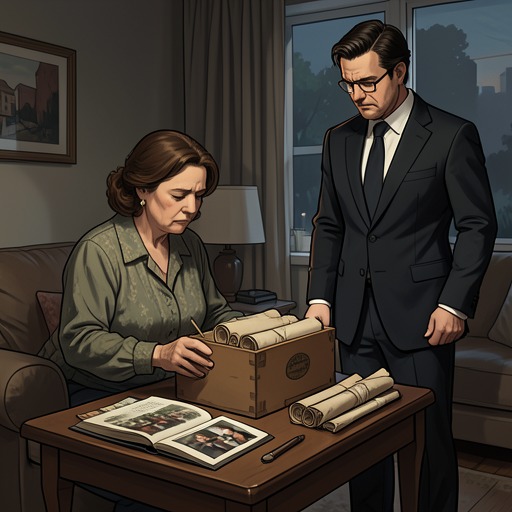
Preserving memories through keepsakes
Always and Forever, Lara JeanPreserving memories through keepsakes is a recurring practice through which Lara Jean tries to make affection durable: she saves objects, gathers moments into stories, and offers mementos to people she loves. Yet a keepsake can carry different meanings for giver and recipient. The scrapbook she makes for Peter is meant to honor their shared history, but he reads it as a sign that she is preparing to leave; a small framed photograph for Chris, by contrast, makes their lasting friendship tangible as she departs for college. The tension between remembrance and separation gives these objects their emotional force.
Memory in ordinary details
Lara Jean’s earliest memories of her mother are not formal keepsakes but intimate scenes she preserves in recollection. After a bath, she sat cross-legged while her mother combed tangles from her hair. Another memory returns to the McDonald’s parking lot, where, while Margot was at piano lessons, mother and daughter shared secret ice-cream sundaes. Lara Jean remembers the caramel and strawberry sauce, and how her mother gave her the peanuts she liked best. These recollections are blurred and ordinary rather than sharply defined; she describes them as a feeling, a hum of memory in which moments blend together. Their tenderness lies precisely in their smallness: the remembered gesture becomes lasting proof of being known and loved.
That private way of preserving the past is set beside the family’s first great loss. Lara Jean remembers her mother’s funeral when she was nine, Margot was eleven, and Kitty was two. The clearest image is not an object but her father’s body shaking as he cried silently beside her, with Kitty in his arms and tears on Kitty’s cheeks. Lara Jean remembers Kitty asking him not to cry and his attempt to smile. The scene left her with the feeling that nothing was safe. Years later, grief for Stormy brings that memory back alongside her grief for her mother. The past returns not as a complete, orderly account but through particular images and feelings that remain vivid enough to be revisited.
Stories kept and lost
Stormy’s death makes remembrance a question of whether a life will be told. Stormy had wanted Lara Jean to transcribe her memoirs, which she planned to call Stormy Weather, but they never got around to it. Lara Jean is left wondering how people will know Stormy’s story. The unrealized book matters because it would have turned Stormy’s memories into a record that could outlast her; without it, Lara Jean must carry the task of remembering and telling herself.
At the memorial in Belleview, that private concern becomes public narration. Lara Jean stands before the small group gathered there, nervous that she will stumble and fail to do Stormy justice. John Ambrose McClaren arrives and gives her an encouraging smile. She begins with a specific scene from 1952: Stormy was eighteen, in the marching band, voted Best Legs, and out on a date with Walt when a dare sent her skinny-dipping in a town lake. When the police shone their lights on the water, Stormy refused to come out until they turned around; she rode home in a police car. The details draw laughter and recognition from those who knew her. Lara Jean then remembers Stormy as a force of nature, someone who chose love and adventure, and frames her death as the beginning of another adventure. The memorial does not replace the unwritten memoir, but it gives Stormy’s story witnesses and preserves her character through a scene others can recognize and share.
The scrapbook and a mistaken goodbye
Lara Jean’s scrapbook for Peter is a more deliberate attempt to make a relationship’s history portable. She spends months working on it, intending it as a record of them. But after she decides to attend the University of North Carolina, Peter interprets the gift differently. He says she has been saying goodbye since making that choice and points to the scrapbook as evidence: if it is something to remember them by, he asks, why would he need it? The object makes a concealed fear visible. What Lara Jean understands as an act of devotion, Peter sees as a memorial prepared in advance.
Their argument shows how a keepsake can become entangled with a relationship’s unresolved expectations. Lara Jean rejects Peter’s reading and says he is the one who has pushed her away since Beach Week. Peter recalls the night she wanted to have sex and says it felt as if she were trying to put a bow on their relationship, assigning him a place in her first love story before moving on to its next chapter. The scrapbook intensifies that interpretation: its preservation of the past seems to him to imply that the shared future is already over. Its meaning is not fixed by the care with which it was made; it is changed by the fears each person brings to it.
Small gifts, lasting ties, and a new agreement
Before Chris leaves, Lara Jean brings her a present. Inside the box is a photograph of the two of them at the beach in matching bathing suits, when they were twelve or thirteen, set in a small heart-shaped frame no bigger than a Christmas-tree ornament. Lara Jean asks Chris to hang it on her wall wherever she goes, so she will know somebody is waiting for her back home. Chris tears up and calls Lara Jean the worst. Here the keepsake’s purpose is direct: the photograph makes their shared childhood visible and carries the promise of home into Chris’s departure. Lara Jean is certain that she will know Chris her whole life, and identifies herself as someone who saves things and holds on.
The yearbook and Peter’s message offer another form of preservation, but one that looks forward as well as back. On the night of the wedding, after the guests have left and the chairs have been stacked, Lara Jean finds the yearbook on her bed and turns to its final pages. Peter’s message, she realizes, is not merely a message but an amended contract. It sets out specific habits for their coming separation: Peter will write a real handwritten letter once a week; Lara Jean will call him once a day, preferably before bed; she will put a picture of his choosing on her wall; and he will keep the scrapbook on his desk where others can see he is taken. They also promise to tell each other the truth, even when it is hard, and that Peter will love her always. Unlike a keepsake that only looks backward, the contract uses paper and writing to give their future relationship concrete practices. The scrapbook that once seemed to Peter like proof of an ending is now explicitly part of how they will sustain the bond.
Remembering as a way to continue
As Lara Jean and Peter look toward college, the desire to preserve their history becomes especially intense. She does not want to forget their shared past or the feeling of Peter looking at her and kissing her. Kitty’s belief that origin stories matter prompts Lara Jean to consider how she and Peter will explain how they met. Their story does not fit neatly into the labels she considers: growing up together belongs more to her history with Josh, while being high-school sweethearts belongs to Peter and Genevieve. Lara Jean settles on a beginning that names the object and the act of remembering: it all started with a love letter.
Keepsakes in Lara Jean’s life therefore do more than store experiences. Hair-combing and sundaes remain as felt memories; Stormy’s unwritten memoir becomes a story Lara Jean must tell aloud; the scrapbook exposes the gap between loving remembrance and anticipated loss; Chris’s framed photograph offers a portable assurance of home; and the amended contract turns recollection into a plan for daily contact. These forms differ, but each gives a relationship a material or narratable shape when time, grief, or distance threatens to alter it. Remembering is not a way to prevent change. It is how Lara Jean tries to carry love through change without mistaking preservation for farewell.