A series of beginnings
AnimalsA series of beginnings is Laura Joyce’s tentative answer to the fear that her life has become a story shaped by other people. First voiced during a delayed flight, the idea transforms her recurring false starts—from evidence of failure into a possible way of living. Elsewhere, illness and crisis give that possibility a material scale: beginning again may mean choosing a meal, responding to an emergency, or sustaining another person through recovery.
The Phrase on the Flight
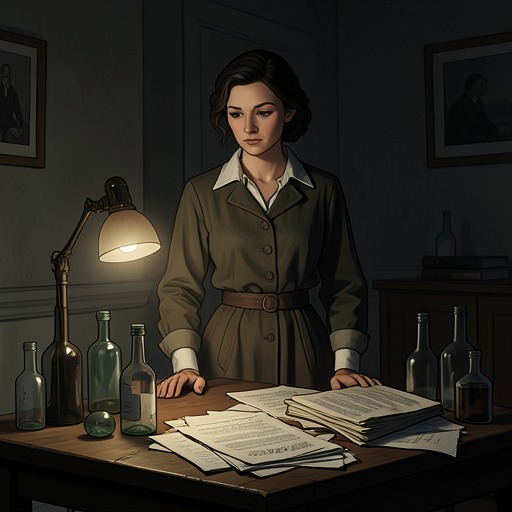
The thought arrives while Laura is waiting on a runway, turning her attention between the tray table and the window. After takeoff, she drinks alongside a fellow passenger, who eventually falls asleep on her shoulder. Looking down at her notebook, she considers how often she has tried to make her life fit a pattern, and how rarely clarity lasts. Her questions about whether an apparent resolution is genuine lead to a more unsettling recognition: she may have become what someone else wanted her to be, and felt powerful while fulfilling that desire, only to find emptiness in the realization that she had become a creation.
Against that account of selfhood, Laura recalls her writing, with its repeated false starts, and says, “I was so good at beginnings.” The phrase is not a claim that she has mastered change. It is a proposal she makes to herself: perhaps a life could consist of beginnings, and perhaps that would be acceptable—or even preferable. In the notebook, the possibility is still forming; the repeated words give the thought a visible, unfinished shape.
Beginnings Against the Brink
The phrase’s sense of possibility has an echo in Laura’s conversation with her father, Bill. When she asks whether every generation has felt that it stood on the brink of a new era, he answers that, in the equivalent of two and a half generations of life, this is the first time he has felt it. Laura believes his sincerity, even as part of her suspects that talk of a renaissance may be a way of meeting fear with the hope that something extraordinary will happen.
The exchange complicates the idea of a beginning. A new horizon can be sincerely felt and still carry dread; hope does not cancel the possibility of disappointment. Laura’s reflection on false starts is similarly ambivalent. Beginning again offers an alternative to treating one fixed version of the self as final, but it does not promise certainty about what comes next.
Care as a Concrete Restart
The book places this open-ended idea alongside the physical work of caring for Bill during illness. Laura’s mother reminds her that she has not spent the night with him when cramps keep him awake or washed bedding five times in twenty-four hours; Mel has seen what that care entails. Bill, in turn, insists on his remaining strength, recalling that he had held on to much of his hair and walked six miles without stopping. When pressed about his meal, he chooses grilled chicken, a side salad, and blue cheese dressing. The scene holds vulnerability and self-assertion together rather than reducing illness to a single story of decline.
That attention to what can be done in the moment recurs when Tyler is unresponsive. Laura shakes her, turns her onto her side, hits her back, and checks her breathing and pulse, frightened that she does not know enough to help. When Tyler rejects the suggestion of hospital treatment, she describes the drip, the wait, and the prospect of being lectured or sent to rehab, insisting that she has only had a bad day. The resistance does not erase the danger; it shows how differently the same emergency is understood by the person in crisis and the person trying to care for her.
Repetition, Recovery, and an Unfinished Self
After the crisis, Tyler stays in bed for four days. Laura calls every hour from work, brings her crushed ice, then prepares mashed fruit and vegetables as Tyler gradually returns to solid food. She cancels a viewing with Julian, who sounds relieved. At night, Laura sits with Tyler as she falls asleep amid sweating and confused, shifting dreams. Care here is repetitive and practical, not a single dramatic act: it gives recovery time and makes the next small step possible.
These scenes do not make Laura’s phrase a promise that every beginning succeeds, or that repetition disappears. Instead, they clarify its significance. Against the notion that a person must arrive at one final, coherent identity, Laura entertains a life that can be revised and begun again. The phrase holds open that possibility while retaining the book’s uncertainty: a beginning may be false, provisional, or hard-won, but it need not be the last one.