Tyler Johnson and her father
AnimalsTyler Johnson and her father are connected by an estrangement that reaches back to her childhood and remains unresolved in adulthood. Their relationship is marked both by his admission that he harmed her and by his attempts to reopen contact on terms that ask her to acknowledge what he has provided. A visit to England ends with him expelled from her apartment; a letter that follows offers regret, justification, and ordinary family news without repairing the breach.
The rupture at the apartment
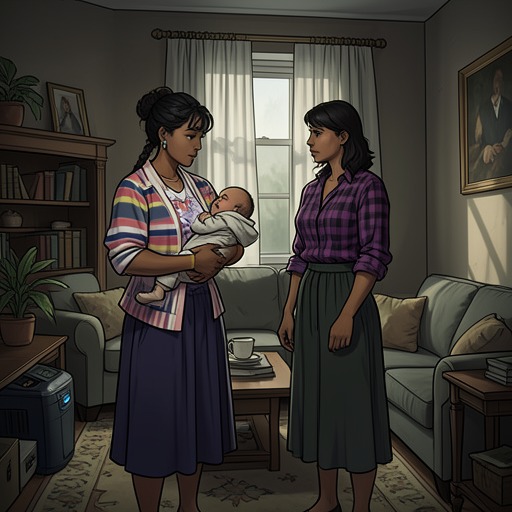
During a visit to Tyler Johnson’s apartment, Laura Joyce hears Tyler Johnson shouting for someone to get out of her house. On the stairs, Laura Joyce passes a pale, older man leaving the building. By the time she reaches Tyler Johnson’s floor, the main door has slammed shut. Tyler Johnson is at her own front door, still wearing a kimono and a clay face mask. Her appearance and breathing suggest the strain of the encounter, though Laura Joyce initially has to ask who the man was. Tyler Johnson confirms that her father has been there, and Laura Joyce realizes she had understood the situation as soon as she heard the shouting.
The visit is not an isolated disagreement over hospitality. Tyler Johnson tells Laura Joyce that letting him pay for the apartment was the biggest mistake she had made. Her anger points to a practical tie that has become a source of resentment: the apartment is associated with her father’s financial involvement, while the forceful expulsion makes clear that payment has not secured him a welcome or a right to remain. After he leaves, Tyler Johnson and Laura Joyce drink wine together. Tyler Johnson speaks in short bursts about the change in their relative strength and her father’s decline, then declines to go out and asks to keep drinking at home. The scene shows the immediate aftermath of the rupture, not a reconciliation.
A childhood shaped by fear
The later account of their history gives the confrontation a longer frame. Laura Joyce recognizes that Tyler Johnson’s childhood involved a recurring pattern of upheaval: doors slammed, bottles thrown, and beds left unslept-in. Afterward, the disturbance would recede, while calls came from her mother’s sisters. Laura Joyce remembers Tyler Johnson at eight, twelve, and fifteen, waiting for the storm to break. The repetition matters: the adult estrangement follows a childhood in which the household could become frightening and then return to apparent quiet without erasing what had happened.
Laura Joyce understands that Tyler Johnson realizes she now knows this history. The recognition is intimate but not easy. Laura Joyce also wonders whether Tyler Johnson understands that part of her envies the force of the causes that shaped Tyler Johnson’s life. The passage does not turn that feeling into a claim that the sisters’ experiences were the same; instead, it presents knowledge as something newly present between them, complicated by what can and cannot be said. The memory makes the father’s visit more than a dispute about an apartment: it recalls the childhood pattern that gives Tyler Johnson’s rejection its accumulated weight.
The letter’s appeal and its limits
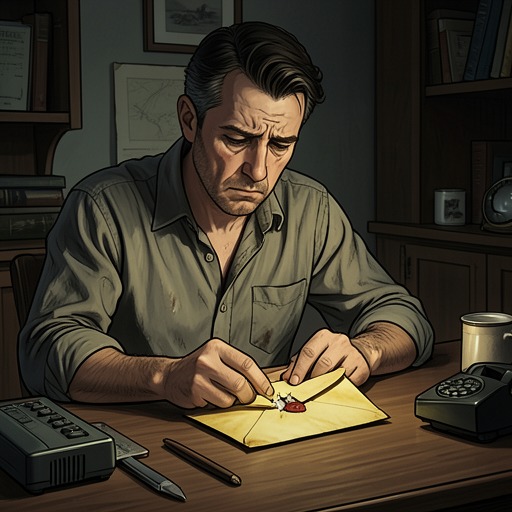
A letter dated December 24, 2006, records the father’s attempt to reach Tyler Johnson after she has refused his calls and thrown him out during his trip to England. He says he made the journey to see Tyler Johnson and Jean, and complains that Tyler Johnson would not give him Jean’s London address, leaving Jean unable to decide for herself whether to see him. His account therefore presents the estrangement as affecting his access to both daughters, while also showing Tyler Johnson setting a boundary around her sister’s contact with him.
He describes himself as a terrible father and husband, and invokes his Christian belief in second chances. He says he does not expect much: a brief conversation once a week or once every two weeks, and some news about life in a different place. Yet the request is not simply for contact. He links it to the financial support he says he did not withhold, including paying for the apartment and helping with additional studies, and asks Tyler Johnson to give something back. The appeal joins an expressed wish to hear from her with a claim that his contribution should count toward what she owes him. Its mixture of remorse and grievance leaves the terms of reconciliation unsettled.
The letter also acknowledges a specific harm: he says he never meant for a bottle to hit Tyler Johnson and that this has been one of the hardest things for him to forgive himself for. The admission confirms that the childhood memories Laura Joyce recognizes are tied to an act for which he accepts some responsibility. At the same time, his emphasis on what he meant and on forgiving himself does not establish that Tyler Johnson has forgiven him. The letter asks her to consider his point of view, but the history it names explains why she may not accept his framing as sufficient.
Family news and unresolved distance
Alongside apology and complaint, the father supplies news from Crawford. He reports that its population is nearing one thousand and recounts that boys on a school trip drowned in a river near Fort Robinson. He also writes about Marshall, Tyler Johnson’s old horse, whom he visits with an apple most Saturdays. A girl named June Fletcher now takes the horse out during holidays, and he is considering letting her have it permanently, but says he wants to check with Tyler Johnson first.
These details give the letter the texture of family correspondence: a shrinking hometown, a familiar horse, and a decision for which he still seeks his daughter’s agreement. They also sit beside the account of the apartment and the bottle, so ordinary news cannot displace the unresolved history. His letter preserves a route by which he tries to remain part of Tyler Johnson’s life, but it does not show that she answers or that contact resumes. The relationship remains defined by that gap between his request for a second chance and her evident refusal, in the available scenes, to let his financial support or regret erase the past.