The Extra Person Status
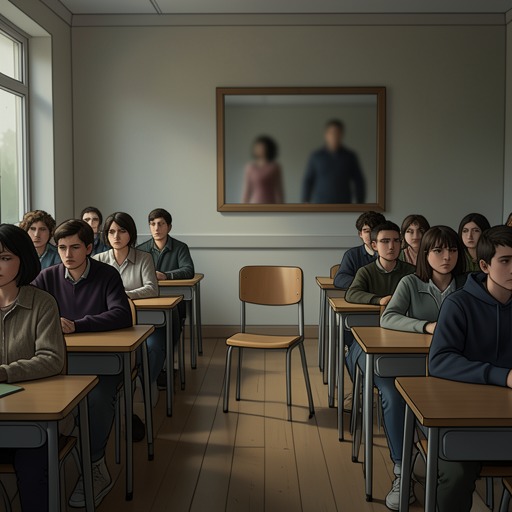
AnotherThe Extra Person Status designates the impossible presence of an additional member within Yomiyama North Middle School Third-Year Class 3. The class appears to contain one more student than it should, usually someone connected to the class who has already died, while altered records and fading memories make the contradiction seem normal. The status is therefore not merely a hidden identity but a condition in which death is temporarily incorporated into the living class, producing the disasters and forcing the students and teachers to govern ordinary school life under extraordinary rules.
Definition and Operation
The status begins when an “extra person” enters the class despite having no legitimate place there. In the historical account preserved by Tatsuji Chibiki, the class began a school year short one desk and chair, yet at least one student or relative of a student died every month. By the end of that year, sixteen people connected with the class had lost their lives. Only after graduation did the teacher in charge understand that an additional student had infiltrated the class; once the ceremony ended, that student disappeared, allowing the teacher to recognize the pattern.
The status operates through a systematic distortion of evidence. While the casualty remains hidden in the class, records and memories are tampered with throughout the surrounding community. Details that should contradict one another are made to fit, and no one recognizes the casualty’s true identity. Tatsuji Chibiki confirms that this alteration is real rather than a mistaken interpretation. The phenomenon also explains why direct participants cannot preserve their knowledge: their memories of the extra person fade and eventually disappear. Chibiki could barely retain what he knew only because he had written notes in a notebook at the time.
The alteration affects social reality as well as documents. A person can attend classes, join activities, and be treated as an ordinary member while the class’s records silently accommodate an impossible fact. Conversely, once the casualty is gone, the community’s memory is repaired. In one account, a boy killed during a camping trip was immediately forgotten by teachers, students, and even his parents; people remembered that the trip had contained nineteen students, not twenty, and behaved as though the boy had never existed.
Historical Examples and Recurrence
The status recurs across different school years, but its identity is not necessarily stable or readily recoverable. Tatsuji Chibiki identifies Mami Asakura as the casualty for 1996, although her name does not belong on that year’s class list. She had originally been a student in Third-Year Class 3 three years earlier, in 1993, and had died in that year’s disasters. The older class list records her name alongside a red X and the notation “October 9—illness,” making the document itself a trace of how a dead former student could be returned to the class.
The 1996 example also demonstrates the danger of incomplete countermeasures. The person assigned to be “not there” abandoned that role partway through the year, and seven people connected with the class died. The casualty status and the “not there” strategy thus form opposing but related positions within the same emergency system: one adds an impossible person to the class, while the other attempts to remove a living participant from ordinary recognition. Both depend on collective compliance, and both impose a human cost when the arrangement fails.
The status is connected to the class’s inherited stories about death and Yomiyama. During an earlier camping trip, Third-Year Class 3 visited Yomiyama Shrine at the suggestion of its head teacher, Mr. Koga. The shrine was badly maintained, and the students cleaned it while convincing themselves that the act might break the curse. The effort failed. The shrine’s association with the mountain, the surname of the boy whose death had helped define the phenomenon, and oral traditions describing the shrine as a boundary between the living world and the land of the dead all reinforce the status’s symbolic geography, though ritual cleansing cannot undo it.
Recognition, Exclusion, and Class Authority
Because the extra person is protected by altered perception, identifying the casualty becomes a struggle over who may define reality. Tatsuji Chibiki’s position outside the direct chain of Third-Year Class 3 allows him to speak with Mei Misaki and Koichi Sakakibara without being bound by the class’s “not there” restrictions. He explains that people with no direct link to the class are comparatively safe, whereas those inside its social and supernatural system cannot reliably preserve knowledge of the casualty. His secondary-library testimony gives Mei Misaki and Koichi Sakakibara a framework for understanding why ordinary evidence has become untrustworthy.
The class responds by creating its own exceptional discipline. When increasing the number of students treated as “not there” from one to two produces no effect, the students no longer have a reason to continue ignoring Mei Misaki and Koichi Sakakibara. After Mr. Kubodera’s death, the class’s behavior changes gradually rather than through a formally announced decision. Naoya Teshigawara begins acting as though Mei Misaki exists and addresses her directly. The change shows that recognition can be withdrawn and restored collectively, but it also reveals how unstable personhood becomes when the class treats social acknowledgment as a survival mechanism.
That discipline reaches even into family relationships. Reiko Mikami and Koichi Sakakibara must behave as though they are separate people at school, with him addressing her formally as “Ms. Mikami” and her treating him as “Sakakibara, the transfer student,” despite living in the same house. Mr. Kubodera and most of the class know the truth from the beginning, which explains why he describes Reiko Mikami as being in a difficult position when the class decides to ignore Mei Misaki and Koichi Sakakibara. The rule does not merely regulate classroom conversation; it suspends ordinary kinship in order to preserve the class’s defensive fiction.
Termination and Consequences
The status can end when the extra person dies. In the camping-trip account, the narrator’s informant kills the boy he believes to be the casualty. The killing remains a real act for which he accepts responsibility, but it also becomes, in his interpretation, a form of salvation because the disasters end after the extra person’s death. Ten days later, the disappearance of every connected person’s memory of the boy appears to confirm that the year’s disasters have stopped and that the community’s memories have been repaired.
The end of the status therefore produces no stable public record of victory. The casualty’s death removes the impossible member, but the same mechanism that restores the class also erases the evidence of the person who was killed. The community is left with repaired normality rather than a clear account of what happened. This is why Tatsuji Chibiki’s notes matter: without deliberately preserved records, even a witness’s understanding dissolves into uncertainty.
The danger persists after the status has been recognized. Tatsuji Chibiki knows that the year’s Third-Year Class 3 has been placed in peculiar circumstances and plans to accompany the students on their ascent of Yomiyama. He warns them to be careful of accidents and discusses canceling the outing if rain arrives. Later, when a student suffers an attack, he insists that it is a familiar medical condition rather than an extraordinary event and tells the frightened students not to surrender to fear. His calm reassurance is explicitly understood as a lie, showing how the class’s emergency order depends on suppressing signs that might reveal the disasters’ return.
Narrative and Thematic Significance
The Extra Person Status turns a school roster into a battlefield between life, memory, and institutional recognition. The class is required to include someone who cannot legitimately belong, while simultaneously excluding living students through the “not there” strategy. The result resembles an exception space in which ordinary rules are suspended but authority does not disappear: teachers, students, family members, records, rituals, and speech all participate in maintaining the altered order.
Its most unsettling feature is the contrast between presence and proof. The casualty may be visible, active, and socially familiar, yet the class cannot retain a dependable memory of who that person is. Once the status ends, the person’s absence becomes easier to accept than the fact of the person’s former presence. The phenomenon therefore makes forgetting an instrument of survival and makes remembrance an act requiring deliberate resistance. The extra person is not only the source of the disasters; the status exposes how readily a community can be persuaded that an impossible life was ordinary and that a real death never happened.